
Trump's Failed Kennedy Center Takeover Shows Why Art and Government Don't Mix
The president's remedy for a "woke" Kennedy Center was to replace one alleged strain of ideological capture with another.
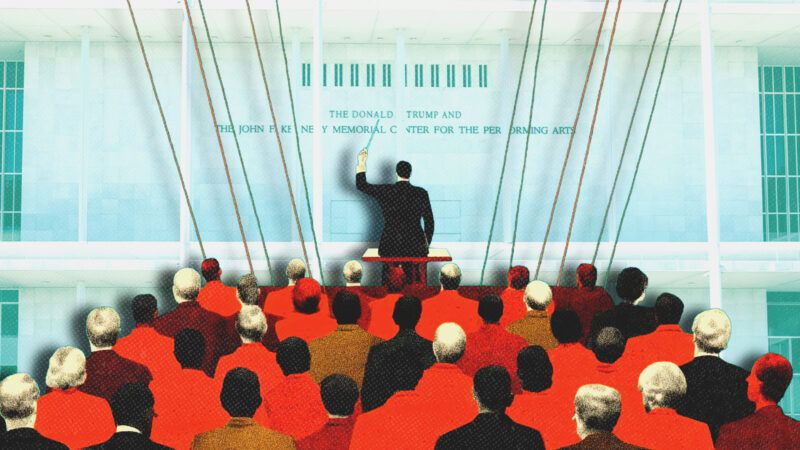
When President Donald Trump announced a takeover of the Kennedy Center last year, he explained it was to combat a specific sort of political and cultural rot. "We don't need woke at the Kennedy Center," he said in February 2025 aboard Air Force One. "Some of the shows were terrible. They were a disgrace that they were even put on. So I'll be there until such time as it gets to be running right."
Or did he mean running Right? The president's recent reversal, in response to a federal judge's ruling that the Kennedy Center had been illegally renamed after Trump, provides an instructive window into the answer.
The decision from U.S. District Judge Christopher Cooper also issued a preliminary injunction against the impending two-year closure, because the Kennedy Center Board of Trustees had "neglected to consider the full range of its statutory obligations," he wrote, although he did not preclude repairs from continuing or a future lawful closure. Kennedy Center lawyers on Thursday directed employees to remove Trump's name from "email signatures, email communications, letterhead, website, brochures, promotional materials, press releases, signs, references in contracts, MOUs, and other agreements," and to scrub "every other reference to the 'Trump Kennedy Center,' the Donald J. Trump and the John F. Kennedy Memorial Center for the Performing Arts, or similar name."
"We are going to be working with Congress to transfer this failing Institution back to them," the president responded in a Truth Social missive last week, "so they can make a determination as to what to do with it."
Why give up so soon? The president's remedy for a "woke" Kennedy Center, it seems, was to remake the Board of Trustees with Trump as chair and his supporters as members, and to use that power to brand everything he could with his name. Which is to say, his remedy was to replace one alleged strain of ideological capture with another. It is a particularly dramatic example of what can happen when government interference and tribal politics infect the arts—a world that, in theory, is supposed to be for everyone, regardless of who has the keys to the building. Art is, of course, often political. But it will struggle to challenge or reach audiences if the institution itself is seen as co-opted by one political movement, or one man.
The Kennedy Center operates in somewhat of a gray zone in terms of its relationship with the public and private sectors. Designated in statute by Congress as the memorial to former President John F. Kennedy, taxpayers fund building maintenance, operations, security, and repairs. Private donors and ticket sales, meanwhile, primarily finance its programming. The institution is the premier place in Washington, D.C., to see top-tier performances, from orchestral music to opera to touring Broadway productions.
Yet it was not always going to be the Kennedy Center. Originally fashioned as the National Cultural Center, it was renamed by law in 1964 to honor Kennedy following his assassination. Memorials to former presidents are obviously not unprecedented. But despite the tragedy surrounding his murder, naming an arts institution after a politician was itself a political act, as was using taxpayer money to create a cultural center to begin with.
Trump is, in many ways, a singular character. But he has provided an example, however cartoonish, of what can happen when you give public control over something that is inherently a private endeavor. The vast majority of the country will never step foot inside what was billed as a "national cultural center." Why are they paying for it? And why does someone like Donald Trump have any say over it in the first place?
The results have predictably been disastrous. Ticket sales plummeted, artists canceled en masse, donations reportedly declined. "It is our desire to perform in our home at the Kennedy Center," Washington National Opera artistic director Francesca Zambello, who said donor confidence had "shattered," told The Guardian in an interview last year. "But if we cannot raise enough money, or sell enough tickets in there, we have to consider other options. The two things that support a company financially, because of the takeover, have been severely compromised." The company left the Kennedy Center soon after.
As an opera lover, I will not punish performers by boycotting their productions. That is not my way of sticking it to the man. Trump's ego will surely rebound; opera, on the other hand, is not exactly known for its commercial viability. (Hello, Timothée Chalamet, you were correct.) Yet I can understand why many people don't want to contribute money to something that they feel fundamentally offends their values.
Last summer, amid the height of the takeover, Parade arrived at the Kennedy Center. The musical tells the story of Leo Frank, a man whom historians widely agree was wrongly convicted of the 1913 murder of a girl named Mary Phagan. After his death sentence was commuted to life in prison, he was lynched by vigilantes.
Before its D.C. run, it was relocated to the center's Eisenhower Theater from its opera house, which is more than twice the size, amid weak ticket sales. The show is a powerful exploration of antisemitism, media malpractice, racial dynamics in the South, and tribalism—the type of complicated story practically made to transcend partisan fractures. At Trump's Kennedy Center, it played to a sparsely filled house.