
The Draft Is Unpopular. Registration Becomes Automatic in December Anyway.
The federal government will now dig through databases to register 18-year-olds for conscription.
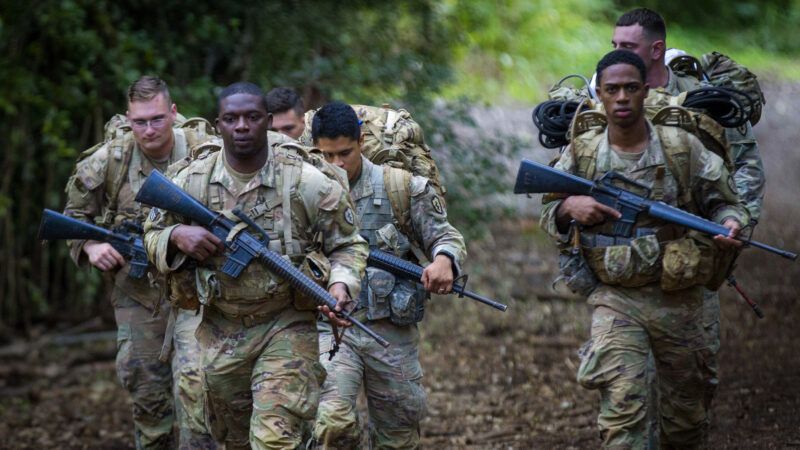
Americans aren't interested in reinstating a military draft, but that's not stopping the government from "streamlining" Selective Service registration—for young men's own good, we're told. That's right, the government is automating draft registration, using the excuse that it's saving registrants from the legal peril inherent in choosing to not register. The real reason, of course, is that fewer men were voluntarily registering, and the government wants to gloss over that mass rejection by potential draftees.
Automated Registration for Your Own Good?
One component of the fiscal year 2026 National Defense Authorization Act (NDAA) "modernizes Selective Service through automatic registration," boasted Rep. Chrissy Houlahan (D–Pa.), who helped push the change. "This update will save taxpayer dollars and reverse falling registration rates by ensuring the Selective Service automatically registers young men, so that none inadvertently face the serious penalties of failing to register."
You are reading The Rattler from J.D. Tuccille and Reason. Get more of J.D.'s commentary on government overreach and threats to everyday liberty.
The Selective Service System (SSS) has now formally proposed a rule to implement automatic registration.
How many men "inadvertently" face legal peril is an open question. There may well be some young men thankful that they're being spared the challenging task of deciding whether to fill their names in on a form. But they're probably offset by the many people who prefer to make their own choices. Admittedly, the potential penalties for not registering are stiff.
"Failure to register with Selective Service is a violation of the Military Selective Service Act," according to the Selective Service System. "Conviction for such a violation may result in imprisonment for up to five years and/or a fine of not more than $250,000." Additionally, "once you turn 26, it's too late to register. Even though you may not be prosecuted, you may be denied student financial assistance, federal job training, and most federal employment at the discretion of the entity providing the benefit or service."
Years of Declining Draft Registration Compliance
Despite the penalties, more young men have been risking running afoul of the law in recent years.
"SSS is experiencing a significant decline in registrations by 18-year-old men," according to Selective Service documents acquired through a Freedom of Information Act request by peace activist Edward Hasbrouck. "In 2020, the registration rate for 18-year-old men nationwide was 61.8%, today it is just 39.9%."
Declining registration by young men reaching the age of majority eroded the total pool of men available for conscription in the case of war. The same document revealed that 90.5 percent of 18- to 25-year-old men were registered in 2020; by 2023 only 84.2 percent were registered.
That said, Hasbrouck pointed out in 2024 that "most men register eventually, but often years after their prime draft eligibility. The SSS allows men to register without penalty until their 26th birthday. Some men deliberately or inadvertently delay registering until they are close to age 26. This minimizes their exposure to a possible draft while preserving their eligibility for federal or state jobs or other programs later in life."
The records are actually less accurate than official data suggests. Men 18 to 25 are supposed to update address changes within 10 days, but few bother. Draft registration records that don't contain current contact information do the government little good.
To deal with its compliance problem, Selective Service has pushed automatic registration for years. In its 2024 annual report, the agency said it sought to "automatically enroll eligible individuals by leveraging existing databases, ensuring compliance without requiring additional action on the registrants' part." It added that 46 states and territories already had "laws enabling constituents to register when obtaining a driver's license, learner's permit, or state identification card." My son was automatically registered when he got his Arizona driver's license. The 2026 NDAA enacts Selective Service's long-desired national policy.
Little Public Enthusiasm for Conscription
But the move towards easing military conscription flies in the face of Americans' preferences.
A May 2026 Overton Insights poll asked, "If President Trump implemented a military draft, would you support or oppose it?" Two-thirds of respondents strongly (59 percent) or somewhat (7 percent) opposed the idea of a military draft. Only a quarter strongly (11 percent) or somewhat (14 percent) supported the idea. Note that even 41 percent of Republicans opposed implementing a hypothetical Trump-chosen military draft (43 percent supported it). Eighty percent of independents and 86 of Democrats opposed the idea of a draft.
It's worth pointing out that the poll frames the implementation of a military draft not just as a presidential power, but one exercised by the current White House inhabitant. In fact, while draft registration is mandatory, it would take an act of Congress to reinstate the draft itself. That would spread responsibility and likely make responses less partisan. But there's little evidence of enthusiasm for reinstating conscription. There might be even less for the new automated registration system that grants the Selective Service System access to information from a host of unrelated sources.
"In reality, this means the federal government will now access databases from state Departments of Motor Vehicles, the Socal Security Administration [sic], and the Census Bureau to gather information to register young men automatically, without their consent," objects the Friends Committee on National Legislation. "This change also threatens the rights of conscientious objectors. Automatic registration removes the opportunity for individuals' moral decision making."
Automatic registration will take us closer to the day when the government unifies data storage for general use and enforcement. That might be a gain for efficiency, but it's not obvious that we should want government officials to be able to more efficiently inflict every rule and whim on the population.
One effect of automatic registration is that it's reminded some young Americans that they have skin in the game. There's been a revival of long largely dormant public pushback by individuals and organizations opposed to conscription. Last month, Sens. Ron Wyden (D–Ore.), Rand Paul (R–Ky.), and Cynthia Lummis (R–Wyo.) introduced a bill to repeal the Selective Service Act, abolish draft registration, and eliminate penalties for failing to register.
Failing passage of the bill or other relevant legislative changes, draft registration becomes automatic for 18-year-olds in December 2026.