
Samurai vs. Squatters: On the Street With the Hired Swords Reclaiming California Property Owners' Stolen Homes
California has failed to protect private property from squatters. Desperate owners are turning to katana-wielding enforcers to reclaim their homes.
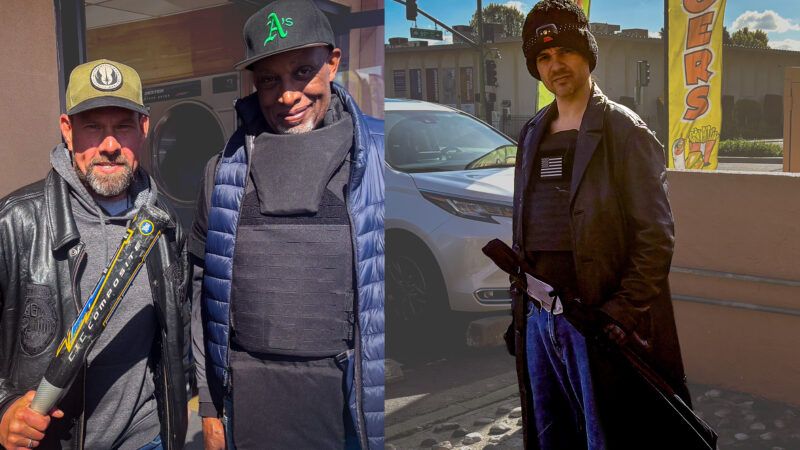
We're probably not going to use grenades on this one, right? Because I got 'em."
James Jacobs has hired a motley crew of toughs online to help him clear squatters out of an Oakland, California, apartment building. None of the hired muscle accepts the offer of smoke grenades. They intend to complete this job with the baseball bats and firearms they brought from home.
"All right, let's do this," says Jacobs. He grabs his katana and sets off in his long black leather jacket toward the apartment. His improvised militia follows single-file behind him. Half a minute later, they confidently walk through the front door of a two-story building off of Oakland's busy International Boulevard.
From across the street, I watch them enter and wait anxiously for the sound of gunshots.
It is another battle in California's low-burning turf war between the squatters who invade homes and the enforcers hired to reclaim them.
Across the Golden State, uninvited occupants have taken over countless residential properties and then refused to vacate. Homes undergoing renovations, vacant rental units, and even whole apartment buildings have fallen prey to squatters. Once they move in squatters are very difficult to dislodge. The legal process to remove them is expensive and can take months or years.
In their desperation, owners are increasingly turning to a rising crop of private rights enforcers to solve the problem. That includes Jacobs and his company, ASAP Squatter Removal.
Jacobs claims to have developed a long list of tools and tactics that enable him to remove squatters far faster than the court system, all while staying within the bounds of the law. Chief among them is a weapon he carries on every job: a katana, a curved Japanese sword that's more synonymous with samurai warriors than clearing squatters.
"In most industries, swords just don't make any damn sense," Jacobs says. "In this particular one, it actually does." The lightly regulated katana, he explains, is an ideal weapon for indoor self-defense and intimidation.
It's also an ingenious marketing ploy in the competitive world of squatter removal services. Jacobs' company has received a healthy amount of media attention from local and international outlets that never fail to mention his sword in the headline.
According to Jacobs, his company has had a near-perfect success rate of removing squatters.
If they were Jacobs' only adversary, his katana might be the only weapon he would need. But ASAP Squatter Removal is engaged in a two-front war. His main competition comes from law enforcement agencies that are none too keen on ceding their monopoly on the use of force to people like Jacobs.
Every job that ASAP Squatter Removal performs requires it to dodge criminal charges. The company has had only mixed success on the latter front. In January, Jacobs and two associates were charged with a long list of felonies stemming from one of their jobs.
The legal and physical risks inherent in anti-squatter work are why California's landlords have called for more systemic reforms that would make Jacobs' business obsolete.
But with reforms stalled in the state legislature, many property owners feel they have no choice but to turn to gray market services and the unique set of characters, with a very particular set of skills, willing to take on this dangerous work.
On the streets, it's samurai vs. squatters.

'It's Not Our Job'
Though aggregate numbers are hard to come by, squatting appears to be on the rise in California. The state's housing cost crisis has helped produce the nation's largest population of homeless and housing-insecure people—many of whom are willing to take on the risks of squatting.
High home prices and an arduous eviction system have also helped make squatting a lucrative scam. Owners will often pay squatters exorbitant sums in "cash-for-keys" agreements to reclaim their valuable real estate.
Meanwhile, property owners who call the police about a squatting situation will receive a near-universal response from law enforcement: "It's a civil matter," meaning, "It's not our problem."
Responding officers often feel they lack the competence to tell on the spot whether someone is an illegal squatter or a lawful occupant. They are thus eager to avoid the legal liability that would come from charging a lawful occupant with a misdemeanor trespassing offense.
Police "have been told in training: If somebody says, 'I live here,' leave them alone. Why risk the lawsuit of removing somebody from a house that they may lawfully occupy?" says Sidhardha Lakireddy, who manages a few hundred units in the Bay Area and has dealt with multiple squatting situations.
Even in seemingly clear-cut cases, the first instinct of many police officers is to avoid getting involved.
Devlin Creighton tells the story of a squatter who moved into a rental unit he owns in San Jose just a few hours after he managed to convince the previous squatting occupant to leave in a cash-for-keys arrangement.
When the police showed up at the property, they initially told Creighton he'd have to follow the monthslong civil eviction process to get his squatter out.
"I'm like, 'She's not going to live here for three months for free. She got here today!'" Creighton recalls telling the officers. "The police, these new guys, were like, 'Well, you know, it's not our job. We're crime. This is civil.'"
Fortunately for Creighton, a more seasoned police sergeant soon arrived who was more willing to hear his side of the story. Creighton's new squatter couldn't answer the sergeant's basic questions, such as "What is your address?" and "When's trash day?" So he forced her to leave. But if the sergeant hadn't been willing to hear Creighton out, the property owner would have had no choice but to go to civil court.
Having to go through a court process to remove a squatter isn't inherently unreasonable. Most states treat squatting as a civil matter to be handled by the courts. California's civil courts move slowly, however. The civil eviction process also enables squatters to claim a long list of procedural rights granted to legal tenants (which they are not) that can stretch a case out for months or longer.
Some lawyers openly sell themselves to potential clients based on their ability to stretch out the eviction process in court. "When it comes to you, the landlord is not stepping on a cockroach; he is stepping on a landmine," reads one eviction defense attorney's website, which claims that fighting an eviction in court can prolong one's occupancy for years. "All during the [civil eviction process], you are paying no rent," it says.
The experience some landlords have removing squatters shows this landmine claim is not a bluff.
'A Terrible Scene'
Zachary, a landlord who owns seven units in the Los Angeles area and who asked only to be referred to by his first name because he fears retaliation from squatters, learned just how lengthy and expensive the civil court process can be when a longtime tenant died in January 2025.
When Zachary went to reclaim the unit, he found four strangers already inside.
"They definitely looked disheveled," he says. "They were people who lived out of suitcases. Their clothes weren't well-kept."
The men showed Zachary a letter claiming they were subtenants of the deceased. They claimed they had a legal right to take over the unit after that person's death.
Zachary's lease with his deceased tenant explicitly forbade subletting, making this claim a legal nonstarter. But when the squatters refused to leave and police refused to eject them, Zachary was forced to file for an eviction in the Superior Court of Los Angeles County in February 2025.
Zachary describes the following months as a nightmare. In response to his eviction filing, the new occupants of his home countersued him. They produced phony documents purporting to show they were legal tenants being harassed after they raised habitability issues with the unit. While Zachary waited for a court hearing on the case, his squatters also allegedly moved in several more occupants who proceeded to trash his units, do drugs on the property, and menace his legitimate tenants—some of whom moved out.
The squatters also demanded $50,000 in compensation for the emotional and financial toll that Zachary's "illegal" eviction efforts had caused them.
When a hearing on Zachary's eviction complaint and his squatters' counterclaims was finally held in late March 2025, the judge ruled in his favor in a matter of minutes. Through appeals and hardship claims, however, the squatters managed to delay their actual eviction for another two months.
When Zachary finally reclaimed the apartment in late May, "It was really in disarray. They had left needles and rotting food. They had a cat that had made a mess in there. It was really a terrible scene."
After they'd left, Zachary found out more about who his squatters were. In the papers of his deceased tenant, there was a request for a restraining order against the squatters. That request described how his former tenant had met the squatters on a dating app and agreed to let them stay in his spare bedroom for a week when they claimed to have nowhere else to go.
When his former tenant finally asked them to leave, the document said, they blackmailed him: The squatters said they'd accuse him of rape if he called the cops to kick them out.
Per the restraining order statement, Zachary's former tenant did eventually call the cops on the squatters. The police did not believe their claims of being raped, but they also told Zachary's former tenant that they couldn't remove the squatters without a court order. An officer encouraged the former tenant to file for a restraining order instead.
California's tenants' rights advocates, who uniformly oppose any efforts to expedite the removal of squatters, would describe Zachary's experience as an example of the system working as intended: A property dispute was raised, and after a few months of process, the legal owner was able to reclaim his unit.
But during the time it took for that process to play out, the squatters were able to exploit procedural protections designed to safeguard tenants' rights to menace actual tenants and destroy Zachary's property.
Zachary estimates he spent $14,000 on fees to lawyers and to Squatter Squad, a Los Angeles–based outfit that handled direct negotiations with the squatters, served them legal documents, and helped secure the unit when it was finally vacated. He had to pay another $43,000 to fix the damage the squatters had done to the unit. He also lost rent on both the squatter-occupied unit and on those neighboring units that were vacated because of the squatters' disruption.
Given the costs and ordeal, it's unsurprising other property owners in desperate situations would turn to solutions outside of the court system, such as katana-wielding men in black leather coats.
'Eviction Alternative'

Jacobs got his start in squatter removal while working in property management after college. Occasionally, a unit would get taken over by a squatter and the owner would pay him some extra money to figure out a way to get rid of the intruder.
One of his first jobs involved a reclusive squatter who had barricaded himself in a vacant apartment unit. Since the squatter almost never left the unit, Jacobs couldn't simply wait for him to leave and change the locks.
When the squatter clogged the toilet, causing neighboring units to flood, Jacobs shut off the water line. As the property manager, he was then responsible for hiring the plumber to fix it. He hired a plumber friend who continually delayed the job. Without water in the unit, the squatter eventually left.*
More anti-squatter jobs soon followed. His day job in property management also gave Jacobs a free legal education in the laws squatters used to stay in units and how the law could be used to get them out.
Over time, Jacobs saw demand for squatter removal services grow.
In 2020, the COVID-19 pandemic shut down most of public life, including the civil courts that process squatting cases. The state of California effectively banned landlords from evicting tenants through 2022. Local eviction moratoriums and other restrictions persisted for years after that.
Eviction filings predictably fell, dropping from around 120,000 per year prepandemic to 35,000 in 2021. The number of these filings that led to actual tenant removals is far less. In effect, property owners were stuck with whoever was occupying their home, be they delinquent tenants or illegal squatters. Moreover, the rising price of real estate also raised the returns squatters could demand through extortionary cash-for-keys schemes.
Though California treats squatting as a crime on paper, the cumbersome civil process that determines who is and isn't squatting means the law's criminal penalties mean little in practice.
In 2025, California landlords supported a bipartisan bill—Senate Bill 448, authored by state Sen. Tom Umberg (D–Santa Ana)—that would have required law enforcement to remove squatters "without unreasonable delay" if they did not vacate a property within 72 hours. Critics of the bill included social justice advocates and legal aid groups who argued that lawful tenants without formal written rental agreements would have no effective protections against eviction.
"This has the potential to target undocumented and marginalized communities without due process of law," said the Western Center on Law & Poverty's Benjamin Henderson in an April 2025 committee hearing. In additional written testimony the center said: "The right to one's home is too fundamental to ignore constitutional due process." Landlords counter that requiring owners to spend months in civil court to reclaim their property poses its own due process problems.
California's S.B. 448 passed unanimously out of two Senate committees in 2025, but it stalled in the legislative process. Lawmakers have not taken up the bill this year.
Meanwhile, California passed legislation giving tenants more time to file responses to their landlord's eviction complaints. It's another procedural right that squatters can claim while delaying their removal.
In Jacobs' view, the entire situation provides a powerful incentive for people to become squatters. "People are realizing, 'Oh yeah, there's money to be made, and I'm not going to get arrested for this,'" he says.
That insight led him to recognize a business opportunity of his own. He started ASAP Squatter Removal in 2020 as a standalone "eviction alternative" service provider.
'Breach and Clear'
For all the laws and regulations that govern real estate in California, Jacobs' business operates on a more anarchic principle: You truly own only what you physically possess.
The standard ASAP Squatter Removal job involves surveilling a property, reclaiming it through a "breach-and-clear" operation when the squatter leaves for the day, and then boarding up the unit and holding it down for as long as necessary.
This seemingly simple process can get complicated fast.
In a world of real estate scams, Jacobs has to do legal due diligence to ensure that the person hiring him is the actual owner and the people to be removed are, in fact, illegal squatters.
"I've been hired to kick out the owner of the property. That's disgusting," he says. "Sometimes the client is a scumbag."
When homes have been taken over by multiple squatters or by organized gangs, it's also not always possible to breach and clear an empty unit. When the squatters are still inside, the risk of physical altercations is high.
For that reason, Jacobs has his clients sign up him and his fellow squatter removers as tenants of the property to be reclaimed. California is a "castle doctrine" state, meaning you can physically defend yourself in your own home. Jacobs claims the castle doctrine has saved him from legal jeopardy when he or one of his hired contractors has shot a squatter in self-defense. (He declined to provide details on these incidents for fear of getting sued by squatters he's removed.)
ASAP Squatter Removal's website claims a 95 percent success rate. The company's (now private) YouTube channel and Yelp page both include effusive praise from clients who've used Jacobs' services to reclaim their property.
"I was faced with a very difficult squatter situation & no help from local law enforcement. ASAP Squatter Removal resolved my squatter problem in just 3 days!" reads a review on the company's Yelp page.
But happy customers don't negate the physical or legal perils of Jacobs' work.
The risk of serious criminal charges is one reason Jacobs has transitioned to using a sword on jobs. "There's really no gun defense. It's really just gun offense," he says. "But with swords, there is [defense]. I can make a cut towards somebody's hand and disable their hand. And that's not attempted manslaughter."
On the more complex jobs, Jacobs needs every defense he can muster.
'The Unpleasant Choices'
The Oakland building Jacobs was hired to clear was one such complex job.
The owner, Maria Auervonderhaid, and a partner purchased the 11-unit building in the late 1990s. For decades, they rented out apartments without incident.
Shortly before the pandemic, Auervonderhaid's business partner died suddenly, leaving her to manage the building by herself—a challenge the aging woman, now in her 80s, was not fully up for. Auervonderhaid also started to show signs of Alzheimer's disease, which further eroded her ability to take care of her property.
Conditions at the building started to deteriorate. Protected by pandemic-era eviction moratoriums, her tenants also stopped paying rent. Soon word got around that Auervonderhaid was losing her grip on the property.
Her "declining health became readily apparent to people to take advantage of," says Auervonderhaid's lawyer, Thomas Meagher. "Before, she was capable of managing the building. That has changed, and obviously other people saw that too."
Squatters moved into some of the units and changed the locks. Evidence of criminal activity followed. Neighboring business owners reported seeing drug deals, weapon sales, and prostitution at the property.

Maria's son, Theo Auervonderhaid, took over managing the building. He says one of the occupants pulled a gun on his uncle when he showed up to remove accumulated trash. The occupants also ran up enormous power bills by charging allegedly stolen electric vehicles, according to Meagher.
In 2024, Auervonderhaid's nonpaying tenants sued her, citing numerous habitability issues at the property, including pests, overflowing trash, and a lack of security. Meagher says that many of these issues were caused by the squatters themselves—and can't be fixed so long as squatters threaten anyone hired to repair the property.
The police have also been of little help in getting the property under control. Theo Auervonderhaid says that when the cops do respond to calls at the building, they write a report and quickly leave. Meagher says that he's even contacted the FBI to report gang activity at the property, and that they also proved to be no help.
At this point, Theo Auervonderhaid says, he would like to sell the property and be done with it. "I have to take care of my mom's healthcare needs, and I want to go back to work. I don't want this to dominate my life like it has been," he says. "The building has become a money pit."
But the presence of menacing squatters means almost no one is willing to buy it. Before anything can get better at the property, the squatters have to go.
Initially, Theo Auervonderhaid and Meagher had tried to hire conventional security guards to provide protection so that work crews could clear trash and make repairs.
"Security [companies] said we'd need a really aggressive crew to do this one," says Meagher. "What does aggressive mean? You find out when you do research."
Meagher's online research turned up Jacobs, who had been profiled by the local outlet Oaklandside in September 2025 and had since done a number of media hits touting his expertise at removing squatters. At first, Meagher says, hiring someone like Jacobs did not seem appealing. "We did not consider that a choice." But as problems at the property continued to mount, Meagher and his client started to get desperate. "You cycle back to the unpleasant choices like ASAP Squatter," says Meagher.
By February, Meagher hired Jacobs' crew to do surveillance of the property, figuring that this would at least give him and his client a better idea of what was going on.
Into the Breach
The complex situation at Auervonderhaid's apartment building, with its mix of legal tenants, nonthreatening squatters, and others who Meagher describes as likely gang members, required a lot of surveillance before any move could be made on the property. Jacobs hoped his men could gain a foothold by occupying an empty unit and then go room by room, removing the squatters in whatever way worked.
ASAP Squatter Removal signed an initial three-day contract with Meagher to observe the property. This work began in earnest on Valentine's Day. Jacobs agreed to let me shadow him during this surveillance phase.
At the beginning of the night, we stationed ourselves across the street from the target property in a parking lot that had been taken over by temporary stands offering flowers and oversized teddy bears. Unfortunately for Jacobs, his initial scouting from earlier in the day had turned up no good news.
A unit on the top floor of the building was boarded up and dark. Jacobs declared this a likely sign of countersurveillance being conducted by the gangsters squatting in the building. He speculated they were filming the street from that unit to ensure that no one, be they police or rival gangs, was sneaking up on them.
There was also a lot of nighttime activity in front of the -building. One heavyset man poured gas into a generator out front. A half-dozen people appeared to be occupying one of the ground-floor storefront units, which from the outside looked like a drug den.
In the alcove entrance of the neighboring tattoo parlor, we saw what looked like a few drug deals going down. That was bad news too. The outdoor drug dealing meant Jacobs couldn't pose as a buyer to get inside the building and see the situation from the inside.
Since he was stuck on the outside looking in, Jacobs started circling the property, looking for additional entrances that could be used in an eventual breach-and-clear operation.
The key to good surveillance, Jacobs told me, is to not be detected by the squatters. To avoid attention, Jacobs will sometimes observe a property from a camper van with blacked-out windows. Other times, he'll disguise himself as a homeless person. "You should see me in my rags," he laughs.
On that Valentine's Day, he opted for a simpler dark hoodie and beanie.
As we circled the property, Jacobs said he saw his business as a mission. Squatters don't just victimize property owners, he told me; they ruin neighborhoods. "I'm just trying to make the world a better place," he said, stepping around a homeless guy smoking a white powder off a piece of tinfoil.
Our walk revealed no easy additional entrances. The property was sandwiched between a tattoo parlor and a funeral home. Residences covered the rear of the property. Jacobs likes to secure three points of entry, to avoid dangerous bottlenecks during a breach-and-clear operation; that would require traversing other properties.
That looked doable, especially if Jacobs could obtain permission from the adjacent owners to stage on their property. Normally, he said, that's something the neighbors agree to, given the problems squatters can also cause for them. But having to hop a few fences makes it much more difficult to coordinate simultaneous entry of the property from multiple angles.
With this information, we made our way back to the parking lot across the road from the target property, where we met up with Arthur Gutierrez, a tall man in a backward baseball cap who serves as Jacobs' right-hand man.
In the parking lot, Jacobs and Gutierrez hit a marijuana vape pen and reviewed intelligence emailed by the client. Jacobs became excited when he saw that squatters were using the property for a pimping operation. Maybe they could hire a girl to pose as a prostitute to gain access to the building, he suggested.
Gutierrez thought it would be simpler to pose as a john "looking for some ass." Jacobs readily agreed and tried to give Gutierrez some cash to pull off the ruse that night. The latter demurred, joking that he'd need additional hazard pay for that. Besides, the heavyset man feeding gas into the generator had been giving us hard stares the whole time we'd been hanging out in the parking lot. Gutierrez proposed returning a day later, when hopefully there would be fewer prying eyes around.
The next day, the scene outside the building was sleepier. The lack of activity gave Jacobs enough confidence to try to get inside on the pretext of looking for "Sharice."
A few minutes after setting off on this gambit, he came back with both good and bad news.
The good news was that the heavyset man who'd been giving us hard stares the night before was now sitting in front of the property, so stoned that he didn't recognize Jacobs. Incapacitated drug users will likely offer less resistance in a breach-and-clear operation.
The bad news was that the front door opened onto a single long hallway with a staircase to the second floor at the back and no doors on either side. That could make for a dangerous bottleneck if Jacobs and his men eventually try to take the property.
Jacobs soon left to meet with the client, leaving Gutierrez and me at the property. We left when about a half-dozen young men left the building and started striding toward us. "Let's take a walk," said Gutierrez.
'That's Why It Pays To Rock the Sword'
Gutierrez needed to charge his phone, so I invited him back to my nearby Airbnb. While there, he expressed some trepidation about the Oakland job.
Gutierrez told me he initially connected with Jacobs through a friend who had met the latter in a bar. Jacobs had mentioned that he was looking to hire military veterans for jobs removing squatters from homes.
That kind of work sounded perfect for Gutierrez. He had served in Iraq during the height of the surge, but after getting out of the military he "didn't have the tools in my tool belt" for civilian employment. What Jacobs was offering sounded more familiar. "I was infantry. Clearing rooms? That's cake."
Most of the ASAP Squatter Removal jobs he'd worked on had been straightforward operations in which they'd move in on a property, board it up, and hold it down, sometimes for months at a time. Gutierrez said he was getting good enough at it that Jacobs had even floated the idea of him starting a Los Angeles branch of the operation.
But things had gone south on a job in San Bruno in January.
The target property was a single-family home their client had purchased in an estate sale. The last legal occupant was a widow who had since moved out. But her son, whom Gutierrez describes as a hoarder with a history of substance abuse, had occupied the property and refused to leave.
ASAP Squatter Removal had managed to secure the property once, but the son had resumed squatting after the client let him return to retrieve some belongings. Then some of the squatter's friends moved in too.
Jacobs later showed me screenshots of texts a woman named Dawn had sent to the new owner. The messages said the son would leave only after being paid $60,000 for moving expenses and lost wages. With the client unwilling to submit to this apparent extortion, ASAP Squatter Removal was hired to go back in.
This time the strategy would be more inventive—and more risky. The plan was to sign Gutierrez, a registered firearm owner, up as the tenant. Because several of the squatters were reportedly out on parole for felony charges, and because felony parolees can't have guns at home, Gutierrez's presence would technically violate their parole and hopefully lead the cops to arrest and remove them.
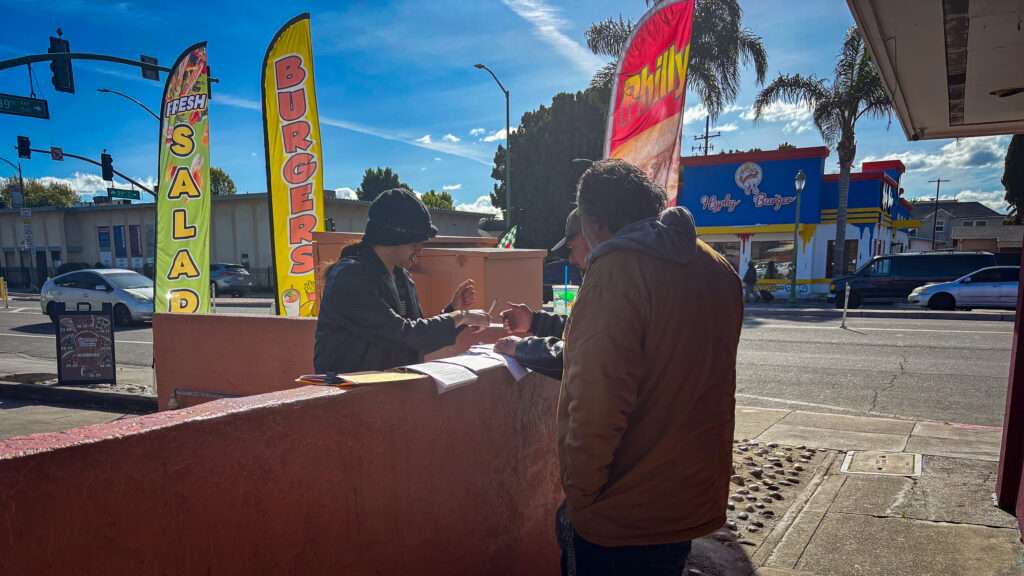
It was a clever idea, in theory. But it didn't work out well in practice, as the bodycam footage Gutierrez recorded during the operation makes clear.
The video shows eight men entering the property in the middle of the night through a locked side gate that they destroy with a battering ram. "We're the new tenants. We're moving in," the men shout in the same kind of harsh bark used by cops announcing a search warrant.
They encounter the first squatter on the ground floor, a man who appears to be so high that he doesn't even get up when the men burst in.
Things get more tense as the ASAP Squatter Removal crew try to move to the second floor. "If you come up these stairs, we'll shoot you in the face," a woman shouts.
At that threat, both Gutierrez and Angel, a heavyset man who'd taken point, draw firearms. Angel continues up the stairs, his weapon aimed in front of him. Gutierrez follows with his pistol aimed at the ground.
The woman's claim was a bluff. Gutierrez's bodycam footage shows no gun in sight. Instead, they find the woman with a man screaming that he's the real tenant.
"I've been paying the electricity bill. I've lived here for 48 years," he declares.
"Forty-eight years? Well, you should have started paying some rent," Gutierrez responds.
Jacobs comes up the stairs. Wire-thin and about 5'8'', he normally cuts a slight figure. That night, confidently strolling through the recaptured home in his black coat, sword at his side, he has all the gravitas of a victorious battlefield commander.
But the victory proves short-lived as the male squatter from upstairs announces that he's calling the cops. "Hide the weapons," Jacobs can be heard saying on Gutierrez's bodycam footage.
Then Gutierrez realizes that he left his phone in his car and that it has their only copy of the lease on it. He grabs Angel and they hustle out to get it.
That's the end of the footage. According to Gutierrez, things only went further downhill after they left.
On their way to get the lease, Angel admitted that he's a felon and is therefore in unlawful possession of a firearm. Meanwhile, the property was now swarming with cops and the rest of the crew were put in handcuffs, though nobody was arrested.
A few days later, Gutierrez was invited to the police station to help account for the situation. When he explained their parole violation plan, the police were not happy to hear it.
Worse still, Jacobs had posted the bodycam footage to the company's YouTube channel, including the part showing the drawn firearms and the part where you can hear him telling the crew to hide the guns. All of which led to the arrests of Gutierrez and Jacobs, who were charged with a litany of felonies, including burglary, kidnapping, assault with a deadly weapon, and a long list of gun enhancements.
At an arraignment hearing in March, Jacobs and Gutierrez arrived without lawyers and entered not guilty pleas to all the charges they'd been hit with. Angel was absent from the arraignment hearing. A warrant for his arrest was issued in January. He was not reachable for comment.
The presiding judge issued a "no contact" order forbidding Jacobs and Gutierrez from going near either the San Bruno property or the alleged victims. The order also forbade them from possessing firearms and body armor.
Outside the hearing room, a defense attorney whom the judge had provisionally asked to represent Jacobs advised the two men to quickly comply with the order and surrender their guns.
At any moment, the police could kick down their door looking for forbidden firearms, he said. That would be an additional charge. "I've seen it a thousand times," said the lawyer, before giving the two a quick fist bump and walking off.
Gutierrez seemed dismayed by this outcome. But when I asked Jacobs about it, he told me he was ecstatic. "That went so well!" he gushed. He'd been afraid they were going to be arrested again at the hearing.
But what, I asked, about the terms of the no-contact order? Will he still be able to do the Oakland job, or any job, without guns or body armor?
"That's why it pays to rock the sword!" he laughed, slapping me on the back. "They didn't say anything about swords!"
The Oakland job was still on.
'The Wrong Way to Handle It'
Professional advocates for property owners advise against using services like ASAP Squatter Removal, citing the legal risks and the potential for physical violence.
"Sure, it's effective, but eventually a property owner is going to be hurt trying to deal with it themselves, a squatter is going to get hurt," says Daniel Yukelson, head of the Apartment Association of Greater Los Angeles. "It's just the wrong way to handle it."
But the fact that people are turning to such extreme solutions is evidence of how broken the state's system for dealing with squatters has become. In a 2024 survey of California landlords conducted by Yukelson's group, 26 percent of respondents had personally been victimized by a squatter at some point.
"I think if you find anybody who's been in the business long enough, it would be hard for us to find somebody who hasn't had to deal with" a squatter, concurs Lakireddy, the Bay Area landlord.
As media coverage of squatting has picked up, some states have passed laws increasing penalties for squatters and expediting the process for evicting them.
In 2024, eight states had laws that criminalized squatting, according to a research brief published by the Pacific Legal Foundation. In 2025, another 15 states made squatting a criminal offense.
Brief co-author Kyle Sweetland says that whether squatting is a criminal offense is a secondary concern. The real issue is whether owners can quickly reclaim their property in court.
Sweetland says states can strike a balance between the rights of owners and tenants by creating expedited civil proceedings for removing squatters. He cites recent reforms in Georgia as a model. Under that state's new system, property owners can serve alleged squatters with a notice to either clear the property in three days, under threat of misdemeanor charges if they don't, or else produce a valid lease.
If occupants do produce a lease, a court must hold a hearing within seven days to determine its validity. If the lease is fake, law enforcement must remove the squatter and the squatter is charged with a felony.
In California, however, reforms like that still remain elusive.
'We Got To Do This Smart'
In the days following his arraignment over the San Bruno job, Jacobs did some more surveillance of Auervonderhaid's building in Oakland. He didn't learn much from it. It was time to attempt a breach-and-clear, he told me, which he scheduled for the upcoming Saturday.
Now a squad of about a half-dozen rough-looking auxiliaries is mustering in the parking lot of a laundromat a few hundred feet from Auervonderhaid's property. One of the men is wearing a vest with a "security" label and a gun strapped to his thigh. Two others are gripping baseball bats and sipping on McDonald's milkshakes.
Jacobs arrives in his leather jacket, carrying his katana and a large bag of body armor.
It's immediately apparent that things are not going to plan. Jacobs had told me he wanted at least 12 guys for the Oakland job, so he's about six men short. Gutierrez is noticeably absent.
To make matters worse, no one brought bolt cutters or crowbars to clear any physical barricades they might encounter. Jacobs showed up without the particle board they'd need to board up any units they do manage to secure.
Jacobs is undeterred. "We got to do this smart," he says. "It just takes one slip-up."
Though he's just a few hundred feet from the property they're planning to take down, Jacobs then launches into a loud description of breach-and-clear tactics. As he explains how to enter a hostile building, I recognize several apparent squatters from the earlier days' surveillance passing behind him on their way to get gas for the generator. They look quizzically at the very conspicuous crowd of men with baseball bats and guns. An Oakland police cruiser makes several slow, repeated passes on the street.
During Jacobs' demonstration, a few of his hired helpers start to look side-eyed at each other. This is clearly not the kind of work they signed up for.
With Gutierrez absent, Jacobs has a spare sword that he offers to anyone who wants it. No one takes him up on the offer.
"I'm more proficient with a bat," says one of the men. "I ain't trying to chop someone's head off for someone else's stuff."
Finished with his tactical briefing, Jacobs runs back to his car to grab the leases he's printed off for the job. While he's gone, two of the men, including the one with the security vest and the gun, walk off without saying anything.
After Jacobs returns, he and the remaining enforcers sign the papers that they hope will protect them from any criminal charges if they get into a fight with the squatters.
With the papers signed, Jacobs offers the smoke grenades. With no takers, he and his improvised militia set off down the street to take the apartment.
An exceptionally chaotic scene follows.
From across the street, I watch Jacobs' men enter the property. They are inside for 30 minutes, during which time some of the occupants start to filter out the front door. Jacobs then reappears and runs back to the parking lot, where he meets a late-arriving guard-for-hire.
The two men go back into the building for a few minutes before coming back out. In the parking lot, they both claim that people on the second floor flashed guns at them.
They were only pistols, the late-arriving guard assures me. "No ARs or shotguns or nothing," he says. "They won't blow your legs off."
Jacobs and the late arrival then take off in a car to a Home Depot 20 minutes away to grab the wood they'll use to board up the recaptured units. The rest of the hired muscle is still inside the building.
A few more tense minutes pass before the police arrive.
From across the street, I see the ASAP Squatter Removal men filter out onto the street with their leases in hand. After a brief conversation with the cops, the officers leave and these men start walking back down the street toward the parking lot where they'd initially mustered. Jacobs is nowhere to be seen.
When I approach the rousted anti-squatter crew, they tell me the cops told them to leave after taking a quick report.
"They just looked at [the lease] and said, 'It's a civil matter. You have to go to court,'" one of the men tells me.
One of Jacobs' hired men lights up a cigarette and shakes his head. I ask him if he's ever been hired to remove squatters before. He nods. To do it successfully, you have to be willing to really intimidate people, he says with a dark look in his eyes.
As we stand in the parking lot, some of the squatters who'd left the building start returning to the property. One of them goes to a car, pulls out a sheathed machete, and starts to walk toward us.
I take this as my cue to leave. The job is over. The squatters won the day.
"We made an honest attempt," Jacobs tells me later. "It should have worked." The cops are more interested in protecting the squatters, he complains.
Now that there's been an incident at the property, Jacobs says there's too much heat to attempt another breach-and-clear. He suggests he might try to get the property condemned so that code enforcement will remove all of the occupants. He also shares a few more elaborate ideas for clearing the property, which he asks me not to print.
Gray Markets in Everything
A critical legislative committee assessment of California's S.B. 448, the stalled reform measure, noted that modern eviction procedures are descended from medieval laws that sought to reduce the violence that came with removing illegal occupants from a landlord's property. The idea was for the state to provide an orderly legal process as an alternative to such violence.
Few would deny the orderliness of California's process for evicting squatters. Voluminous tenant protections and civil procedures ensure that every i is dotted and t is crossed before an owner can reclaim what's been taken from them.
Yet this very process has produced its own form of chaos. People have learned that if they invade a property, they can physically occupy it for months or, in extreme cases, even for years, all while the legal owner spins his or her wheels in costly court proceedings.
Meanwhile, the police, who hold a monopoly on the lawful use of force, cite the same orderly process as an excuse to wash their hands of the squatter problem and reduce the services they provide to property owners. When new market entrants arrive to provide their own rough form of property rights enforcement, police and prosecutors respond, as legal monopolies typically do, by seeking to crush the competition.
The criminal cases against Jacobs, Gutierrez, and Angel are ongoing. A preliminary hearing on the charges was held in March. And while the presiding judge dismissed the kidnapping counts, the other charges, including assault with a deadly weapon, still stand. A trial readiness hearing is currently scheduled for mid-July.
Jacobs founded ASAP Squatter Removal for the same reasons any entrepreneur starts a business. He observed a demand for a service that was not being provided. He believed he had developed some innovative techniques that would succeed where others had failed. He was willing to absorb the associated risks.
In a more anarchic world, Jacobs might be more successful. In a world where the state was a more effective guarantor of property rights, there might be no demand for eviction alternative services to begin with.
But in this world, as long as California's eviction system remains ineffective and unreformed, some entrepreneur with a sword, literal or figurative, will always step forward to meet the need.
On the streets, it'll still be samurai vs. squatters.
This article originally appeared online. The web version has been updated to reflect the print edition.
*CORRECTION: The details of Jacobs' first squatter removal were originally misstated.