
Trump's Pro-Union Labor Secretary Out
Plus: Scandal at the Department of Labor, the real reasons people use psychedelics, more problems with Trump's triumphal arch, and more...
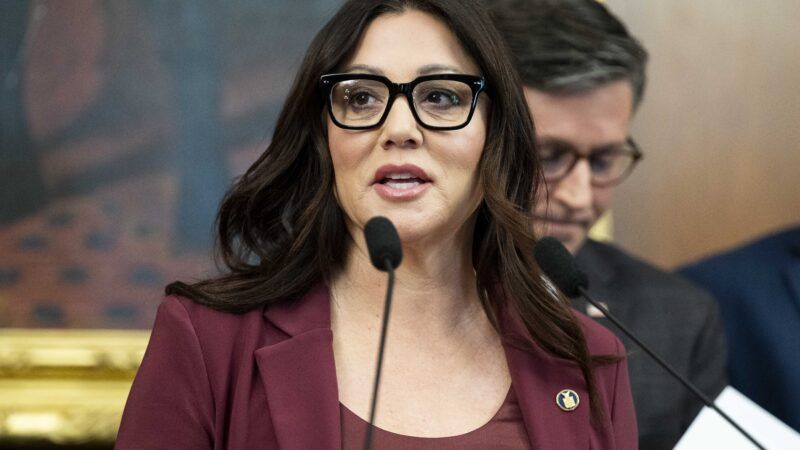
Labor secretary quits. President Donald Trump's controversial head of the Department of Labor, Lori Chavez-DeRemer, resigned her position in the administration on Monday amid a swirl of misconduct allegations.
The Reason Roundup Newsletter by Liz Wolfe Liz and Reason help you make sense of the day's news every morning.
White House Director of Communications Steven Cheung announced the news in an X post yesterday evening in which he praised Chavez-DeRemer for doing a "phenomenal job" and said Keith Sonderling, the current deputy secretary of labor, would take over as acting head of the department.
Labor Secretary Lori Chavez-DeRemer will be leaving the Administration to take a position in the private sector. She has done a phenomenal job in her role by protecting American workers, enacting fair labor practices, and helping Americans gain additional skills to improve their…
— Steven Cheung (@StevenCheung47) April 20, 2026
Prior to joining the Trump administration, Chavez-DeRemer was a congresswoman from Oregon, who was notable for being one of a very small number of Republicans to support federal legislation forcing pro-union policies on the whole country.
That included the Protecting the Right to Organize (PRO) Act, which would have made it harder to classify workers as independent contractors, ended right-to-work policies in the states that have them, and expanded the power of the National Labor Relations Board.
Additionally, Chavez-DeRemer co-sponsored federal legislation that would have given almost every government employee the right to unionize and overturned state laws that forbid public sector workers from collective bargaining.
Chavez-DeRemer lost her reelection bid in 2024.
Her relatively pro-union stances made her an odd pick for a Republican administration. Three GOP senators, including Rand Paul, voted against her confirmation, while 17 Democrats supported her.
Personal issues. It appears it was Chavez-DeRemer's personal behavior, and not her policy positions, that proved to be her undoing. Before resigning, the secretary was being investigated by the DOL inspector general over allegations that she drank on the job, was having an affair with a member of her security staff, and concocted official travel plans to pay for personal travel.
Chavez-DeRemer's husband had also been accused of sexual misconduct by DOL staffers and had reportedly been banned from the department's D.C. headquarters building. Last week, The New York Times reported on the secretary's husband and father texting her female staff. Politico cites a "Republican close to the Trump administration" saying the text messages were "the final straw."
In her own statement on X, Chavez-DeRemer said that she was "proud that we made significant progress in advancing President Trump's mission to bridge the gap between business and labor and always put the American worker first."
It has been an honor and a privilege to serve in this historic Administration and work for the greatest President of my lifetime.
At the Department of Labor, I am proud that we made significant progress in advancing President Trump's mission to bridge the gap between business…
— Secretary Lori Chavez-DeRemer (@SecretaryLCD) April 20, 2026
Chavez-DeRemer is the third cabinet secretary to leave Trump's second administration, following former Homeland Security head Kristi Noem and former Attorney General Pam Bondi.
Doing drugs, not medicine. As this newsletter covered yesterday, the president signed an executive order aiming to fast-track Food and Drug Administration review of psychedelics for medical uses.
That's all well and good, writes Jacob Sullum in Reason. But this medicalized approach to legalizing psychedelics also ignores why most people take them. Writes Sullum:
In a 2023 survey of psilocybin users, for instance, the RAND Corporation found that the most common motivations included "fun" (59 percent), "personal development" (45 percent), "curiosity" (43 percent), and "spiritual growth" (41 percent). Needless to say, these are not applications that the FDA is likely to recognize as legitimate. And while 49 percent of respondents said they used psilocybin for "improved mental health," even that category overlaps only partly with the diagnoses that would be necessary to obtain prescriptions under federal law.
Trump's initiative, in short, falls far short of acknowledging that adults have a right to use psychedelics for whatever reasons they deem compelling. It therefore does not do much to address the injustice of threatening people with arrest and prosecution for exercising that right.
Scenes from Washington, D.C.: One can criticize Trump's proposed triumphal arch for being gaudy*. If you need more reasons to dislike it, Washingtonian spoke to an architect who has thoughts.
A proposed triumphal arch could dramatically reshape DC's skyline. One landscape architect has thoughts. https://t.co/tu8giV4Qu0 pic.twitter.com/WSxgj2Q2te
— Washingtonian 🌸 (@washingtonian) April 20, 2026
QUICK HITS
- The Onion makes a bid to acquire InfoWars.
- Curious
Japan's Phillips Curve Looks Like Japan https://t.co/NvUmEDHygs pic.twitter.com/FEyizHsHFv
— Todd Jones 🦊 (@toddrjones) April 17, 2026
- Even more curious. Virginia Democrats are proposing a lobster-shaped district as part of their plan to heavily gerrymander the state.
This is what Democrats call "fair." pic.twitter.com/k4xGGBQLEZ
— Virginia GOP (@VA_GOP) February 6, 2026
- It appears peace talks between the U.S. and Iran will be held in Pakistan as the ceasefire is set to end tomorrow.
- Tim Cook is stepping down as Apple CEO.
- Federal Reserve independence is the spotlight at the confirmation hearing for Fed chair nominee Kevin Warsh.
CORRECTION: The original version of this article misstated which jurisdiction in which the triumphal arch would be built.