
Why J.D. Vance Is a Risky Bet for Republicans in 2028
Vance's support for unpopular policies could spell trouble for the GOP in 2028. But this could be a good thing for the party's future, says Jonah Goldberg.
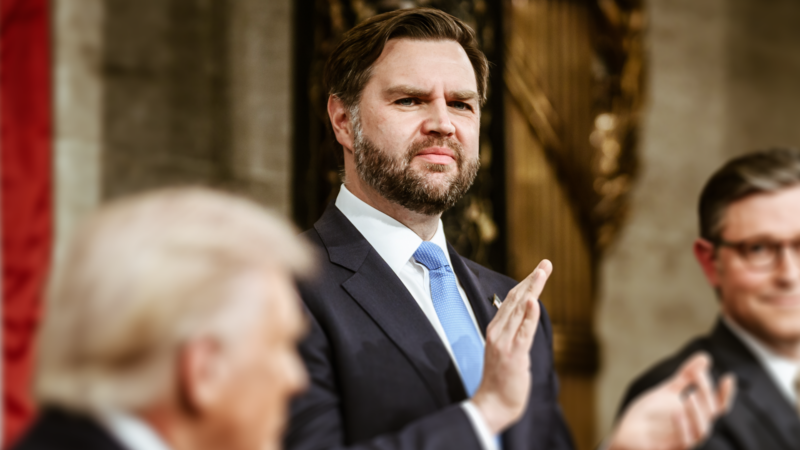
On Tuesday, citizens in 16 states headed to the polls to cast their vote in the midterm primary. While some of the races ended in some high-profile victories, Tuesday's election was significant for another reason: It marked the beginning of the end of Donald Trump's presidency.
With Trump (and the Constitution) ruling out a third term, the GOP will soon have to figure out who will lead the party after he leaves the White House in 2029. The options as of now leave much to be desired.
Up until recently, Kristi Noem was considered a frontrunner, but she was ousted as the Department of Homeland Security secretary on Thursday after being grilled by lawmakers for spending millions in taxpayer dollars to boost her national name recognition. Meanwhile, Secretary of State Marco Rubio, who has been a key player in the administration's unpopular immigration crackdown, is not viewed favorably by most of the public. This leaves Vice President J.D. Vance as the presumptive nominee, even though he is no longer supported by a majority of the Republican Party.
A potential Vance nomination in 2028 could be concerning for those Republicans who still care about principled leadership and classical liberalism. As Reason's Stephanie Slade wrote when Vance was selected as Trump's running mate, the former Ohio senator has a "troubling history of articulating illiberal views about the use of government power. He argued on the Senate campaign trail that conservatives should 'seize the administrative state' and use it 'for our own purposes.' He then floated the idea that a Republican president could simply ignore court rulings he doesn't like."
Vance's embrace of whatever ideas are politically advantageous appears to be a feature, not a bug. Indeed, his chameleon-like attitude has allowed him to fit in with, in the words of Slade, the "three loose factions" of the dissident right: "theocons, national conservatives and neoreactionaries." It also led him to take on unique battles, including defending far-right influencer Nick Fuentes.
"I don't think Vance is a Nazi. I don't think he's a racist, per se," The Dispatch's Jonah Goldberg recently told Reason's Nick Gillespie. But "[he] is at the forefront of what I would call, and have called, the anti- anti-Nazi wing. It's not so much that he agrees with Nick Fuentes, or he loves everything that Tucker Carlson is doing, but he'll be damned if he'll tolerate excessive criticism or any attempt to silence or cancel these people."
The rise of Vance and other figures like him is, in many ways, an indictment of where much of the right stands today. "I think there are a lot of people on the right who are very right-wing," says Goldberg. "But their respect for institutions, their respect for the Constitution, their respect for norms, basic decency, and all that kind of stuff has gone out the window."
This lack of respect for constitutional order has been especially evident in the second Trump administration, which has seen the president circumvent Congress to illegally levy tariffs on goods from most of the world and extract the leader of a foreign country. In the most recent example—starting a war in Iran—Congress has chosen not to stop the administration and has instead gone through mental gymnastics to defend Trump.
Like the rest of Trump's actions, Vance has defended the bombings in Iran, which could come back to hurt him in 2028, given the public's disapproval of the war. But it's not just support for unpopular policies that might sink Vance; history, too, is not on his side.
"Only two times in American history since 1800 has a sitting vice president been elected straight to the presidency," says Goldberg. These were Martin Van Buren and George H.W. Bush. "So the only scenarios in which it makes sense that a vice president would win the third term or would win on the heels of his president is if that president was popular."
With Trump's favorability hovering in the low-20s, it seems unlikely that Vance will join that exclusive list with Van Buren and Bush, which would be a good thing for the GOP.
"Once the celebrity goes, you're left with a bunch of politicians, some of whom are really dumb or mean, or obnoxious, and who have to actually make arguments not based on bullying," says Goldberg. "I think that's a great world for…mainstream conservative, mainstream libertarian stuff because those guys actually have good facts on their side."