
Trump Bragged About Lower Gas Prices. Then He Bombed Iran.
You can have low gas prices or war in the Middle East, but not both.
Presidents like to claim good economic news as vindication, whether they had anything to do with it or not. Former President Bill Clinton often claims that the economy simply adds more jobs under Democrats than under Republicans, but that analysis only works if you ignore Congress and any other external economic forces.
Ultimately, presidents have very little direct impact on the economy. That's why egg and beef prices remain high, even though President Donald Trump pledged to "immediately" lower grocery prices "starting on Day 1."
But there are actions a president can take that will have direct, immediate effects on prices—for example, launching a war in the Middle East.
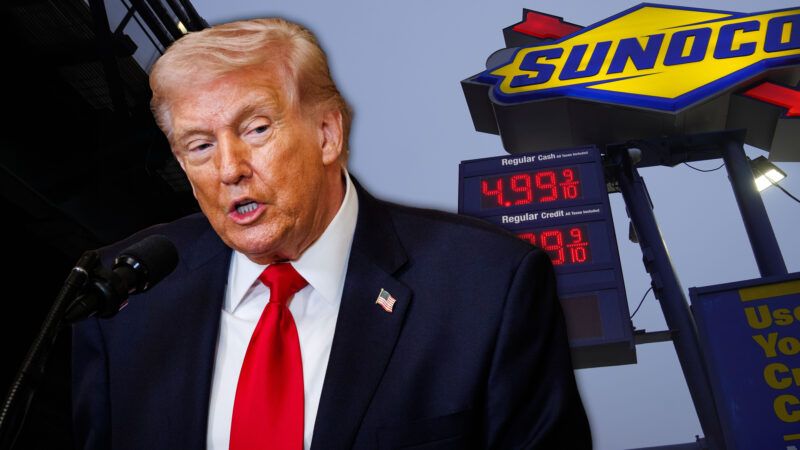
"Gasoline, which reached a peak of over $6 a gallon in some states under my predecessor—it was quite honestly a disaster—is now below $2.30 a gallon in most states. And in some places, $1.99 a gallon," Trump said last week in his State of the Union speech.
Four days later, the U.S. joined Israel in bombing Iran. And since then, oil prices have spiked, as have prices at the pump.
"Tankers have been staying away from [the Strait of] Hormuz since the U.S.-Israeli attacks on Iran that began on Saturday," The New York Times reported this week. "A prolonged conflict could ripple broadly across the global economy, threatening the energy supplies of countries halfway around the world and stoking inflation. International oil prices have climbed 12 percent since the fighting began, trading Tuesday around $81 a barrel, and natural gas prices have surged in Europe and in Asia."
"Oil prices surged to their highest levels in nearly two years on additional signs that the U.S.-Iran war has no clear end in sight," Barron's added Thursday. Crude oil has not hit $80 a barrel since July 2024.
With that, gas prices around the country have also increased. Just within the last week, as of this writing, the price per gallon is up 30 cents or more in 22 states, according to GasBuddy. Only nine states have seen price increases lower than 20 cents per gallon. (Hawaii is the only outlier, having essentially remained flat at $4.35.)
"The White House is 'looking under every rock for ideas on improving energy prices, especially gasoline prices,'" Politico's Ben Lefebvre reported Tuesday, quoting an energy industry executive.
Of course, Republicans often tout their efforts to boost domestic oil production. "American oil production is up by more than 600,000 barrels a day," Trump said at the State of the Union. "American natural gas production is at an all-time high because I kept my promise to drill, baby, drill."
Trump is right that domestic production is helping soften the blow, because without it, the price spike would be untenable.
"Without all of the United States' substantial crude production, Americans could already be paying $4 or even $5 a gallon for gasoline. That makes the energy spike caused by the Iran war even more painful," Chris Isidore and Matt Egan wrote for CNN. "And no matter how much oil the United States produces domestically, oil is traded in a global market—one that President Donald Trump just upended."
Of course, this is not the worst case scenario. "Over the period of US operations in Iraq between 2003 and 2011, crude oil averaged roughly $72 per barrel," writes Landon Derentz of the Atlantic Council. "Adjusted to today's dollars, that is north of $100 per barrel."
But it still remains the case that while presidents have little direct effect on granular data like gas or grocery prices, launching a seemingly needless war of choice in the Middle East is one easy way to drive up people's cost of living.