
Trump Should Have Made His Case for War to Congress and the American People
The administration was wrong to unilaterally and unconstitutionally commit the U.S. to war.
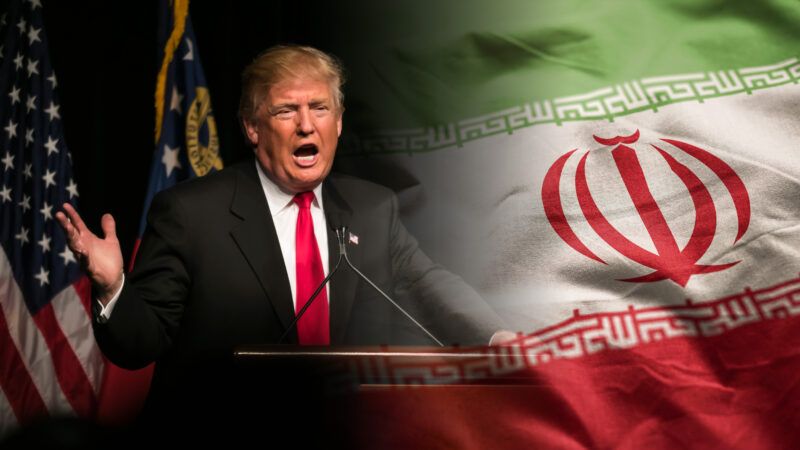
The world is undoubtedly a better place after the killing of Iran's supreme leader Ayatollah Ali Khamenei and roughly 40 of his murderous colleagues by joint Israeli and American military strikes. Iran's Islamist regime has slaughtered its own people while encouraging terrorism around the world for decades. But those strikes carry serious risks and costs. Are they worth the tradeoffs? The Trump administration should have made its case to Congress and the already skeptical public and satisfied the Constitution's requirements by doing so.
You are reading The Rattler from J.D. Tuccille and Reason. Get more of J.D.'s commentary on government overreach and threats to everyday liberty.
War Without Debate
On Saturday, the U.S. and Israel launched much-anticipated strikes after claiming negotiations with the Iranian regime over the status of its nuclear weapons program had stalled.
"A short time ago, the United States military began major combat operations in Iran," President Donald Trump announced. "Our objective is to defend the American people by eliminating imminent threats from the Iranian regime—a vicious group of very hard, terrible people. Its menacing activities directly endanger the United States, our troops, our bases overseas, and our allies throughout the world. For 47 years the Iranian regime has chanted 'death to America' and waged an unending campaign of bloodshed and mass murder, targeting the United States, our troops, and the innocent people in many, many countries."
True enough. The president recited a litany of crimes in which the Islamist regime has been implicated, including the 1983 bombing of the U.S. Marine barracks in Beirut by Iranian proxy Hezbollah, and the October 7, 2023, Hamas attack on Israel, which Iranian forces helped plan. To this list we can add the attempted assassinations of Iranian dissident Masih Alinejad in Brooklyn and of then-presidential candidate Trump himself. Trump also called out Iran's efforts to acquire nuclear weapons. And he urged the suffering Iranian people, who have weathered brutal attempts to suppress protests, to take advantage of the military strikes to overthrow the regime.
Unfortunately, this was the first time many Americans—members of the public and lawmakers alike—heard the Trump administration make a somewhat coherent argument for taking on Iran's government. It came as strikes were already underway despite the Constitution reserving to Congress the responsibility to "provide for the common Defence," "to declare War," "to raise and support Armies," and "to provide and maintain a Navy." Lawmakers were informed of the attack on Iran, but only after the country was committed to hostilities and their related dangers and expense.
Congress and the People Were Never Consulted
"I am opposed to this War," Rep. Thomas Massie (R–Ky.) objected. "This is not 'America First.' When Congress reconvenes, I will work with @RepRoKhanna to force a Congressional vote on war with Iran. The Constitution requires a vote, and your Representative needs to be on record as opposing or supporting this war."
Rep. Ro Khanna (D–Calif.) shares Massie's skepticism towards military action. He and Massie might have voted against authorizing war with Iran even if they'd heard the administration's arguments. Or perhaps they and other lawmakers would have been persuaded. We don't know, because the president didn't make a case until bombs and missiles had already been launched.
No effort was made to convince the public, either, and that's a mistake because the administration has been shedding popular support. An Associated Press–NORC poll published last week found that "when it comes to his handling of foreign affairs, most do not trust Donald Trump to make the right decisions about international military action (56%) or the use of nuclear weapons (59%)." That's despite the fact that "eighty percent of adults express at least a moderate degree of concern that Iran's nuclear program poses a direct threat to the U.S."
Unpersuaded, Americans Are Unprepared for Consequences
That's going to be a problem as the war with Iran has consequences. While the strikes have been relatively bloodless for Americans so far, three Americans are reported to have died. The war has also interrupted shipping in the region, meaning tankers at anchor rather than transporting oil and gas. Oil prices are expected to surge with add-on effects for people filling their cars and heating their homes. The American people might accept casualties and added costs if they're convinced of the necessity for such sacrifices. But that's asking a lot when bodies come home and prices soar for unclear reasons.
For Israelis, the reasons for this war are clear. They've been targeted and murdered for years by Iran's Islamist regime, suffering thousands of casualties as a result. Khamenei, the late supreme leader, vowed to destroy Israel and made every effort to kill its people through terrorism and direct attacks. Israelis have every reason to view the Islamist regime as an existential threat and to work to bring it down.
But a threat to Israel, even though it's a close U.S. ally, is not necessarily a threat to the United States justifying American intervention. The ongoing danger to Israel posed by Iran's government may add to the case for attacking the Islamist regime, but that case still must be made to Congress and the public.
This is especially true since, perversely, American popular support for Israel has eroded since Hamas's murderous October 7 attack. "Forty-one percent of Americans now say they sympathize more with the Palestinians in the Middle East situation, while 36% sympathize more with the Israelis," according to Gallup. Some Americans were undoubtedly repulsed by Israel's vigorous and sometimes misdirected efforts to root out Hamas after the latest and worst of a series of atrocities by the Iran-backed group. Again, better efforts to persuade the public might have kept popular sentiment better aligned with the victims of October 7.
More Uncertainty To Come
The situation isn't going to get easier going forward. So far, Iran's response to the attacks appears to be a burn-it-all-down strategy that involves not just targeting American and Israeli forces but also raining missiles on its Arab neighbors. They're unlikely to cause a lot of damage, but they're inflicting casualties. And then there are the parked tankers and anticipated rises in fuel prices.
Beyond that is the question of what comes next. Above, I commented that the world is a better place for Khamenei and company's removal, but that's no guarantee for the future. It's difficult to imagine worse people taking charge in Iran, but sometimes the world surprises us. Trump urged the Iranian people to "take over your government. It will be yours to take." But we don't yet know who will rise to that challenge and seize the reins of power. That means more uncertainty and danger ahead.
The Constitution requires the president to go to Congress before waging war. Good sense advises convincing lawmakers and the public of the necessity of military action before embarking on such ventures. The Trump administration did the world a favor by decapitating the Iranian government. But it was wrong to unilaterally and unconstitutionally commit the U.S. to war.