
The Trump Administration's War Against ICE Critics
By conflating opposition with terrorism, federal officials go down a dangerous path.
It's no secret that the Trump administration is thin-skinned about criticism and intolerant of efforts to document its activities. Administration officials smear ideological opponents and those who monitor Immigration and Customs Enforcement (ICE) as potential "domestic terrorists." So, it's no surprise the administration is targeting online channels where its opponents coordinate. It's no surprise, that is, but it's an intolerable attack by yet another presidential administration on free speech rights.
Last week, the Electronic Frontier Foundation (EFF) urged tech companies to resist federal demands for data about users who have been critical of the administration.
You are reading The Rattler from J.D. Tuccille and Reason. Get more of J.D.'s commentary on government overreach and threats to everyday liberty.
Resisting Attacks on the First Amendment
"DHS has consistently targeted people engaged in First Amendment activity," warns Mario Trujillo, a senior staff attorney for the civil liberties group. "Among other things, the agency has issued subpoenas to technology companies to unmask or locate people who have documented ICE's activities in their community, criticized the government, or attended protests."
Trujillo emphasizes that the subpoenas "are unlawful" and that the Department of Homeland Security (DHS) has been leery of testing their legitimacy. In November, DHS withdrew a subpoena seeking details about Instagram users who posted about ICE raids in Los Angeles rather than defend the document in court.
EFF recommends that tech companies abide by recommendations developed with the ACLU of Northern California. Among other things, it urges that subpoena recipients fight the demands in court, inform targeted users so they can secure legal assistance, and resist gag orders that seek to prevent recipients from warning users and publicly discussing the situation.
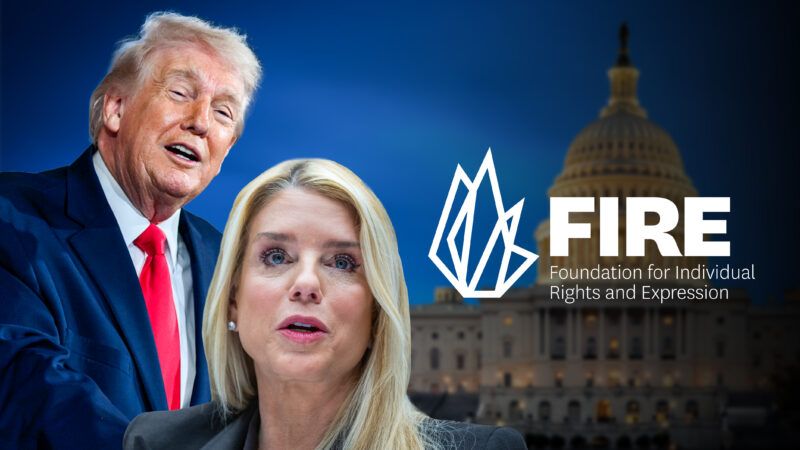
The Foundation for Individual Rights and Expression (FIRE) is also battling the administration's war against critics. As reported by Reason's August Billings, FIRE is suing the federal government on behalf of two plaintiffs who created a Facebook group and an app that helped people document ICE activities.
"As U.S. citizens, we have the right to keep each other informed about what our government officials are doing and how they're doing it," commented Mark Hodges, one of the plaintiffs.
The problem is that the Trump administration doesn't recognize that right. In December. Reason's C.J. Ciaramella asked a DHS representative if the feds considered following or recording federal agents to be obstruction of justice. He was told, "That sure sounds like obstruction of justice."
Since then, after violent clashes in Minneapolis culminating in two killings of protesters by federal agents, the FBI has opened an investigation into Signal group chats used by opponents of the federal immigration crackdown.
"That sort of Signal chat being coordinated with individuals, not just locally in Minnesota, but maybe even around the country," FBI Director Kash Patel commented, "if that leads to a break in the federal statute or a violation of some law, then we are going to arrest people."
Patel claims the investigation will result in arrests "if" Signal chats lead to violations of law, but that's a big "if" that could be applied to any conversation at any time. Recording, tracking, and sharing information about government enforcers is perfectly legal.
Recording and Doxing Cops Is Legal
"While the Supreme Court itself hasn't yet faced the issue squarely, the seven federal circuits that have done so—the 1st, 3rd, 5th, 7th, 9th, 10th, and 11th—all agree that the First Amendment protects the right to record police performing their duties in public," points out Walter Olson, a senior fellow at the Cato Institute's Robert A. Levy Center for Constitutional Studies.
The Trump administration must have some lawyers on staff who told them the same thing. So, federal officials have complained that critics are doxing—collecting and publicizing information about—federal agents and that this is, perhaps, illegal-ish.
"Videotaping ICE law enforcement and posting photos and videos of them online is doxing our agents," DHS Assistant Secretary for Public Affairs Tricia McLaughlin told the Center for Media and Democracy last September. "We will prosecute those who illegally harass ICE agents to the fullest extent of the law."
But doxxing isn't illegally harassing. It's not illegal anything.
"Government officials and employees don't enjoy special immunity from 'doxxing'," writes David L. Hudson, Jr., associate professor of law at Belmont University, for FIRE. "Merely disclosing the names of government agents or places where they carry out their official duties is constitutionally protected speech, especially when tied to political criticism."
If collected information is then used to do something illegal—like attack people in their homes—that's a different matter. But it's that extra action that violates the law, not the gathering of faces, names, and addresses. Unfortunately, the administration (like many of its predecessors) seems to have a problem with criticism and opposition of any sort.
The Administration Conflates Opposition With Terrorism
In the wake of the assassination of conservative figure Charlie Kirk, when many Americans were understandably profoundly upset by the crime, the White House issued a memo charging that "common threads animating this violent conduct include anti-Americanism, anti-capitalism, and anti-Christianity; support for the overthrow of the United States Government; extremism on migration, race, and gender; and hostility towards those who hold traditional American views on family, religion, and morality." U.S. Attorney General Pam Bondi followed up with a directive to federal prosecutors and law enforcement agencies to target "domestic terrorists" identified in part by "extreme viewpoints on immigration, radical gender ideology, and anti-American sentiment."
It's true that these viewpoints can inspire crimes—just look at Kirk's murder, for starters. But if you target beliefs rather than violent actions, you go down a dangerous path that threatens everybody. Under the last administration, the FBI investigated fans of the Gadsden flag and other "Revolutionary War imagery." In both cases, government officials clearly targeted opponents, not crimes. The intent was to stifle people's right to dissent, not address real threats to the public.
That's why the EFF, FIRE, tech companies, and regular people need to resist efforts to investigate critics of the government and to shut down communications platforms. They need to resist not because the critics are always right, but because governments can't be permitted to target and muzzle their opponents.