
Tom Homan Defends Masked ICE Agents by Claiming Threats Are Up 'Over 8,000 Percent'
Homan's numbers are misleading, but even if they weren't, it wouldn't justify allowing an entire federal law enforcement agency to operate in anonymity.
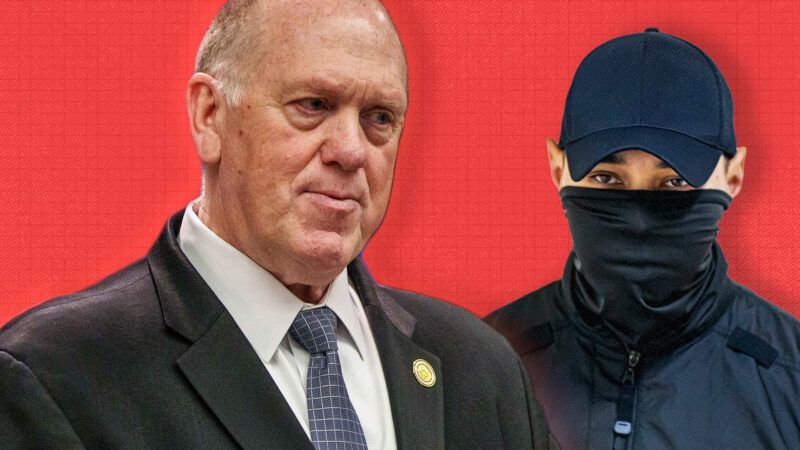
The Department of Homeland Security (DHS) shut down over the weekend, with lawmakers demanding reforms to the way it has operated under the Trump administration. In particular, Democrats want more accountability for Immigration and Customs Enforcement (ICE), including an end to ICE officers wearing masks.
So far, Republicans have resisted that request. On Sunday, White House border czar Tom Homan made the case that ICE agents must mask for their own safety.
"Look, I don't like the masks either," Homan told CBS' Ed O'Keefe, "but because threats against ICE officers are up over 1,500 percent, actual assaults and threats are up over 8,000 percent, these men and women have to protect themselves."
The DHS has claimed multiple times in recent months that ICE officers are experiencing an 8,000 percent increase in death threats, adding in January 2026 that officers also face "a more than 1,300% increase in assaults."
"Those figures are deceptive," Radley Balko wrote in The New Republic in December. "The 2024 baseline figure against which the administration is making these calculations is 10, according to Fox News. That is, there were 10 alleged assaults on ICE officers between January and June 2024. There were 79 in 2025. Meanwhile, over the same period, the number of federal agents participating in deportations and removals has swelled from 6,000 to over 30,000."
Philip Bump noted last year in The Washington Post that most of the assaults cited by the DHS and the Department of Justice were minor scuffles that occurred during immigration arrests, suggesting a correlation with the increase in enforcement actions. (Bump also noted that in these scenarios, wearing masks would have had no effect on the outcome.)
Of course, assaults against ICE officers should not be ignored or excused. But 79 assaults over the course of a year, amid a five-fold increase in operations, does not suggest officers are at increased risk of violence—and it certainly doesn't justify letting them operate in anonymity.
In fact, Alex Nowrasteh of the Cato Institute found that 2025 was actually the second-safest year for both ICE and Customs and Border Protection (CBP) agents since the DHS was founded in 2003. "Law enforcement officers who don't work at ICE or Border Patrol have a death rate 6.3 times higher than that of immigration enforcement officers in 2025," Nowrasteh wrote.
There are also practical reasons why an entire federal law enforcement agency should not be allowed, as a matter of course, to operate completely anonymously on American streets.
In October, an internal FBI bulletin warned that masked and anonymous ICE agents "mak[e] it harder for Americans to distinguish between lawful officers and imposters while eroding trust in law enforcement," according to a Wired summary.
Last year, plainclothes ICE agents in masks and balaclavas arrested two men in a Virginia courthouse. The county prosecutor said in a statement he was "greatly concerned that arrests carried out in this manner could escalate into a violent confrontation, because the person being arrested or bystanders might resist what appears on its face to be an unlawful assault and abduction."
And yet Republicans remain committed to ICE officers being allowed to operate anonymously within the U.S., for their own safety.
"Why don't they talk about maybe passing legislation to make it illegal to dox agents or something like that?" Homan asked O'Keefe. "The masks right now are for officer safety reasons."
"This was stated as an explanation, as a justification, as an argument for masks," Chris Geidner wrote at Law Dork. "In reality, it is a deep admission of the fundamental moral failing at the base of the Trump administration's lawless actions. If you knew what the administration is doing, it would not be sustainable."
And yet it's a common refrain among Republicans. "There's a lot of vicious people out there, and they'll take a picture of your face, and the next thing you know, your children or your wife or your husband are being threatened at home," added Sen. Thom Tillis (R–N.C.), who has broken with the Trump administration in recent weeks but supports allowing ICE to remain masked.
"[If you] unmask them and you put all their identifying information on their uniform, they will obviously be targeted," House Speaker Mike Johnson (R–La.) agreed.
But "that's just an after-the-fact excuse," Steven Greenhut wrote at Reason in September. "This shouldn't be news to conservatives, but the Constitution is meant to protect ordinary people from their government rather than the other way around. The first concern is to protect our liberties, not to ensure that armed agents have an easier time of it."
Besides, it's not always clear what Republicans even mean when they complain about agents being "doxed." In January, ICE officer Jonathan Ross shot and killed Minneapolis activist Renee Good in her car. Days later, DHS Secretary Kristi Noem discussed the case on Face the Nation. But even though she had already publicly labeled Good a domestic terrorist, Noem objected to host Margaret Brennan even mentioning Ross.
"Don't say his name," Noem admonished. "For heaven's sakes, we shouldn't have people continue to dox law enforcement when they have an 8,000 percent increase in death threats against them." When Brennan noted Ross' name was already public, Noem replied, "that doesn't mean it should continue to be said."
This definition is completely different from what Tillis warned of, where activists use a federal employee's personal information to threaten or intimidate them. No government agent operating in public should be exempt from oversight, especially after killing a woman in broad daylight.
"Government officials and employees don't enjoy special immunity from 'doxxing,'" Belmont University law professor David L. Hudson Jr. wrote in 2024. "To the contrary, the power they exercise makes it even more important that people be free to criticize them and disclose information that holds them accountable."
"An anonymous police force is an unaccountable police force," Reason's C.J. Ciaramella wrote last year. "It's essential for government transparency, public trust, and the rule of law that the officials dictating and enforcing public policies can be identified by media outlets and citizens without fear of retribution."