
Stephen Miller's Hardline Immigration Tactics Are Backfiring
Miller says he’s waging a war for America. Americans see a brutal war on them.
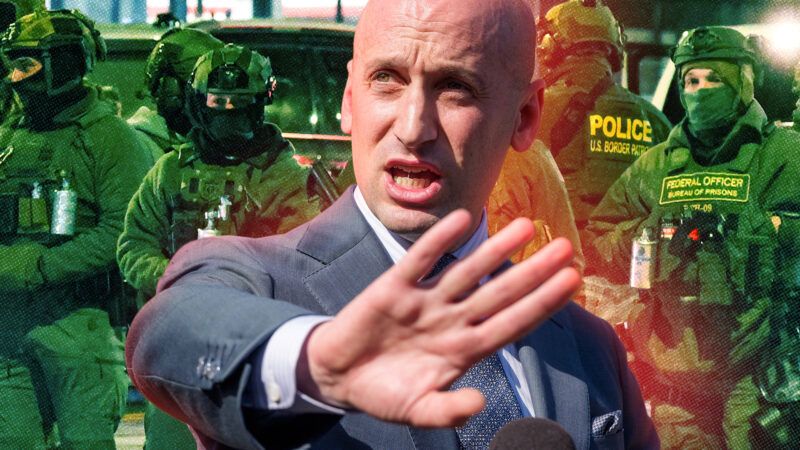
When news broke last weekend that federal immigration agents had shot and killed a second U.S. citizen in Minneapolis, the Department of Homeland Security (DHS) was quick to go on the offensive. Alex Pretti, the 37-year-old intensive care unit nurse who was killed, a DHS post on X initially claimed, "wanted to do maximum damage and massacre law enforcement." DHS Secretary Kristi Noem said that Pretti had "brandished" a gun at officers. Pretti was indeed carrying a gun, for which he was legally permitted. But multiple videos of the incident clearly show that he had been disarmed before he was shot, and a DHS review released days later notably did not include the claim that he brandished his weapon.
As with the killing of Renee Good by federal immigration officers days earlier, senior Trump administration officials rushed to prejudge the incident before the facts could possibly be known by painting the dead citizen as an agitator and aggressor. Rather than acting cautiously, Noem and her agency simply lied. And in doing so, they had smeared a man killed by his own government.
Those lies came directly from senior White House adviser Stephen Miller, according to Axios. It's not hard to believe that report. Miller is, by most accounts, the mind behind President Donald Trump's immigration policy, including its most visible and aggressive aspects—the deployment of the National Guard to Los Angeles last year, the attempts to create a chaotic scene in Portland, Oregon, and the surge of masked federal agents into Minneapolis that resulted in the killing of Pretti and Good.
On social media, Miller himself asserted that Pretti was a "domestic terrorist" and an "assassin." And in the days afterward, Miller continued with the militant rhetoric. He often paints immigration as an invasion with civilizational stakes. And this week, he declared that, after losing an election, Democrats "launched an armed resistance to stop the federal government from reversing the invasion."
Miller isn't just seeking dutiful immigration enforcement. And he's not just spouting ugly rhetoric on social media. He just doesn't want the public to believe that immigration policy is equivalent to a war on America's streets, he needs them to, because that's the only way to justify the sort of wartime tactics he favors on American streets.
Trump's second-term raids are not merely designed to sweep up immigrants for deportation; they are designed to act as shows of force, a dangerous and occasionally deadly form of political theater. And while Trump bears ultimate responsibility for the immigration sweeps and their consequences, it is Miller who has most clearly shaped their operational character. The masks, the menace, the militarism—these are all direct manifestations of a cruel and apocalyptic worldview, in which force is the only real governing power, illegal immigration represents a form of "invasion," legal immigration mechanisms like birthright citizenship are "destructive and ruinous policies aimed at the heart of the Republic," and public protest of deportation raids that turn violent is tantamount to "insurrection."
There's an ugly underlying race-essentialism to Miller's outlook: According to a recent Atlantic profile, Trump broke up an immigration dispute between Miller and a moderate Trump aide by saying, "Stephen, if you had it your way, everyone would look exactly like you." Miller, a source told The Atlantic, responded, "That's correct."
Some of this can be understood as an outgrowth of Trump's own worldview. The president notoriously launched his first campaign by declaring that "when Mexico sends its people, they're not sending their best…They're bringing crime. They're bringing drugs. They're rapists." But Trump's personal ability to implement policy and execute on his impulses is limited without competent staff to follow through. Miller is the White House aide who turns Trump's immigration ideas into reality. As the Atlantic profile put it, he's "the man who turns President Trump's most incendiary impulses into policy."
Policymaking is a craft and a process, and like most crafts, it tends to reveal the character of its practitioners. Under Miller's watch, immigration agents on the street aren't just duly enforcing immigration law, they are doing so in a way that engenders maximum conflict and maximum hostility, emphasizing shows of force over dispassionate legal procedure. In court, meanwhile, immigration officials have repeatedly lied to judges and ignored their orders, in flagrant violation of the law. And Miller, from his perch in the Trump administration, is urging them on, pushing obvious falsehoods about Pretti (among other incidents), instructing Department of Homeland Security agents that they have "federal immunity," and repeatedly describing court rulings against the administration as "judicial tyranny." If you want to understand why ICE is acting the way that it is, look at Stephen Miller.
Yet while there are certainly divides over ICE and its tactics—witness the fractious social media reaction to videos depicting Renee Good's killing—the agency's aggression and lack of accountability are clearly political losers, even amongst nominal supporters. A recent Quinnipiac University poll found that 57 percent of voters disapprove of ICE's aggressive enforcement; no less than Joe Rogan has compared ICE tactics to "the Gestapo." When Republican pollster Kristen Soltis Anderson conducts focus groups of Trump supporters, she recently told The New York Times, it is "notable how [immigration enforcement] does come up as an area where it feels like it's gone too far for some." That sense that enforcement has gone too far is a direct byproduct of the incendiary tactics Stephen Miller favors.
Even as the public has turned on his project, Miller has worked to maintain the impression that he has a majority on his side, making him a sort of populist militant fighting for real Americans against traitorous enemies. Days after Renee Good's killing, he posted that Americans had voted "overwhelmingly for mass deportation" but that "the response of the Democrat Party and its activists has been to support and orchestrate violent resistance against federal law enforcement."
Miller's menacing, militarized tactics are helping drive shifts in public sentiment. Prior to Trump's second term, public opinion generally favored Trump on immigration, and even recent polls have shown the public still trusts Republicans over Democrats on the issue.
But it's hard to make a persuasive case that masked, militarized law enforcement tactics are necessary to protect Americans when confronted with videos showing Americans losing their lives and their liberty to those very same tactics. It's simply not credible to say that what's happening on the streets of Minneapolis is necessary to uphold the law when the rule of law is so obviously being flouted.
Miller's fundamental argument is that masked ICE agents roaming the streets are waging a valiant and necessary war to protect America. But with two dead U.S. citizens, a flood of official lies designed to shield federal law enforcement from oversight, and a social media stream of videos showing immigration agents harassing, intimidating, and demanding papers just to go on with their lives, what Americans increasingly—and rightly—see is a war being waged against them.