
The Greenland Fiasco Shows the Stock Market Is the Ultimate Check on Trump
Economic globalization and financial markets encourage the "Trump always chickens out" (TACO) cycle. If you like peace, that’s a good thing.
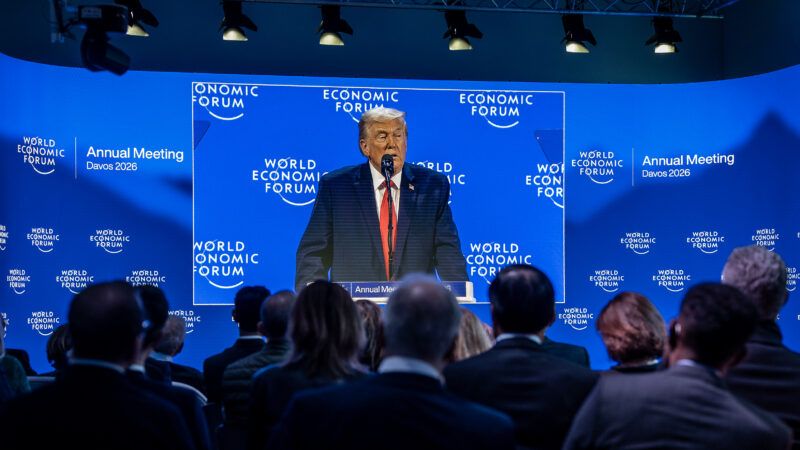
After weeks of saber rattling, President Donald Trump announced that he would not use military force to annex Greenland during a Wednesday speech to the World Economic Forum in Davos, Switzerland. While Trump has railed against globalization for giving American workers "nothing but poverty and heartache," Americans should thank global financial markets for helping to check the president's worst impulses.
As the old saying goes, "When goods don't cross borders, soldiers will." It doesn't necessarily follow that when goods cross borders, soldiers won't, but luckily for Americans, Greenlanders, and Europeans, the global financial market's response to Trump's belligerence is likely responsible for the "Trump always chickens out" (TACO) phenomenon in the case of Greenland.
Dominic Pino, editorial writer at The Washington Post, explains the economic causes of TACO with a simple illustration of the S&P 500 from January 16 to January 21:
Genuinely insane that we've just been doing this over and over for months pic.twitter.com/TQpvUbJdDO
— Dominic Pino (@DominicJPino) January 21, 2026
Trump "runs his mouth," causing markets to plummet. Then he "walks it back," causing markets to rebound. If markets were perfectly efficient, one would expect TACO to be priced in, which would eliminate the very thing responsible for TACO: market decline. Arin Dube, provost professor of economics at the University of Massachusetts Amherst, explains that markets do initially price in TACO, but this encourages Trump "to do more stuff until the markets actually [think] he may not TACO and prices start to fall…which restores TACO."
Dube calls this phenomenon the "TACO cycle," and that's exactly what we just saw happen.
Trump said that the U.S. "need[s] Greenland from the standpoint of national security and Denmark is not going to be able to do it" on January 4, the day after the capture of Venezuelan dictator Nicolás Maduro by American special forces. In response to this vague, thinly veiled threat, the leaders of Denmark (whose kingdom includes Greenland, an autonomous territory), France, Germany, Italy, Poland, Spain, and the U.K. issued a joint statement on January 6 stating that "Greenland belongs to its people" and that "security in the Arctic must…be achieved collectively, in conjunction with NATO allies." Unsurprisingly, a strongly worded missive from European leaders did not succeed in dissuading Trump.
On January 14, Trump doubled down on Truth Social, insisting that "the United States needs Greenland…in the hands of the UNITED STATES. Anything less than that is unacceptable." Later that day, after talks with the Greenlandic and Danish foreign ministers failed to resolve the dispute, Denmark, Norway, Sweden, France, Germany, the U.K., the Netherlands, and Finland dispatched military units to Greenland. Trump responded to this show of strength on January 17 by threatening these very countries—every one a NATO member and American ally—with double-digit retaliatory tariffs to take effect on February 1.
Until this point, January was "a period of relative market calm," according to The New York Times. But when stock markets opened on Tuesday at 9:30 a.m., the economic backlash to Trump's credible threat was swift.
The S&P 500 witnessed a 2 percent drop, the biggest decline since October, and "both the dollar and U.S. government debt lost value," reports The New York Times. As the TACO cycle would predict, Trump announced the very next day that he "will not be imposing the Tariffs that were scheduled to go into effect on February 1st" following a conversation with Mark Rutte, the secretary general of NATO, which "formed the framework of a future deal with respect to Greenland." Accordingly, by noon on Thursday, the S&P 500 had erased most of the losses it had suffered since Friday's close.
In an interview earlier this month, Trump told The New York Times that the only things limiting his global powers are his "own morality" and his "own mind." Perhaps he should add American investors to that list.