
Syria's Kurdish Revolution Has Been Crushed
The multiethnic, anarchist-inspired experiment seems to be over.
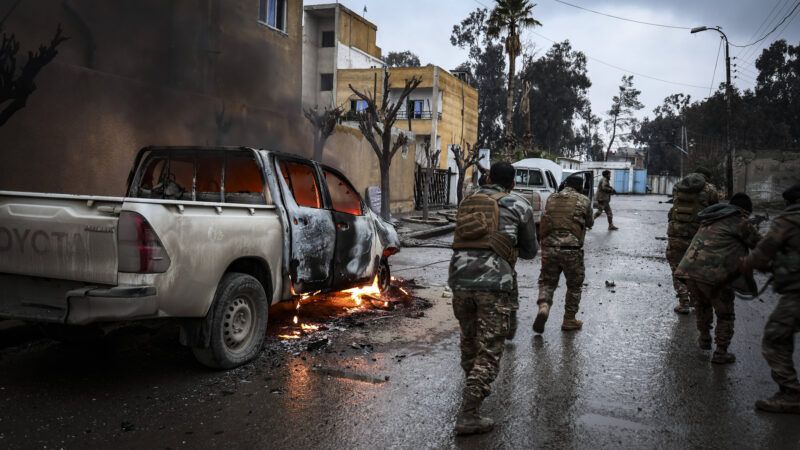
The Kurdish rebels of Rojava, the northeastern region of Syria, promised a type of revolution that had never been done before. Rather than trying to break the country into ethnic states, they would join with their neighbors to decentralize the state from below. And for over a decade, it seemed to work. The Syrian Democratic Forces (SDF) brought together Kurdish, Arab, Assyrian, and other militias in a multiethnic, feminist, anarchist-inspired revolution.
That dream has come crashing down over the past few days. Syrian President Ahmed al-Sharaa, who took over Damascus in the 2024 revolution, launched an offensive against the SDF last week. Arab tribes that had fought alongside the SDF for years suddenly turned on a dime, and the SDF was squeezed back into a handful of Kurdish cities. On Tuesday, the two sides agreed to a four-day ceasefire in order to negotiate the next steps. Whatever comes of it, the experiment in a multiethnic revolution seems to be over.
The U.S. government, whose forces fought alongside the SDF for years, reacted coolly to its fate. Ambassador Tom Barrack, the U.S. envoy to Syria, wrote on social media that "the original purpose of the SDF as the primary anti-ISIS force on the ground has largely expired, as Damascus is now both willing and positioned to take over security responsibilities." He implied that the SDF should submit to al-Sharaa and be less stubborn about preserving "the semi-autonomy the SDF held amid civil war chaos."
If cynical, it wasn't a dishonest or surprising position. The Obama and Trump administrations always described their relationship to the SDF with the phrase temporary, transactional, and tactical. President Donald Trump and his advisers made it clear throughout his first term that they were eager to switch from the SDF to a more expedient partner, such as Turkey, especially as their goals shifted toward fighting Iran in Syria.
While the U.S. wasn't fully committed to the SDF, the SDF had no choice but to follow U.S. priorities. And those priorities may have led to the fatal overextension of the Rojava revolution. Rather than defending Rojava's mixed Kurdish-Arab heartland, the SDF was pushed by U.S. military planners to hunt down the last remnants of the Islamic State group elsewhere in Syria. In conservative, homogeneously Arab places like Deir el-Zour and Raqqa, the SDF was transformed from a revolutionary militia into an occupying army ruling over a hostile population.
The final mistake, however, seems to have come from the SDF's own leadership. When al-Sharaa took power in the December 2024 revolution, many Arabs made it clear that they would rather take their chances with the new government than remain part of the SDF. And al-Sharaa himself set a December 2025 deadline to negotiate a merger between the SDF and the new government. The clock was ticking, and the SDF would have to compromise on some things—particularly its territory—to preserve the core of Rojava. It did not.
Still, many of the revolutionary achievements are likely to outlive the SDF. The Rojava revolution taught a generation of rural Syrian women to bear arms and, more importantly, to participate in political life. It also forced the rest of Syria to reckon with the country's diverse reality. Even al-Sharaa's proposed surrender terms include granting full civil rights to Kurds, recognizing Kurdish as an official language, and declaring the Kurdish new year a national holiday, achievements that would have been impossible two decades ago.
In a 2024 book, sociologist Amy Austin Holmes compared Rojava to the Republic of Mount Ararat, a short-lived Middle Eastern revolution from long ago. Although Mount Ararat fell in 1931, its legacy lived on for decades, partially inspiring the Rojava revolution. When people get a taste for freedom, it tends to linger.