
California Billionaires Are Leaving the State in Response to Proposed Wealth Tax
The wealth tax would discourage investment and likely lower tax revenue for California.
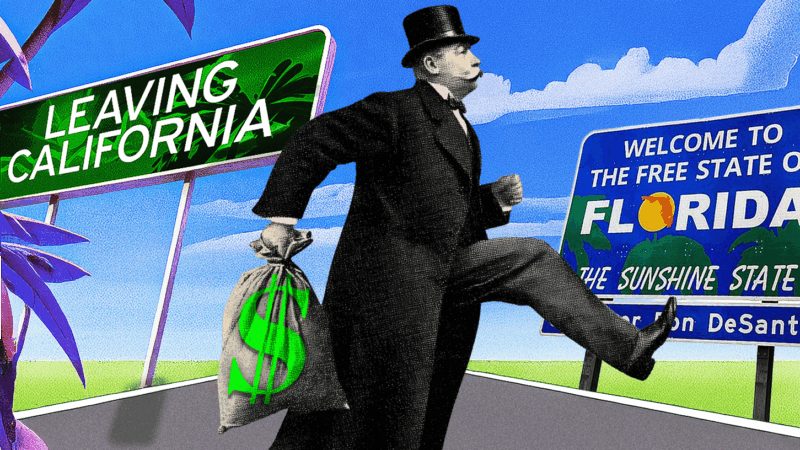
The ultrarich are leaving California as a result of a proposed billionaire tax. "Eat the rich" may be a popular rallying cry, but it's not viable public policy.
The ballot measure, which was submitted in November 2025 by Suzanne Jimenez, a health care union representative, would impose a one-time 5 percent tax on billionaires who were California residents as of the measure's tax "obligation date" of January 1. Even though the initiative has not yet passed, venture capitalist Chamath Palihapitiya estimates that $1 trillion of billionaire wealth "has left California" in advance of the measure's tax obligation date. California billionaires have also taken "income tax revenue, sales tax revenue, real estate tax revenue and all their staffs (and their salaries and income taxes) with them," says Palihapitiya.
The measure would create a Billionaire Tax Health Account, which would receive 90 percent of the revenue generated by the tax. Funds from this account would go "to protect or enhance Medi-Cal," California's Medicaid program. (That same program was found by the Biden administration to have improperly claimed nearly $53 million in federal funding on behalf of noncitizens with ineligible immigration statuses from October 2018 through June 2019.) The remaining 10 percent would go to a new Billionaire Tax Education and Food Assistance Account, which would subsidize public K-12 education, plus two years of community college. This account would also help pay for "CalFresh, CalFAP, CalFood or California's Universal Meals Program for school meals."
The government should not be in the business of redistributing wealth, and a wealth tax is an especially ineffective means of generating revenue for any purpose. Moving costs might make it hard for other individuals and businesses headquartered in California to leave, but billionaires are highly mobile; they can easily become residents of another state by purchasing a house, acquiring a driver's license, and registering to vote there.
California Democratic Gov. Gavin Newsom understands this eventuality. The New York Times reports that Newsom opposes "'state-level wealth taxes' because they encouraged those who would be affected to move to another state." To avert this outcome, Newsom has been "relentlessly working behind the scenes against the proposal" and "he would fight the measure if it reached the November ballot," according to the Times.
The act itself recognizes billionaires' ability to evade taxation: "A large percentage of billionaire wealth is never taxed by the State due to billionaires' unique ability to control the timing, location, and amount of income tax that they pay." This tax avoidance is exactly what has happened since the ballot measure was submitted.
Importantly, the tax conflates voting shares with equity, as Garry Tan, president and CEO of venture capital firm Y Combinator, recently explained on X. This means that under the law, Google co-founders Larry Page and Sergey Brin—who each possess 30 percent of the voting rights in Google, but only own 3 percent of its equity—would have to pay a 5 percent tax on the value of their voting control. Tan estimates that this figure would come to about $60 billion each, and in order to pay this, both Page and Brin would have to liquidate 50 percent of their Google shares. The two co-founders recently fled the state to avoid this potential penalty.
But it's not just Google that would be affected. Palmer Luckey, CEO of defense technology company Anduril, recently predicted that the wealth tax would force billionaires to "'sell huge chunks' of their companies, and to 'immediately pivot into profit [obsession] over mission or long-term sustainability,'" reports Newsweek. In an X post, Luckey said the tax "makes founder-led companies practically illegal"—not something California should do if it's looking to expand its tax base.
The measure requires more than half a million verified signatures by June 25 to qualify for a ballot vote in November. Even if it doesn't pass, it has already prompted the flight of wealthy Californians from the state.