
Iran's Inflation Protests Turned Into an Uprising. Will Trump Get Involved?
The unrest started with a merchants' strike, escalated into a bloody crackdown—and might become an American war.
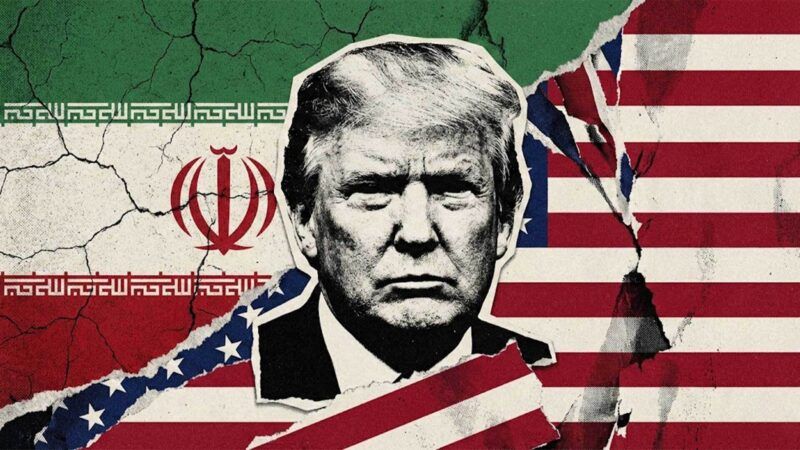
Ayatollah Ruhollah Khomeini, who made Iran an Islamic republic in 1979, famously said that revolution was "not about the price of watermelons." He held economics in contempt as the science of feeding donkeys. As his successor, Ali Khamenei, is learning, people will make a revolution about the price of watermelons. Demonstrations against inflation in late December have become some of the most violent unrest in Iran since the 1979 revolution.
The country has been under a total communications blackout since January 8, but the information that has emerged from Iran indicates that there has been a massive, bloody crackdown. The Human Rights Activists News Agency, a nonprofit in Virginia, has verified 483 civilian deaths and 47 deaths of police and military personnel. On Sunday, Iranian state television broadcast video from a morgue in Tehran overflowing with bodies; authorities claim that the situation is now under control and hosted a progovernment rally in Tehran on Monday.
Meanwhile, President Donald Trump has repeatedly threatened Iran if the government kills protesters. He told reporters on Sunday that "it looks like" his line has been crossed, and that he "might meet" with Iranian negotiators, or that "we may have to act because of what is happening before the meeting." His cabinet is scheduled to meet on Tuesday to discuss options, including war, to support the protesters.
Trump's promise to intervene "encouraged [Iranian authorities] to act much more aggressively and brutally," Johns Hopkins School of Advanced International Studies Professor Vali Nasr said during a panel hosted by the Quincy Institute for Responsible Statecraft, where I used to work. "You just end the protests quickly and take this off the table, so if that's the excuse for intervention, it's not going to be there anymore," he explained, quoting a hypothetical Iranian official.
As the space for political dissent has shrunk in Iran, protests have become more frequent and violent. In 2009, around 72 people were killed in protests by the reformist movement against a contested presidential election. In 2019, the government responded to protests about fuel prices by shutting down the internet, killing at least 321 people, and banning reformists from parliament. In 2022, when Iranians rose up against mandatory hijab laws, the crackdown killed at least 551 people.
This round of protests began with a merchants' strike that was triggered by the Iranian rial hitting a record low against the U.S. dollar. (Unlike many of Iran's self-inflicted economic problems, economist Esfandyar Batmanghelidj pointed out, the currency crisis has been directly caused by U.S. economic sanctions.) In the midst of the protests, the government announced that it would cut billions of dollars from import subsidies—increasing prices in the short term—and instead give citizens an additional $7 per month.
The unrest suddenly escalated in the second week of January. Video evidence from before the communications blackout, compiled by military observer Mark Pyruz, shows that protest sizes ballooned by five times between January 5 and January 7. Then, several Kurdish parties and Reza Pahlavi, the former crown prince exiled in 1979, called for their followers to come out on the night of January 8. At that point, authorities shut down the internet.
It's unclear how much control Pahlavi actually has on the ground. Last summer, after the Israeli war with Iran, he claimed to have recruited 50,000 defectors from the Iranian government online. On Sunday, the former crown prince called on oil workers to go on strike in a video message. There's no evidence that Pahlavi has been able to summon either the defectors or the strikes; on Sunday, he went on Fox News to appeal publicly to Trump, who has refused to meet with him, for help.
Not all of the Iranian opposition agrees with the call for U.S. intervention. "It has to be by the will of the people from within," film director Jafar Panahi, who has been jailed several times in Iran, told Variety. In Los Angeles on Sunday, a protester showed up in a truck draped in signs condemning both the Islamic Republic and a possible U.S. intervention. Other protesters attacked the truck, which plowed through the crowd, injuring two people.
Either way, the decision on whether to intervene is in the hands of neither the Iranian nor the American public. Throughout the past year, Trump has been asserting his authority to start wars by himself, without any kind of mandate from Congress or the public. The final decision—assuming it hasn't been made already—will be made behind closed doors on Tuesday.
"This tyrannical regime needs to end. We need to end this for the good people of Iran, and for ourselves, and for the people of Israel," Sen. Lindsey Graham (R–S.C.) said at a fundraiser on Sunday. "I haven't slept or eaten in three or four days."