
The Trump Administration's Deportation Reels Keep Getting Copyright Strikes for Using Music Without Permission
Without any real consequences for copyright infringements, the Department of Homeland Security doesn't have much incentive to follow the law.
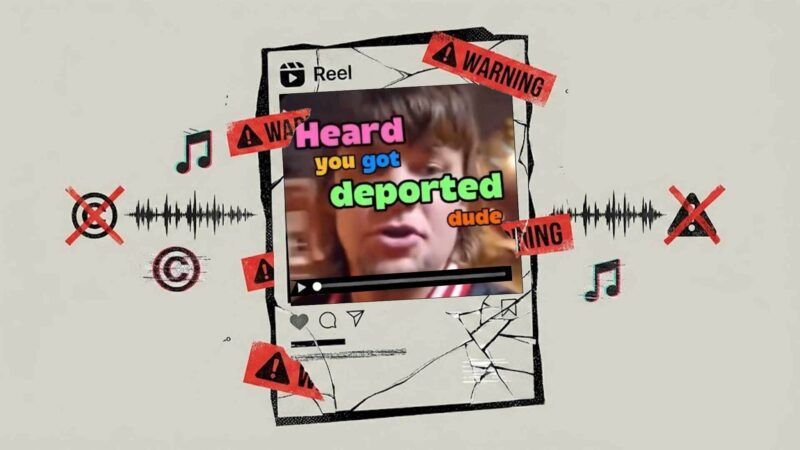
As masked Immigration and Customs Enforcement (ICE) agents deploy to U.S. cities, the Trump administration is also running a social media campaign. Its effort to stay viral online is colliding with copyright law.
Between January 26 and November 10, 2025, the Department of Homeland Security (DHS) posted 487 times on Instagram—more than 28 percent of the agency's total posting since joining the platform in 2014. The posts promote the crackdown by mixing 20th century propaganda with modern memes, and they feature a wide range of popular imagery and audio.
But not all the content they use has been licensed—or welcomed. Several creators have pushed back on the unauthorized use of their copyright-protected work.
In July, the band Black Rebel Motorcycle Club blasted DHS for using its rendition of "God's Gonna Cut You Down" without permission in a since-removed video featuring DHS Secretary Kristi Noem. "It's obvious that you don't respect Copyright Law and Artist Rights any more than you respect Habeas Corpus and Due Process rights," the band said in a post on X.
Singer Kenny Loggins requested that his song "Danger Zone" be removed from an AI video Donald Trump posted on Truth Social depicting the president dumping feces on protesters from a fighter jet. Songs by MGMT, Jay-Z, and Tom Petty were likewise removed after the artists or their estates condemned the unauthorized use. Olivia Rodrigo also called out DHS for using her song "all-american bitch" in a video encouraging self-deportation. Rodrigo, whose father is Filipino, commented, "Don't ever use my songs to promote your racist, hateful propaganda."
DHS' unauthorized use of copyright protected work extends beyond music. Over the summer, the White House used audio from British airline Jet2.com without the company's endorsement.
In September 2025, comedian Theo Von objected to DHS using his voice in a video. "I didn't approve to be used in this," Von wrote in a comment to the video. "I know you know my address so send a check." He requested the video be removed, saying that his views on immigration are "more nuanced than this video allows."
The department also used the Pokémon theme song and visuals in an unauthorized promotional video, comparing undocumented immigrants to fictional creatures that are caught for sport, and posted an image from the video game Halo, likening undocumented immigrants to a parasitic infection. When asked about the pushback from the game's creators, a DHS spokesperson told journalist Alyssa Mercante, "We will reach people where they are with content they can relate to and understand, whether that be Halo, Pokémon, Lord of the Rings, or any other medium."
DHS is bound by copyright law, as Congress waived the federal government's sovereign immunity from copyright infringement. While the agency might claim the posts qualify as "fair use"—which permits limited use of copyrighted material without permission for reasons such as criticism, commentary, and news reporting—promotional material and recruitment advertisements would likely be considered commercial use, requiring copyright holder permission.
Although this "ask for forgiveness, not permission" approach risks lawsuits, the Trump administration—under a notoriously litigious president—seems to be willing to roll the dice. So far it's working. Despite many notable copyright strikes on social media platforms this year, no lawsuits have been filed against DHS or the Trump administration for any recent copyright infringements.
Even if the Trump administration were taken to court, it isn't clear that a loss would stop the offending posts. Successful plaintiffs cannot compel the federal government to stop or remove infringing material. They can only demand that the artists receive "reasonable and entire compensation," including monetary damages and lost profits associated with the infringement. Litigation may make sense when copyright holders can prove they've suffered large monetary losses from the government's infringement, but litigation is not an effective way to stop future use of unauthorized content.
Rather than spend time and money acquiring approval for its use of copyrighted work, DHS can simply shrug off instances where creators object. Without any real consequences for copyright infringements, DHS simply doesn't have much incentive to follow the law. Under Trump, DHS flouts copyright law with impunity. Ironic, given the whole premise of its propaganda push is that it's restoring the rule of law to the immigration system.