
A Bipartisan Push to Revive a 1930s Law Could Make Grocery Prices Even Higher
If the government revives the Robinson-Patman Act to force suppliers into charging small and large retailers the same price for vastly different quantities of the same product, that will mean higher prices.
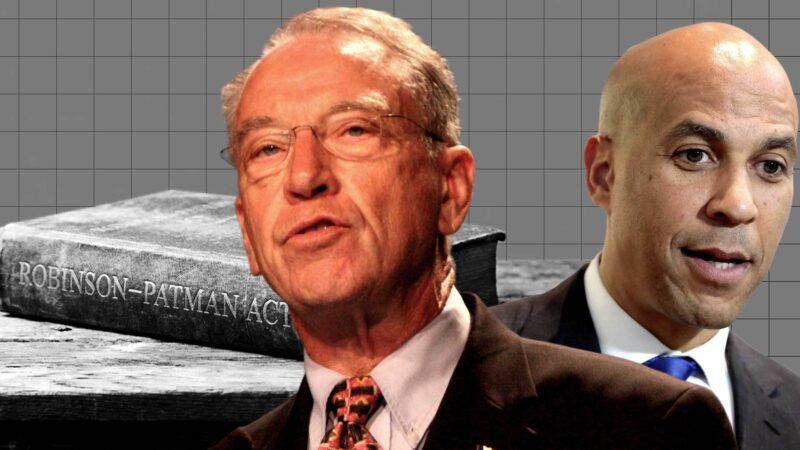
Groceries, like almost everything these days, are seeing prices rise. Millions of Americans have tempered some of these hikes by purchasing bulk goods at wholesale prices at warehouse club retail stores such as Costco, Sam's Club, and BJ's Wholesale Club. But these savings could soon cease. A bipartisan coalition of lawmakers is looking to crack down on wholesale prices by reviving a nearly 90-year-old antitrust statute.
In the weeks leading up to Congress' winter recess, Sen. Chuck Grassley (R–Iowa) solicited the signatures of fellow Senate Republicans on a letter to Attorney General Pam Bondi and Federal Trade Commission (FTC) Chairman Andrew Ferguson asking them to investigate supply practices that hurt small businesses, particularly grocers. Reason has acquired a copy of the letter, which calls on Bondi and Ferguson "to utilize all federal laws…to bring enforcement actions against any discriminatory conduct that you may discover in violation of…the Robinson-Patman Act."
The Robinson-Patman Act (RPA) is a 1936 antitrust law that bans discrimination "in price between different purchasers of commodities of like grade and quality…where the effect of such discrimination may…tend to create a monopoly in any line of commerce." After a period of strong enforcement in the mid-20th century, recent decades have witnessed a marked decline in federal RPA cases: Before the FTC, under the leadership of Chairwoman Lina Kahn, sued Southern Glazer's Wine and Spirits for selling alcohol to larger retailers at lower per-unit prices in December 2024, it had been more than 20 years since the federal government filed an RPA suit. Then–FTC Commissioner Melissa Holyoak dissented from Khan's complaint, which she characterized as "elevating the interests of competitors over competition" in a way that was "at odds with the plain text" of the RPA.
Grassley argues that the statute recognizes certain forms of price discrimination as harming competition, but he doesn't acknowledge that the RPA allows price differentials that reflect "differences in the cost of manufacture, sale, or delivery resulting from the differing methods or quantities in which such commodities are to such purchasers sold or delivered."
Grassley claims that a lack of competition is forcing independent grocers "to accept increasingly discriminatory terms and conditions for their products, including less favorable…price terms"—even as he rightly describes the grocery business as "experienc[ing] high turnover and low margins." Such phenomena are textbook indicators of a competitive industry, not a monopolized one.
Grassley also claims that "independent businesses are often the only source of groceries, consumer goods, or pharmaceuticals in many small towns and urban centers." If this were true, such small businesses needn't worry about larger firms receiving bulk price discounts; they wouldn't be competing with them at all.
Of course, the opposite is true. Local businesses face intense competition from Amazon, Walmart, Target, FreshDirect, CVS, Walgreens, and the myriad other firms that ship groceries, goods, and drugs directly to consumers. These large firms enjoy bulk discounts and attract customers by passing on part of their savings to them in the form of lower prices.
Unfortunately, Grassley is not the only official looking to leverage the RPA to punish productive firms and consumers. On Thursday, December 18, Sen. Cory Booker (D–N.J.) introduced the Fair Competition for Small Business Act of 2025, which would amend the RPA to "allow state attorneys general to pursue monetary damages against distributors and retailers that engage in unlawful price discrimination." Rep. Maxine Waters (D–Calif.) has introduced companion legislation in the House.
Grocery prices are high. Cracking down on wholesale pricing won't fix this problem, it will exacerbate it.