
Department of Homeland Security
Trump Is Using the 'Misinformation' Censorship Playbook Republicans Attacked Biden For
The party in power changes. The pressure to silence critics doesn’t.
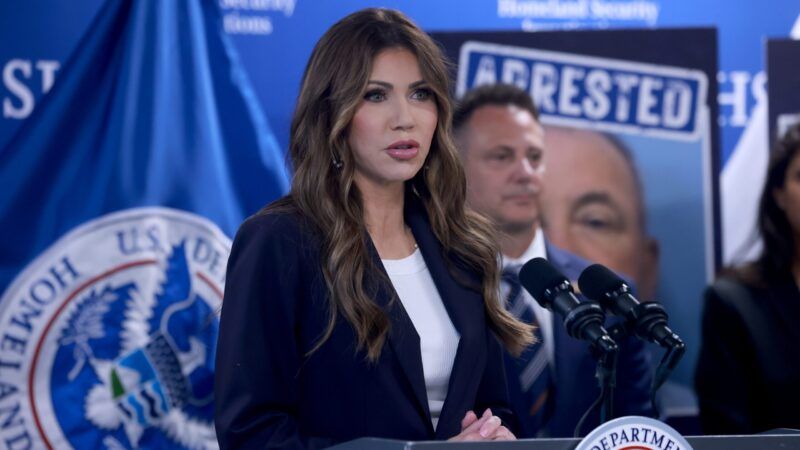
A Department of Homeland Security (DHS) spokesperson recently complained about alleged "lies, smears and AI deepfakes that are designed to deceive Americans" about President Donald Trump's immigration agenda. Pressed on whether the government was talking with social media platforms to stem this purported misinformation, the spokesperson said, "Yes and we are also putting resources forward to ensure DHS combats this."
It wasn't so long ago that candidate Trump and his Republican allies were decrying the Joe Biden administration for pressuring platforms to police misinformation. The Trump administration seems to have warmed to the idea.
Many on the left, who previously supported giving the government greater power to combat so-called misinformation, are and should rightly be fearful of a Trump administration empowered to censor speech it disagrees with.
The DHS announcement signals a deeper shift toward government-driven moderation of online speech—a shift that threatens to turn every administration into a speech arbiter. The power to dictate what can be said on the internet is inherently prone to abuse, no matter who holds it. The stakes are high.
Jawboning for Me but Not for Thee
Under the First Amendment, federal and state governments cannot censor speech they dislike, so instead of blatantly shutting down a news organization or online platform, government actors often try to force a company to do their bidding through more subtle means. These demands often happen behind closed doors, backed by an implicit—or sometimes explicit—threat that refusal will bring government retaliation. Because the government wields so much power over businesses, these companies understand they are in a weak position to resist. This practice is called "jawboning."
When the Biden administration made public and private demands that social media companies remove "misinformation" and "disinformation" related to the COVID-19 pandemic, it ended up at the Supreme Court in Murthy v. Missouri. The Court ultimately punted by ruling that individual social media users who claimed their speech was suppressed lacked standing to sue.
This was disappointing. Internal emails from various social media companies showed that senior leaders felt they had no choice but to comply with the administration. Meta's leaders internally said that they needed to change policy because they had "bigger fish to fry with the Administration." YouTube claimed it needed to keep Biden officials happy since they wanted to "work closely with the administration on multiple policy fronts." Amazon moved to "accelerate" its policy changes ahead of a call with Biden officials. Thankfully, the Supreme Court did at least uphold the principle that jawboning is wrong and unconstitutional in another case, NRA v. Vullo.
Today, the Trump administration appears to be invoking Murthy as cover for its own pressure campaigns against online platforms. Apple removed an app that allowed users to report sightings of Immigration and Customs Enforcement (ICE) officers in real time. After complaints from Attorney General Pam Bondi, Meta removed a Facebook group that shared information about ICE agents. Now, the DHS says it is communicating with social media companies about supposed immigration misinformation. It would be naive to suppose it hasn't applied any pressure during those talks.
It is entirely possible that the government can point to specific acts of illegality. It's also possible that some of this content violates platform policies. For example, Meta claimed it removed the Facebook page with information on ICE agents for violating its "policies against coordinated harm." It is possible this group was persistently violating this policy. But as long as these companies remain vulnerable to government pressure, we cannot simply trust officials who insist their demands are legitimate.
Shining a Light on Government Communications
One of the most powerful elements of jawboning is its secretive nature. We don't know exactly what the government said to these companies, and implicit threats are powerful because companies can't point to specific wrongdoing. When government officials make more explicit and public threats, it is easier to stand against them. When Federal Communications Commission Chairman Brendan Carr argued for repercussions against Jimmy Kimmel for his statements following the murder of Charlie Kirk, his "we can do this the easy way or the hard way" line made the coercion unmistakable and sparked widespread outrage.
But when those conversations happen out of public view, there is no way to know whether officials are making lawful requests—or leaning on companies to censor protected speech.
The solution is greater transparency into government communications with platforms. In most cases, there is no reason why we should not know what the government is saying to private companies about issues of online speech. All government agents should be required to report any requests, suggestions, or encouragement to suppress or moderate speech. This could be compiled and maintained in a public database by the Office of Management and Budget. Existing provisions for protecting privacy or national security, such as those in the Freedom of Information Act, can allow the government to redact or protect truly sensitive information.
Such a requirement would immediately discourage jawboning by forcing officials to operate in the open. And when they step over the line, there would finally be a public record to support legal action. It wouldn't matter which party is in power: Such transparency could help keep the government's censorial ambitions in check.
Government Cannot Be Trusted To Regulate Misinformation
No government should be empowered to police misinformation. The current battle over immigration enforcement no doubt includes falsehoods and misleading statements from both sides. Actors across the political divide have spread misleading claims and embraced narratives that fit their worldview.
This is nothing new. COVID-19 misinformation also split down partisan lines, with the right spreading conspiracies about vaccine dangers and the left exaggerating the virus's threat to justify sweeping restrictions. This included support for the idea that the government should have the power to regulate online speech to combat COVID-19 misinformation.
Those on the right were correct to be concerned with the administration attempting to adjudicate what was and was not COVID-19 misinformation. Because the government used its power to police information, claims now considered plausible—from the virus's origins to the harms of school closures—were silenced.
Now, those on the left are alarmed to see those same powers invoked by a president they oppose. The Trump administration views content that opposes its immigration actions as dangerous misinformation. It is free to argue its case—but not to coerce platforms into enforcing its views. Transparency about government contacts with platforms is essential to prevent secret censorship, and more speech—not enforced silence—is how we resolve disagreements in a free society.