
Bill de Blasio's Diversity Push for These Schools Lowered Admissions Standards—and Didn't Increase Diversity
New data display the failures of the expanded Discovery Program.
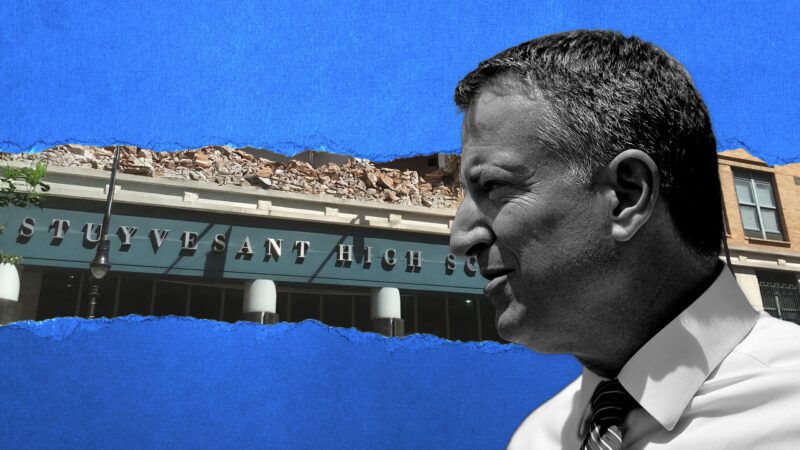
New York City's eight specialized public high schools have exemplified American meritocracy for over a century. Through an admissions process that relies solely on the Specialized High School Admissions Test (SHSAT), which cuts through the noise of privilege to home in on raw intellectual potential, students from all five boroughs have a chance to attend these elite institutions, regardless of socioeconomic status. But the meritocracy of these schools has been waning.
In 2018, then-Mayor Bill de Blasio lambasted the specialized high schools, which are largely attended by white and Asian students, for having a "diversity problem." He blamed the SHSAT. De Blasio initially attempted to eliminate the test entirely, but the state Legislature stopped him. So in the fall of 2019, he expanded the Discovery Program, which fills the remaining seats at these schools with students who missed the SHSAT cutoff score of the city's least competitive specialized high school.
In the six years since, the program has failed to achieve any of its goals. Newly released data reveal that admissions criteria have been markedly weakened, while their racial demographics remain virtually unchanged.
In November, the city responded to Reason's September 2024 Freedom of Information Law (FOIL) request for the scaled SHSAT scores of students admitted to the city's specialized high schools through the standard process and via the Discovery Program. Reason requested data going back to 2014 to establish a longer pre-trend, but the city refused to furnish SHSAT statistics for Discovery Program students before 2018 because "this portion of the request would involve more than a simple extraction of data from a single computer storage system." (Reason is in the process of submitting further FOIL requests to acquire these and other data.)
The data we do have show that admissions standards at Stuyvesant High School, the city's most competitive specialized high school, were substantially lowered following the program's expansion.
To make matters worse, de Blasio publicly misrepresented how the Discovery Program works. He said the expanded Discovery Program will "offer 20 percent of specialized high school seats to…students who just missed the test cut-off"(emphasis added). Those unfamiliar with the Discovery Program reasonably conclude that "the test cut-off" refers to the cutoff for the particular school to which a Discovery applicant is admitted, but this is not the case.
In the fall of 2018, the 20 students admitted to Stuyvesant via the Discovery Program all got a scaled score of 481, "just missing" the 482 cut-off for The Brooklyn Latin School—the least competitive of the specialized high schools—and missing regular admission to Stuyvesant by 78 points. In the fall of 2020, a year after the Discovery Program's expansion, over 150 students were admitted to Stuyvesant. As the number of students admitted via the Discovery Program grew, the disparity between the minimum scaled SHSAT score for Discovery and regularly admitted students grew to 100 points.
The program has even failed to achieve its racially motivated objective. When NYC Education Department Chancellor Richard Carranza and de Blasio announced their plan to "improve diversity at specialized high schools" in June 2018, they predicted that the expanded Discovery Program would result in "an estimated 16 percent of offers [going] to black and Latino students."
In fall 2018, a year before the Discovery Program's expansion, only 6 percent and 4 percent of admitted students were Hispanic or black, despite making up 23 percent and 20 percent of test-takers, according to official statistics. This fall, the combined percentage of Hispanic and black admissions remains at 10 percent. The story is the same at Stuyvesant: In fall 2018, about 3 percent of admitted students were Hispanic, and only 1.1 percent were black. Flash forward to this fall, and the combined percentage of Hispanic and black admissions decreased to 3.5 percent.
In September 2024, the 2nd Circuit Court of Appeals ruled that an aggregate disparate impact on Asian-American test-takers is unnecessary to establish an Equal Protection Claim under the 14th Amendment if the Discovery Program was expanded with discriminatory intent. Considering de Blasio and Carranza explicitly emphasized the intended racial effect of the program's expansion, it is hard to imagine what argument defendants can mount.
Unfortunately for New Yorkers, the expanded Discovery Program will likely continue under incoming Mayor Zohran Mamdani. Although Mamdani withdrew his call to abolish the SHSAT this August, he has said nothing about rolling back the expanded Discovery Program. Considering he's vowed to eliminate the gifted and talented program for kindergartners, it's unlikely he will end de Blasio's subversion of the specialized high schools' academic excellence.
In its six years, the only "success" the expanded Discovery Program can claim is undermining meritocracy and greatly increasing the number of unqualified students at some of the country's best high schools.