
New Yorkers Don't Compost. Will They Be Fined Into Compliance?
The city mandates composting, but New Yorkers don’t like to be told what to do with their garbage—and don't seem all that clear on the rules in the first place.
Most New Yorkers are lawbreakers and don't even know it.
New York City requires residents to separate certain sorts of food scraps from the rest of their trash. Composting diverts waste from landfills, creates nutrient-rich soil, and helps the environment by reducing greenhouse gases. When food scraps are buried in a landfill, they decompose without access to oxygen, causing the release of methane. Composting lets rotten food breathe and reduces methane emissions. In New York City, composting is also supposed to save money by reducing the amount of trash that the city hauls to landfills and incinerators, many of which are out of state.
The city's older, voluntary residential curbside composting initiative started as a pilot program 13 years ago under Mayor Michael Bloomberg. In his 2013 State of the City address, he declared that he would "tackle New York City's final recycling frontier, and that is food waste." Mayor Bill de Blasio wanted to expand the program, but in 2018 that was put on hold due to exploding costs and low participation rates.
Around this time, according to the Citizens Budget Commission (CBC), the city was spending an estimated $1,700 per ton to collect organics compared to $291 per ton of regular trash, as special composting trucks were carrying relatively little waste. The CBC also reported that in participating neighborhoods, almost 90 percent of organic material was still going in the regular trash in 2017. During the pandemic, budget constraints forced the sanitation department to pause compost pickups altogether.
The city made composting mandatory in late 2024, under Mayor Eric Adams. Since then, residents have had to separate eggshells, orange peels, and other food scraps from regular trash and dispose of these organic materials in composting bins. In April 2025, the city began issuing fines of up to $300 to property owners who failed to comply. The city paused fines for most violators a few weeks later, on the grounds that New Yorkers needed more time to learn what to do. Now, under Mayor Zohran Mamdani, the composting enforcement fines are back.
With all this confusion, it's hardly surprising that New Yorkers are not great composters. According to the New York City Independent Budget Office (IBO), "Organic waste—food scraps, yard waste, and other compostable materials—make up roughly 36% of the City's residential waste stream, yet organics collections were 2.4% of residential waste collected in [fiscal year] 2025." In other words, New Yorkers separated only about 7 percent of their organic waste from the regular trash during the first nine months of the citywide composting program. A recent report from the city government says that the amount of all organics separated from the rest of the trash increased by 25 percent in fiscal year 2026. Given the already low levels of compliance, the figures are still not encouraging.
It's unclear exactly how much the city is spending on this largely ignored program. A spokesperson for the Sanitation Department told Reason, "It is difficult to put a number on it, since composting is integrated with so much of [the department's] other work, but for personnel and processing, the city budget includes baselined funding for 299 uniform positions at a recurring cost of $33.4M a year for curbside organics collection."
Still, some have tried to estimate how much the city would need to compost to make the program cost-effective. Samantha MacBride, a former director of research and operations at the sanitation department, has estimated that the city would need to sort out about 30 percent of its organic waste.
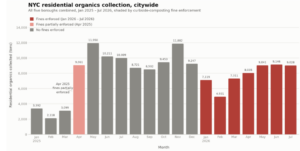
The Mamdani administration attempted to increase compliance by reinstating fines at the beginning of this year. Buildings face tickets of up to $300 for failing to compost or composting improperly, but the fines haven't had much impact. According to data from the city's sanitation department, there was a brief jump in the amount of organic waste collected after Adams instituted fines in April 2025. But oddly, the monthly tonnage collected in May, June, and July of 2025 (when fines were not being enforced) was higher than in May, June, and July of 2026 (when fines were in effect).
Suppose all residents complied with the composting mandate. Would the city even be able to process all that waste? Absolutely not.
As of 2025, the city can handle only about 400,000 tons of organic waste per year. That organic waste goes either to traditional composting facilities or to anaerobic digesters, which turn waste into energy. Based on the IBO's estimate that 36 percent of residential waste is compostable, New York residents produce around 1.1 million tons of compostable organic waste per year.
The city's composting and digesting facilities would hit capacity if New Yorkers put barely more than a third of their organic waste into brown bins. Not that the city is close to that level of compliance. Right now, it's still trying to tell New Yorkers the mandate even exists.
In one amusing effort to alert citizens about composting, the city launched a Sex and the City marketing campaign funded by a grant from the Environmental Protection Agency. The ad features the composting mascot "Scrappy" on the side of NYC buses and urges residents to call 3-1-1 if their buildings aren't complying with the rules.
Reason asked several New Yorkers whether they understood this ad. Overwhelmingly, they did not.
One might think this PSA would at least inspire Carrie Bradshaw wannabes in Manhattan to compost, but no. Manhattanites actually tend to be the worst composters. This may be due to living in cramped apartments and large apartment buildings. The borough with the highest composting rate is actually Staten Island, the city's Republican stronghold, where many residents live in single-family homes.
Steven Cohen, who used to run Columbia University's Earth Institute, is skeptical that the program will ever achieve 100 percent compliance. He believes composting is a worthwhile endeavor, but as he told Reason, "It takes a lot to change people's habits." That's why he has proposed an alternative to relying on individuals to sort their trash: AI.
Ideally, he says, a mixed stream of garbage could go to "essentially a waste mining facility where artificial intelligence and robotics will do the separation for us and try to extract the value out of the waste stream." Instead of paying to send garbage to landfills, he says, we could extract, process, and sell the valuable mineral resources in the waste stream. Some places, such as Portsmouth, Virginia, have begun experimenting with AI trash sorting, but the technology is still in its early stages.
And for now, New York City seems determined to keep its mandatory composting program going with fines and confusing reminders from Scrappy.
Photo Credits: MEGA / Dennis Rees / MEGA / Newscom/DRSTA/Newscom; John Marshall Mantel/ZUMAPRESS/Newscom; RICHARD B. LEVINE/Newscom: Rafael Ben-Ari/Chameleons Eye/Newscom
Music Credits: "Sneaky Tactics" by Ilona Harpaz via Artlist; "Gentle Persuasion" by Matt Evans via Artlist; "Second Smile" by LMOP via Artlist; "Catch Me" by Ty Simon via Artlist; "The Microwave Dance" by Semo via Artlist