
How Many 'Ghost Apartments' Are There in New York City?
Mayor Zohran Mamdani says there are only a few thousand vacant, unrentable, rent-stabilized units. Landlords say it's many times that.
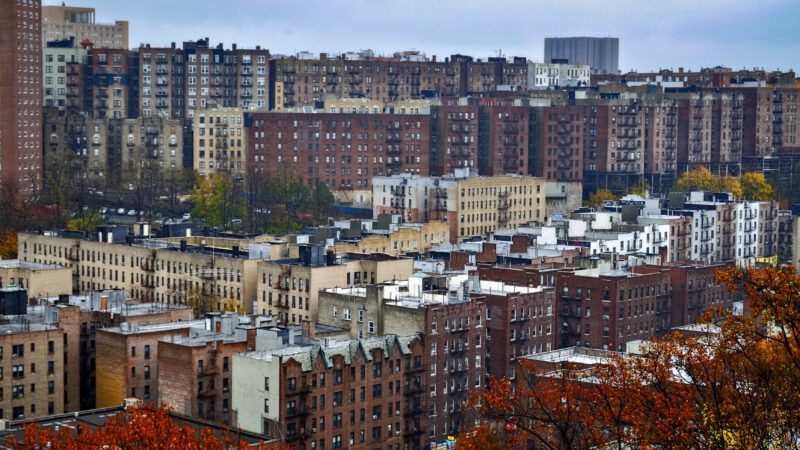
The most visible sign of the damage caused by New York's rent stabilization law is the so-called "ghost apartments": vacant, dilapidated units where the legal rents are so low that the owners can't afford to repair them and put them back on the market.
The perennial debate is not whether ghost apartments are real, but how many there are.
Property owners argue that the tightening of the state's rent control law in 2019 has created tens of thousands of these ghost apartments in New York City, and their number is growing year over year.
Rent Free Newsletter by Christian Britschgi. Get more of Christian's urban regulation, development, and zoning coverage.
A lawsuit filed last year by several city landlords argues that the existence of ghost apartments serves as proof that New York's rent caps on vacant units are an uncompensated (and therefore unconstitutional) taking of their property.
Mayor Zohran Mamdani, in a recent New York Times event with Andrew Ross Sorkin, put the number of unrentable vacant apartments (which he considered those that had been vacant for five or more years) at around 6,000.
Saying otherwise was "dangerous," contended the mayor.
"In the midst of a housing supply crisis in our city, the mayor chooses to evade the question and the real problem: Units sit empty for years because of bad policy," countered Kenny Burgos, CEO of the New York Apartment Association, in a statement provided to Reason.
Theoretically, the state Division of Housing and Community Renewal (DHCR), to which landlords have to report the occupancy status of their rent-stabilized units by April 1, should be able to clear up this confusion.
These figures provide a snapshot of the vacancy rate for rent-stabilized apartments. But a data dump by the DHCR last week provided little extra clarity on the real number of "ghost apartments."
The latest DHCR analysis shows that of the 1,086,000 rent-stabilized apartments in the New York City area, 58,200 were registered vacant in 2026. Another 32,000 were registered as "temporarily exempt," meaning they are occupied by an owner, a building superintendent, or are being used for a nonresidential purpose.
Last year's vacancy numbers were also revised upward from 57,000 to 60,000.
Roughly a fifth of these vacancies were from apartments registered this year, The New York Times reports. A state official told the Times that any increase in vacancies is largely driven by newly constructed rent-stabilized apartments that have yet to be leased out.
(Typically, rent stabilization covers units built before 1974. New units can fall under rent stabilization if they were financed using certain tax credits, state subsidies, or are income-restricted units in buildings that benefited from recent upzonings.)
The remaining vacant apartments are a mix of units that are still on the market but not currently occupied and the aforementioned ghost apartments that are in such bad physical condition that they can't be rented out.
The archetypal ghost apartment is a unit in an older building that was occupied by a single tenant for a long time.
Under both the pre- and post-2019 rent stabilization law, rents on occupied rent-stabilized units could generally only rise by the annual rent increases allowed by the city's Rent Guidelines Board (RGB). (These increases are typically a few percentage points. This year, the RGB, a majority of whose members were selected by Mamdani, froze annual rent increases.)
A long-term tenancy therefore means that rents have been kept low for potentially decades.
Because these buildings are old, their maintenance needs are also very high. Additionally, the 2019 law eliminated landlords' ability to claim higher rent increases when a unit became vacant. It also strictly limited the rent increases that landlords could claim for unit repairs.
Critics of the 2019 rent law argue that ghost apartments are what result from older, long-occupied units with low legal rents and high maintenance needs hitting the market. Landlords can't finance their repairs, so they sit empty.
Ghost apartment skeptics point to the fact that the latest DHCR numbers show the share of older vacant units holding flat over the past couple of years. The number of older vacant units has also only increased by a few thousand since the 2019 rent law went into effect.
Per the Times' parsing of the data, there are 27,000 vacant rent-stabilized apartments that were registered as rent-stabilized before 1990. That is an increase from 21,000 vacant pre-1990 apartments in 2019.
On its face, that doesn't appear to be a massive increase in unrentable ghost apartments.
But looking only at the change in the raw numbers of older vacant apartments is a crude measure. So is lumping all pre-1990 apartments into the same category, as the DHCR data does.
It would still miss major changes in the composition of older vacant units. It's possible the vacancy rate for relatively higher-rent, higher-quality units that entered rent stabilization in the 1980s fell while the vacancy rate for pre-1974 units rose. That would suggest an increase in ghost apartments, even if the top-line vacancy numbers were not increasing year over year.
The top-line vacancy rate is almost certainly higher than what DHCR reports. Per a 2024 memo from the Rent Guidelines Board, 110,000 rent-stabilized units lacked lease information or the lease information contained errors.
These units are counted as occupied units in the numbers that DHCR reports, even though the lack of lease information could indicate vacancy. If even some of these units are vacant, the vacancy rate would be higher, as all are currently counted as occupied.
Even if one accepts the overall rent-stabilized vacancy rate as roughly accurate, that would still signal serious distress in the rent-stabilized sector.
If a good is priced at a below-market rate, one should expect a shortage of it. The lower price attracts more buyers than producers are willing to supply at the discounted price. One would therefore expect the vacancy rate for rent-stabilized units to be lower than the vacancy rate for market-rate units.
The last citywide vacancy survey conducted in 2023 put the city's overall vacancy rate at 1.41 percent, and the rent-stabilized vacancy rate at less than 1 percent. Per the latest DHCR numbers, it's now about 6 percent.
In other words, the cheapest apartments in New York are also the least occupied. In an incredibly expensive market, that's telling, and suggests serious problems with the quality of these units. Otherwise, why would they not be moving at the steeply discounted price?
(The only other, not necessarily mutually exclusive explanation is that many vacant rent-stabilized units are also income-restricted units where the income-eligibility requirements impede the ability of landlords to rent them out to qualifying tenants.)
Even if these units aren't "ghost apartments" by Mamdani's definition, they're still, for all intents and purposes, off the market. And that's a problem.