
Wives for Sale, Poisoned Husbands, and 12-Year-Old Brides: The Grim Reality of Preindustrial Marriage
“Traditional” marriage was rarely about love and more about who happened to be around.
Preindustrial marriage was not the fairy tale that many people imagine. Some assume that in the villages of yore, life was simpler, love and marriage came easily, and most of our ancestors lived happily ever after in contented, wedded bliss. In reality, limited partner choices, widely tolerated domestic abuse, and frequent early deaths meant marriage was fraught with challenges. In short, marriage wasn't always happily ever after.
People in the past faced few options when it came to marriage. The number of potential partners in one's tiny village was low—the few available choices might all be one's cousins, increasing the risk of birth defects in any resulting children.
Peasants typically married within their own villages, which were so insular that local dialects often proved unintelligible to people living just a few miles away. Travel was rarer, and communities were more secluded than a modern person can easily envision. As William Manchester evocatively put it in his book A World Lit Only by Fire, "Each hamlet was inbred, isolated, unaware of the world beyond the most familiar local landmark: a creek, or mill, or tall tree scarred by lightning." People typically gathered and socialized at a much smaller scale than the modern mind can fathom: The largest crowd recorded in 17th century England, the army that fought at Marston Moor, would easily fit five times over in a modern sports stadium. By the 18th century, little had changed, and the majority of villagers married people living within 10 miles of themselves.
The tiny pool of possible marriage partners often produced matches that might raise eyebrows today, such as blood relatives and couples with large age gaps. As Kirstin Olsen wrote in the book Daily Life in 18th-Century England, "A husband 10 or 15 years older than his bride would arouse little comment," for such relationships were common.

Given the highly limited pool of marriage partner choices, perhaps it is unsurprising that many people seemingly settled for spouses ill-suited to them. Olsen wrote that "much of the satirical literature of the 18th century…lampooned marriage as a hell or prison sentence for one or both partners. The most typical attitude toward marriage evinced in 18th century literature and visual art is a sly, collegial misery." The poem "Wedlock" by the Englishwoman Mehetabel Wesley Wright (1697–1750), herself pressured into a loveless marriage with a plumber, paints a typical picture:
Thou source of discord, pain and care,
Thou sure forerunner of despair,
Thou scorpion with a double face,
Thou lawful plague of human race,
Thou bane of freedom, ease and mirth,
Thou serpent which the angels fly,
Thou monster whom the beasts defy,
Whom wily Jesuits sneer at too;
And Satan (let him have his due)
Was never so confirmed a dunce
To risk damnation more than once.
That wretch, if such a wretch there be,
Who hopes for happiness from thee,
May search successfully as well
For truth in whores and ease in hell.
The Flemish poet and nun Anna Bijns (1493–1575) similarly advised other women to avoid marriage in her poem "Happy the Woman Without a Man." She wrote that a newlywed wife becomes "sorry and sad within a single year" as her husband gets drunk, beats her, cheats on her, and "consider[s] her a slave, that's all."
Men were also often unhappy in marriage. In 1682, an anonymous writer urged men to avoid the institution:
Husband! Thou Dull unpittied Miscreant
Wedded to Noise, to Misery, and Want;
…
Marry'd! O Hell and Furies! Name it not,
…
Begot in Hell to Prosecute Mankind.
'Tis the Destroyer of Our Peace and Health,
Mispender of our precious Time and Wealth;
The Enemy to Wit, Valour, Mirth, all
That we can Virtuous, Good, or Pleasant call.
By Day 'tis nothing but an endless Noise;
By Night the Eccho of Forgotten Joys:
Ye Gods! that Man by his own Slavish Law,
Should on himself such Inconvenience draw
…
And if thou'rt still Unmarry'd, thou art safe.
with whores thou can'st but venture, what is lost
May be Redeem'd again with Care and Cost;
But a Damn'd Wife, Inevitable Fate,
Destroys, Soul, Body, Credit, and Estates.
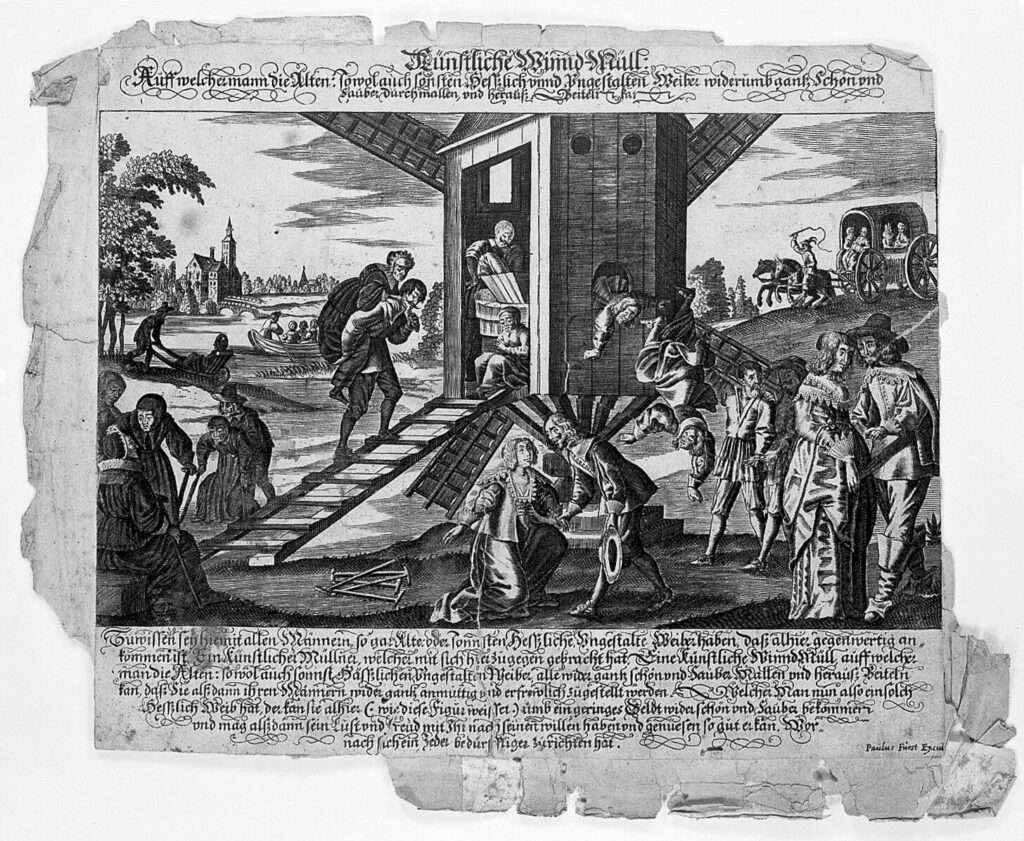
Disdain for one's wife was common, and many men were dissatisfied with their wives' appearance, lack of faithfulness, drinking habits, and temperaments. Emily Cockayne points out that "a curious little work of 1672 illustrated a misogynistic fantasy. It described a Dutch invention to help all unhappy husbands: a windmill to reform bad wives." The illustration depicts ugly, frowning women entering the mill, led by their husbands, and beautiful, smiling women exiting the contraption. An accompanying description claims that the mill can transform "all sorts of women, as the old, decreped, wrinkled, blear-ey'd, long-nosed, blind, lame, scolds, jealous, angry, poor, drunkerds, whores, sluts; or all others whatsoever. They shall come out of [the] mill, young, active, pleasant, handsome, wise, loving, vertuous and rich."
Widespread antipathy toward one's spouse also found expression in distasteful jokes, such as the following from The Spirit of English Wit:
To "a gentleman in the country, whose wife had the misfortune to hang herself on an apple-tree, a neighbour came in, and begged he would give him a cyon [scion] of that tree, that he might graft it upon one in his own orchard; 'for who knows,' said he, 'but it may bear the same fruit?'"
Not Your Grandparents' 'Traditional' Marriage
Those who imagine that the people of the past unfailingly adhered to stricter standards of sexual restraint and chastity might be alarmed at the frequency of shotgun marriages: A third of all brides were already pregnant at their weddings. Moreover, in England, one historian has suggested that in the 17th century, only about half of those regarded as married were actually married according to canon law (i.e., the ecclesiastical legal system). Many couples forwent a formal wedding and simply moved in together; they were treated as married under common law.
Although shotgun and informal marriages were frequent, marriages often ended in a less-than-ideal manner as well, typically with the untimely death of the husband or wife. Life in 17th century Europe was so fraught with disease, war, and accidents that most marriages ended with a spouse's early death, making remarriage and blended families far more common in the preindustrial past than today, despite what many might assume. Indeed, because life expectancy was low, couples who married in their mid- to late 20s typically had fewer than 20 years together before death ended their union. There often was no lengthy mourning period between a spouse's death and remarriage. In England, up to one-third of widows remarried, and half of them did so within a year of their husbands' passing.
The devastation wrought by the death of a spouse was worsened by sexist inheritance laws. Widows were often dependent on the sons who inherited their husbands' property for support.
Even during wedding celebrations, death was never far from our ancestors' minds. The rate of death in childbirth for medieval women was astronomical. Manchester writes: "On her wedding day, traditionally, [a bride's] mother gave her a piece of fine cloth which could be made into a frock. Six or seven years later it would become her shroud."
Still, people eked out what joy they could get from wedding celebrations. Among ordinary people, weddings were rude and raucous affairs. Olsen explains, "The guests kissed the bride, played practical jokes, sang obscene songs, and ate." When the couple withdrew to their dwelling after the ceremony, they were offered little privacy, as "outside the revelers sang dirty songs and shouted insinuations about what was going on in the bedroom." In Scotland, in a tradition called "the blackening," revelers pelted the bride and groom with rotting food, manure, and mud in preparation for the hardships of marriage.
Weddings were also occasions for alcohol abuse and physical altercations, as historian A. Lynn Martin notes in a research paper:
The anonymous author of In the Christen State of Matrimony (1543) complained that, "when they come to the preaching they are half drunk, some all together….When they come home from the church, then begins excess of eating and drinking and as much is wasted in one day as were sufficient for the two newly married folks half a year to live upon."…The amount of drink consumed was in truth gargantuan…so much wine was consumed by so many people at a wedding at Parma in 1247 that a relatively few banished men were able to seize control of the town.
The situation was no better in France. In the Auvergne region, weddings often ended with evening bouts of violence, after many hours of drunken rowdiness led to fistfights.
Physical fights were far from the only disturbing part of preindustrial weddings. The bride, and the groom for that matter, might both be children. As Manchester writes: "Females could marry…when they reached their twelfth birthday. The age for males was fourteen. Even before she had reached her teens, a girl knew that unless she married before she was twenty-one, society would consider her useless, fit only for the nunnery, or, in England, the spinning wheel (a 'spinster')." Even in the 18th century, in England, legally the groom might be as young as 14 and the bride merely 12 years old, though thankfully that was rare in practice. Early marriages did occur, however. In 1623, a London parish clerk wrote disapprovingly of the wedding of a 17-year-old boy working as a thread maker to the 14-year-old daughter of a porter, calling them a "couple of young Fooles."
People born in ordinary households at least usually had some say in whom they married and when, whereas children in elite families were frequently betrothed from preposterously young ages. Patricians typically arranged betrothals for their children soon after age 7, and in some cases as early as 3.
Following these prepubescent betrothals, marriages could take place soon after the bride reached the age of puberty. Eleanor of Aquitaine (1122–1204) married Louis VII of France when she was 15 and he was 17. Lucrezia Borgia (1480–1519), a prominent Italian noblewoman, was married off to her first husband when she was just 13. The groom was 27. As another example, England's King John (1166–1216), the monarch who issued the Magna Carta, married Isabella of Angoulême when she was 12 years old. He was 33. In 1533, Charles V negotiated a marriage contract for his 11-year-old niece, Christina of Denmark, and a man four times her age, granting the groom the right to consummate the union immediately.
Our ancestors were not always faithful to their spouses, but the lower classes may have had a slightly cleaner record than the nobles in that regard. Among the nobility, adultery was nearly universal. In fact, Manchester claims: "Those wives in the noblesse d'épée who remained faithful to their husbands were mocked by the others. To abstain from…adultery was almost a breach of etiquette, like failing to curtsy before royalty."
Abuse, Divorce, Murder, and Wives for Sale
Formal divorce was beyond the means of most ordinary people, so marriages typically dissolved when one spouse died or through abandonment. In 18th century England, only the wealthy could afford the means to secure private acts of Parliament to obtain a divorce, a process that was both complex and extremely costly, requiring both substantial money and influence. A rather shocking (to modern sensibilities) form of divorce known as wife selling sometimes occurred among those who could not afford a formal dissolution of marriage; the Ipswich Journal records such a sale occurring in 1789:
Oct. 29, Samuel Balls sold his wife to Abraham Rade in the parish of Blythburgh in his county for 1 [shilling]. A halter was put around her neck and she was resigned up to this Abraham Rade.
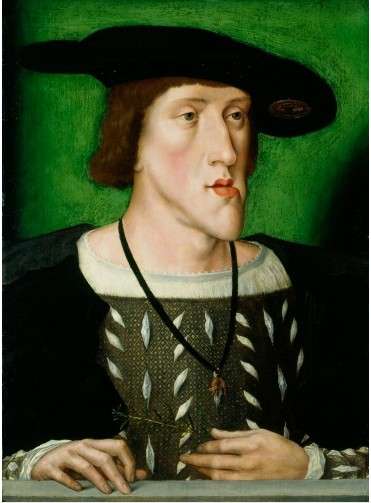
Charles V was a symbol of numerous problems with preindustrial marriage: His deformed jaw was the result of consanguineous marriages in his family, and he also once negotiated a marriage contract between his 11-year-old niece and a man four times her age, granting the right to consummate the union immediately. Portrait of Emperor Charles V, c. 1514.
Such bizarre episodes offer insight into the somewhat quizzical attitude that ordinary people held toward the official marriage code, with local customs and practices varying wildly. Despite the rarity of formal legal divorce among ordinary people, marriage did not usually last long given the high rate of premature death, and it was common for someone to marry several times after being repeatedly widowed.
Many unhappy marriages turned downright abusive. Olsen says, "Domestic violence was tolerated by the courts so long as it was limited to 'moderate physical correction,' and a man could even commit his wife to an insane asylum against her will." Domestic violence was celebrated in works of popular culture such as the upbeat wife beater's anthem, "The Cooper of Fife," a traditional Scottish folk song that inspired a country dance and similar English and American folk ballads. The contrast between the lyrics, which tell a tale of domestic violence, and the song's cheerful tune is jarring to a modern listener. An abused woman's best hope was often not legal recourse, but the possibility that a male relative, neighbor, or sympathetic passerby might notice her plight and take action on her behalf. Olsen wrote: "Neighbors [sometimes] intervened when men beat their wives, shaming the abusers with public processions and chants, or simply stopping a beating, as a saddler did in 1703, telling the abusive husband, 'you shall not beat your wife.'"
Oddly enough, roving nocturnal gangs of bored, drunken young men were perhaps an abused wife's most likely defenders. Some such "youth groups," A. Roger Ekirch relates, "contributed to social control, disciplining adulterers, abusive husbands, and cuckolds for violating common morality. Often occurring at night, charivaris in France, mattinata in Italy, and 'skimmington rides' in England subjected errant neighbors to 'rough music,' mockery, and on occasion, physical abuse."
Women, for their part, were also known to engage in criminal cruelty toward their husbands, such as by lethally poisoning them. Sometimes, these murders were committed in retaliation for domestic abuse. "Aqua Tofana," which one writer called the "bottled revenge of the 17th century wife," was a poison discovered in 17th century Sicily, notoriously sold through much of Italy by women to other women seeking to discreetly end their husbands' lives. Hundreds of victims (mainly men murdered by their wives) are estimated to have perished from the colorless, odorless poison, the precise ingredients of which are today unknown. Women were also occasionally known to attack their husbands at night while the latter slept, according to Ekirch:
An abused housewife in York warned her loutish spouse that she could kill him in bed at night if she wanted. In Germany, Margaretha Craft of Hallbach slew her second husband in bed with an axe "shortly after their union," later covering with manure his severed remains in the cellar. In 1737, a Connecticut husband—perchance while snoring—received from his wife a shovel of hot embers in his gaping mouth.
Interestingly, in England and Scotland, women who killed their husbands were charged not with murder but with petty treason, for defying the "government" of their husbands.
Not all abuse amounted to murder. A church court record from 1598 in Scotland describes a woman named Margaret Schort confessing to throwing a shovel at her husband, splashing ale in his face, cursing at him, and scratching him, for which her public punishment was recommended.
Although women certainly engaged in abuse of men as well, sexist laws frequently enabled men's abuse of women. Should a woman earn money, her husband could appear at any moment and claim her earnings, which the law recognized as his property. For example, in 18th century Britain, a wife could not enter into a contract, draft a will without her husband's consent, or determine her children's education or apprenticeships. In a separation, she lost custody automatically.
With so many difficulties accompanying marriage in the premodern age, it may seem a wonder that anyone married at all. Many people didn't. Contrary to popular belief, in much of Europe, marriage was less common in the past than in modern times. A large number of people never married. Married people were only about a third of the population, compared with about 50 percent in Western Europe today. In northwestern Europe, being married was not common for most adults until well into the 17th century.
But remaining single in the preindustrial world brought its own challenges, as Olsen notes: "The life of a spinster could be a difficult one, with extended family using unattached female relatives as temporary live-in housekeepers when a wife died." In other words, marriage was often the only way that women could avoid the fate of becoming unpaid live-in housekeepers to relatives. Economic necessity thus motivated many marriages. Marrying for love only began to emerge as an ideal in the 18th century and became more and more accepted during the 19th century.
This article is adapted from The Grim Old Days by permission of the Cato Institute.