
I'm Italian American, but I Don't Celebrate Columbus Day.
The holiday brings out many of the worst excesses of identity politics.
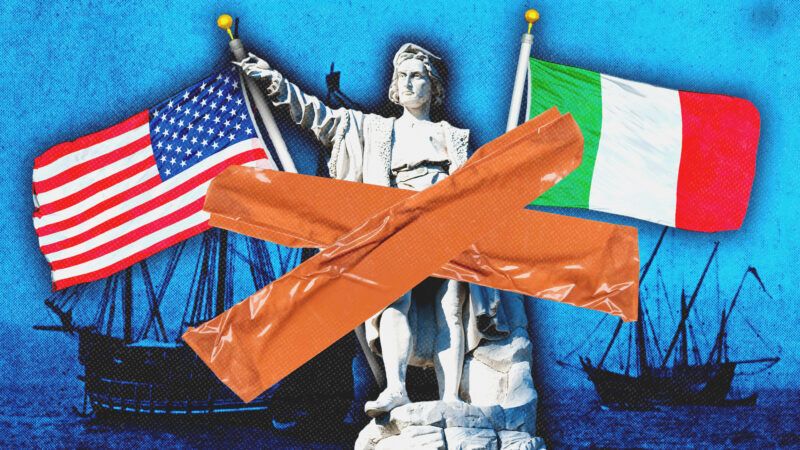
Bless my Italian-American mother's memory—her maiden name was Guida, and her parents were immigrants from southern Italy who never learned to speak English. But I won't be observing Columbus Day this Monday. Indeed, I stopped caring about it years ago. Traditionally a celebration of Italian-American pride and the Genoese explorer who "discovered" the New World, for decades the day has come to embody many of the worst excesses of identity politics, both among its champions and its detractors.
Whatever political and cultural purposes it might have once served, Columbus Day now functions as an annual showcase for ethnic grousing about real and imagined slights from generations or even centuries ago. We need less of that in today's America, especially from populations that are doing well (like Italian Americans), even as we need to be honest about our failures, in the past and the present, to live up to our ideals of pluralism, tolerance, and unity.
As you may recall, back in 2021, President Joe Biden didn't exactly bump or demote Columbus Day, but he did proclaim that Indigenous Peoples Day would take place on the same day, "lending the most significant boost yet to efforts to refocus the federal holiday celebrating Christopher Columbus toward an appreciation of Native peoples." Last year, President Donald Trump denounced the "left-wing arsonists" who emphasize the explorer's gruesome historical record and issued a White House statement, announcing "our Nation will now abide by a simple truth: Christopher Columbus was a true American hero."
If this all sounds like familiar TV satire or a popular meme, that's because The Sopranos mined it for all it was worth during its 1999–2007 run. As I wrote when series star James Gandolfini died in 2013, the entire series is "profitably read as a meditation on the end of ethnic America, at least as ethnicity was defined in the 20th century." As the mob boss at the center of the show, Tony Soprano knows better than anyone that the scripts that arguably worked for his grandparents, parents, and his own generation just didn't make sense anymore in a country that had moved on from rigid and essentialist notions of race and ethnicity. Indeed, The Sopranos run covers the period between when the census first introduced a multiracial category to the election of the first black president.
The Sopranos' interest in post-racial identity explicitly intersects with Columbus Day celebrations and protests in an episode from the show's fourth season (2002), which features a surprisingly funny-yet-deep grappling with Italian-American identity.
In one scene, the gangster Tony Soprano and his wife Carmela confront their son A.J., who is quoting from Howard Zinn's A People's History of the United States:
Carmela: His history teacher, Mr. Cushman, is teaching your son that if Columbus was alive today, he would go on trial for crimes against humanity, like Milosevic in, you know, Europe.
Tony: Your teacher said that?
A.J.: It's not just my teacher. It's the truth. It's in my history book.
Tony: So you finally read a book, and it's bullshit….He discovered America is what he did. He was a brave Italian explorer, and in this house, Christopher Columbus is a hero. End of story!
Yet things immediately get impossibly complicated. Tony and his associates learn of a Columbus Day protest organized by native Americans, which leads to a scene of anger but also confusion. Furio, an enforcer on Tony's crew who is actually from Naples, Italy, asks a series of questions.
Furio: I thought Columbus was the hero of America.
Ralphie: It's these Indians and the commie fucks. They want to paint Columbus as a slave trader rather than as an explorer…
Silvio: …I'll tell you what it is. It's anti-Italian discrimination. Columbus Day is a day of Italian pride. It's our holiday, and they want to take it away.
Furio: Fuck them! But I never liked Columbus. In Napoli, a lot of people are not so happy for Columbus, because he was from Genoa….The north of Italy always had the money and the power. They punished the south for hundreds of years. Even today, they put up their noses at us, like we're peasants (spits). I hate the north!
Silvio organizes what becomes a violent counterprotest that he fails to attend because he was playing blackjack at an Indian casino, of all places. "I woulda been fucking there, but I forgot this was a Monday," he lamely explains, and then has a telling conversation about Italian-American identity with Tony.
Silvio: [Italian] people suffered.
Tony: Did you? Except maybe for the feds?
Silvio: My grandparents got spit on because they were from Calabria.
Tony: Let me ask you a question. All the good things you got in your life, did they come from Calabria? Did they come to you because you're Calabrese? I'll tell you the answer. The answer is no….Did you get all this shit because you're Italian? No, you got it because you're you. 'Cause you're smart, 'cause you're whatever the fuck. Where the fuck is our self-esteem? That shit doesn't come from Columbus or The Godfather or Chef-Fucking-Boyardee.
Silvio: We got to tiptoe around the Indians, though, don't we? We can't call our teams the Braves or the Tomahawks…
It's true that the origins of Columbus Day as a national holiday are grim and speak to some of the ugliest elements of American racism. The earliest local celebrations in the United States date back to 18th century but took little or no notice of Columbus' ethnicity or religion. There were few Italians in America at the time, and the fact that Columbus was sailing for Catholic Spain, one of the great rivals of Protestant Great Britain in settling the New World, complicated things, Trump's proclamation notwithstanding. When Washington Irving published his massively popular, super-influential, and highly fictionalized biography of Columbus in 1828, he basically cast the superstitious European navigator as a Yankee entrepreneur who had to convince the reactionary regents Ferdinand and Isabella of Spain that the world was not flat but round (a theory that had already been widely accepted). Irving's biography somehow managed to make Columbus, who never set foot in any part of what was to become the U.S., an archetypal American.
The first federal Columbus Day observance only came in 1892, but it was a one-off, proclaimed by President Benjamin Harrison in part as a sop to the growing number of Italians who had started showing up en masse a decade earlier (all told, around 4 million Italians would emigrate to the U.S. between 1880 and 1920). In New Orleans 1891, the (Irish) police chief had been killed, and 11 Italians were charged with the crime. None of the defendants was convicted at trial, but all were killed in what was up to that point the largest mass lynching in U.S. history. Harrison denounced the violence when it happened, and it clearly influenced his Columbus Day proclamation, which also coincided with the 400th anniversary of Columbus landing at San Salvador.
For decades, anti-Italian sentiment in the U.S. was widespread and undisguised. In the wake of the New Orleans lynching, The New York Times ran an editorial asserting that the victims were "sneaking and cowardly Sicilians, the descendants of bandits and assassins,…[who] are to us a pest without mitigation." Though he would later condemn lynching, Theodore Roosevelt wrote to his sister about the New Orleans violence, calling it a "good thing." And as Daniel Okrent documents in 2019's The Guarded Gate: Bigotry, Eugenics, and the Law That Kept Two Generations of Jews, Italians, and Other European Immigrants Out of America, Roosevelt also called Italians "the most fecund and the least desirable population of Europe." Immigration restrictionists in the late 19th and early 20th centuries, writes Okrent, would routinely refer to Italians—especially from the southern part of the country—as transmitting "spiritual hookworm," possessing innately criminal genes, and otherwise polluting America's gene pool. The first person prosecuted under New York's early gun control law, The Sullivan Act, was of Italian heritage, and 70 percent of those charged under the law in its first three years had Italian surnames. In 1924, the restrictionists won, passing ultra-restrictive immigration laws that shut down newcomers from undesired countries. In the decade before the The Johnson-Reed Act, an average 200,000 Italians moved to America each year. That figure dropped to 4,000 a year after the law was passed.
In the 1930s, President Franklin D. Roosevelt, after lobbying by groups like the Knights of Columbus and individuals like National Enquirer publisher Generoso Pope, issued two proclamations establishing Columbus Day as an annual observance and it became an official federal holiday in 1968, with Lyndon Johnson's strong support. Today, slightly less than 5 percent of Americans claim Italian heritage, which in no way confers second-class or outsider status to any of us. That is progress we should acknowledge and embrace, rather than keep alive by leveraging our ancestors' pain and suffering as a way to claim current victimhood.
We'd be better off as a country rejecting the mentality satirized so deftly in The Sopranos a quarter-century ago, the passive-aggressive actions of the Biden administration, or the ideological diktat of the Trump administration. We could instead treat ethnic pride not as a zero-sum game but as source material for the next great amalgamation of American identity, one more element in a melting pot that gets bigger and more capacious with each new addition. Writing in Reason about the 500th anniversary of Columbus' first contact with the New World, the great Peruvian novelist Mario Vargas Llosa (1936–2025) emphasized that mestizaje, or the mixing of races and ethnicities, is the essence of the modern world and irreversible. It doesn't foretell the extermination of any culture but the continuation of it. Regardless of parentage, he argued, we are all "the children of Columbus," which ironically might mean we should stop celebrating Columbus Day the way we have been.