
If Manchester City Weren't (Basically) Owned by the UAE, Their Scandal Would Be a Lot Less Complicated
Plus: Nick Saban is wrong again, and could this be the last year of MLB’s playoff format?
Hello and welcome to another edition of Free Agent! It's a good week to keep your mouth shut.
Sorry, Dad, but we're leading off with soccer today. That's what happens when national governments get involved in sports! Then it's time to be mad at Nick Saban and we'll close with thoughts on the MLB playoff format.
Don't miss sports coverage from Jason Russell and Reason.
Locker Room Links
- The Portland Trail Blazers hired a new TV announcer, then fired him hours later after people dug up racist and sexist things he had tweeted over a decade ago as a teenager.
- Outgoing Washington, D.C., Mayor Muriel Bowser wants to spend almost $400 million on upgrades to "modernize" Nationals Park, which is less than 20 years old. (I was there about 10 days ago, it's modern enough already.)
- As we briefly noted last week, South Korean golfer Tom Kim needed an individual or team win at the Asian Games this week to earn an exemption from military conscription—he won by three strokes.
- The Big Ten is falling behind the SEC, at least on all-important football TV ratings.
- College football leaders are still considering playoff expansion to 24 teams, but lost revenue from conference championship games is a major obstacle. Also important: Viewership is down 11 percent this year from last year, and the lower stakes under a bigger playoff system probably aren't helping.
- Elsewhere in Reason: "The Millennial Internet Is Dead, and Politicians Killed It."
- If you wondered why you're seeing commercials for a Senate race happening nowhere near you while you watch a national sports broadcast, this might be why:
If you're seeing political TV ads during 🏈 for elections far away from where you live, that's because at this stage in the cycle it is likely less expensive to buy a TV ad during a regional/national NFL game than to buy it locally. Or there's more inventory nationally.
That's…
— Ed O'Keefe (@edokeefe) October 4, 2026
Don't Let Governments Get Into Sports and You Won't Have This Problem
Always be careful who you go into business with.
That's a lesson the Premier League may now be learning the hard way. If you thought it was a lot when the Los Angeles Clippers seemed to send tens of millions of dollars to Kawhi Leonard to circumvent the NBA salary cap, just wait until you hear what Manchester City's owners did to avoid financial rules in soccer.
Over the course of a decade, the team allegedly hid more than $1 billion in fake sponsorship deals. Those deals cover 2009 through 2018, and it's unknown if, and to what extent, the same thing has been going on since then (the club has not been fully cooperative with the Premier League's investigation).
If Manchester City arranged more than $1 billion in fake sponsorship deals between 2009 and 2018, it's probably fair to assume that much of the revenue generated from 2020 to 2025 was also fake. They could have at least added a dip during COVID to make it look more realistic. pic.twitter.com/vwUbcot2NJ
— Joe Pompliano (@JoePompliano) October 1, 2026
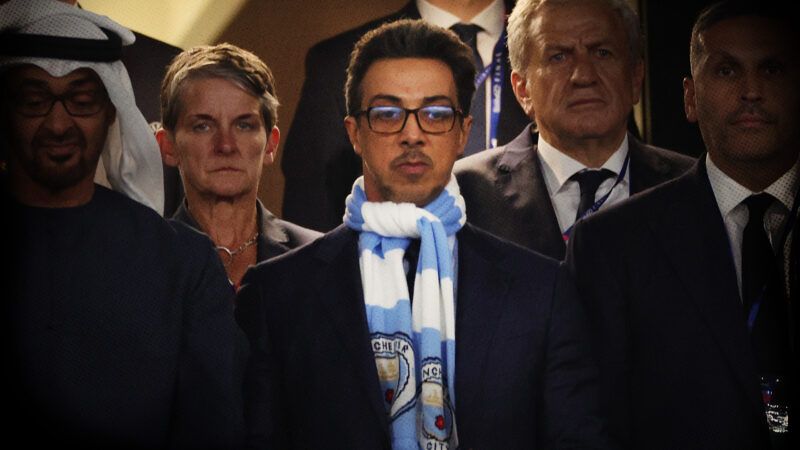
In short, while American sports fans demand their billionaire team owners spend more of their personal funds on their teams, Manchester City went ahead and did it. That's easier to do when your team is, for all intents and purposes, owned by the United Arab Emirates. The club is owned by City Football Group, which is 81 percent owned by the private equity firm Abu Dhabi United Group, which is owned by Sheikh Mansour—the UAE's vice president and a member of the royal family (and you thought President Donald Trump's entanglements with private companies were bad!). Since 2009, the team's jersey sponsor has been Etihad Airways, and since 2011 they've played in the Etihad Stadium in the Etihad Campus of Manchester—Etihad Airways, of course, is a state-owned enterprise of the UAE.
Soccer doesn't have a salary cap, but it has "financial fair play" rules where owners are not allowed to use outside wealth to cover the club's losses (basically, teams are supposed to break even over a certain period of time). Player acquisition is also much more free market than in American sports leagues—there's no draft to send the best young talent to bad teams, so wealthy teams can just buy the rights to the best players in the world and then give them lucrative contracts.
The scheme worked. Man City won the Premier League three times in that 2009–2018 timespan (five more since), plus several domestic cup trophies and the European Champions League in 2023. Their women's team has enjoyed recent success too. It's worth mulling how much of their success, fueled by the shady sponsorship deals, created even more unjustly gained sponsorship revenue.
Now, the powers that be in soccer are trying to decide City's punishment, while the club readies its appeal. The team might be stripped of past trophies, fined into oblivion, given a massive points deduction in the Premier League table, or automatically relegated to the second division.
If any of that happens, the UAE is threatening to pull back on massive investments from the United Kingdom.
We do not own a football club but if you punish this football club that we do not own we will punish you https://t.co/e4AII1T8WR
— Chris (@CWeatherspoon_) October 2, 2026
All that creates a second point of pressure on the Premier League via their own government. "I would be really concerned to lose them," Prime Minister Andy Burnham (the former Manchester mayor) said about the possibility of Man City's owners taking their ball and going home by selling the team if their punishment is too harsh. So competitors and fans are calling for the harshest possible punishments, but on the other side are two governments. (Don't worry, club chair Khaldoon al-Mubarak has diplomatic immunity.)
What a mess. That's why it's important to be careful who you go into business with. You might end up working with liars, cheats, and shady characters—or worse, a government.
Nick Saban Doesn't Make Any Sense
Nick Saban has a silly argument to make about capping student-athlete pay but not coach pay. They are "totally different markets," he said. "How much value does a coach create for a university?"
Saban, no doubt, created plenty of value for the University of Alabama. But he couldn't have done that without Derrick Henry, Julio Jones, and many more star athletes who created incredible value for Saban and the university while getting very little in compensation.
He's right of course. Player pay and coaching pay ARE totally different markets.
That's why in every pro sports league, the best players are paid significantly more than the best coaches. They're way more valuable. https://t.co/I3btb9F422
— Rodger Sherman (@rodger) September 30, 2026
Yet, in case you missed it last week, the Senate passed a bill (the Protect College Sports Act) to limit spending on student-athlete compensation while rejecting an amendment to limit spending on coaches. Its backers say there's runaway spending on student-athletes, but say little about all the spending on coaching salaries and buyouts.
Congress shouldn't pass a law at all limiting that spending, in my opinion, (just look at all the problems exemplified by Manchester City and the Clippers above!). But if they're worried about athletic spending getting out of control, then just limiting spending on student-athletes won't fix the problem—universities will find other ways to spend on athletics to get the same result they want, which is essentially better marketing than any commercial can ever provide.
While we're on the subject, I have another complaint about the student-athlete compensation cap in the Protect College Sports Act. The cap isn't flat over time, it's set to rise with inflation—permanently. But all the evidence we have from professional sports shows that athlete salaries rise faster than inflation, even in salary cap systems. By tying the cap's rise to inflation, Congress is basically making it much better to be a student-athlete today while screwing over the athletes of the future—athletes who don't currently have a voice to complain about it.
The Last Year of MLB's Playoff Format?
Another postseason, another year to complain about the MLB playoff format—except this time, with a collective bargaining agreement in the works (however far off that may be), the format may actually change before the next time the playoffs roll around (again, however far off that may be).
I think it's tough to look at the teams eliminated in the Wild Card round and argue they deserved to advance instead. The Red Sox were eliminated by the Yankees, who had six more wins in the regular season. The Astros, with a negative run differential and the worst record for a division winner in baseball history, were knocked out by the White Sox, who had been in a division title fight but came up just short. The Cubs forgot how to hit and were knocked out by the Padres. The Phillies got sent home by the Braves, who had six more wins and a better run differential by the slight margin of 101.
But I still hate the three-game format. Your team spends months and months looking at their playoff spot, and if you have two bad days in a row it ends. I've had flight delays last longer than these postseason runs. Does it really feel like your team made the playoffs?
I'd be fine going back to the format with just one wild card team, or two wild card teams if we have to do a play-in game (don't call it the playoffs, though!). But most importantly, make the divisional round a best-of-seven series (inventory for TV is king, here). Give people at least a little bit longer to have their hope before the Dodgers inevitably slam that door closed.
Replay of the Week
A lot happened this week, but it's hard to resist a multisport goalie goal double feature.
THREE DAYS INTO THE SEASON AND WE ALREADY HAVE A GOALIE GOAL!! pic.twitter.com/4EeZoqz3Wv
— NHL (@NHL) October 2, 2026
🚨 GOALIE GOAL GOALIE GOAL GOALIE GOAL 🚨
Jordan Farr heads home the late equalizer for @LoudounUnitedFC! 😱 pic.twitter.com/4LzbzaDp4f
— USL Championship (@USLChampionship) October 4, 2026
That's all for this week. Enjoy watching the real game of the weekend, as future Man City opponents Swansea City and Norwich City face off in the EFL Championship (7:30 a.m. Eastern on Saturday on CBS Sports Network).