
People Get Paid for Blood, Plasma, and Drug Trials—Why Not Kidneys Too?
Instead of kidney waitlists that kill thousands of people a year, let people get paid for kidney transplants.
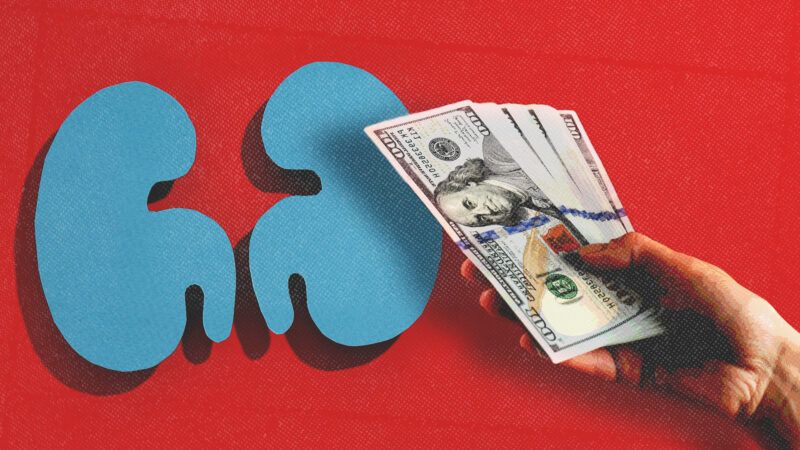
About 4,000 people in America die every year while waiting for kidney transplants. More than 95,000 currently need regular dialysis to stay alive while waiting for transplants. The average person who needs a kidney must endure the discomfort and restrictions of dialysis for three to five years during the wait.
Most countries have organ-donation systems like America's—and long waitlists. Iran, by contrast, legalized payment to kidney donors in 1988; within 11 years the country eliminated its waitlist. Payment compensates donors for their time, pain, and risk; it also increases the supply of willing donors.
People often object to paying donors on the grounds that it is wrong to commodify the human body. Compensation, they say, would reduce a person from a human being with dignity and inherent worth to a vending machine of fluids, tissues, and organs. This argument does not hold up.
We Commodify Our Bodies All the Time
Women have been paid to nurse other women's babies for nearly all of recorded history. Virtually every major religion has praised or affirmed wet nursing as a profession. The Catholic Church has two patron saints of wet nursing; the Quran explicitly authorizes payment for it; rabbinic law treats it as ordinary labor.
Yet wet nursing clearly commodifies the human body. The nurse is paid to produce her milk for someone else's child.
Or take payment for blood and plasma. If someone wanted to avoid using any good or service that relied on bodily commodification, he would have to go the way of Jehovah's Witnesses and refuse blood transfusions on ethical grounds.
True, blood donors are rarely paid in the United States, but a robust secondary market exists for donated blood. Blood-collection services such as the Red Cross sell blood to hospitals for a few hundred dollars per pint, and hospitals charge insurance companies a few thousand dollars per pint. Even if a bodily product is not paid for at collection, it can still be commodified further down the supply chain.
In America, plasma donors get paid about $50 per donation and can donate up to two times per week. That system is incredibly beneficial to donors: They are less likely to take out high-interest payday loans; they lower their drug use, and areas with paid donation centers have less crime.
The U.S. is one of a few countries that have legalized paid plasma donation, but countries that have not done so still have to pay for plasma. Those countries have chronic plasma shortages and must import it, typically from the U.S. Again, just because donors are not paid does not mean the product is not being bought and sold by other entities. The top five plasma-producing countries (the U.S., Germany, Austria, Hungary, and the Czech Republic) produce 90 percent of the world's plasma, despite having just 10 percent of the world's population. All of them pay donors.
Plasma is crucial for making a variety of medicines. It is used in anti-D immune globulin, which is deployed in pregnancies in which a mother's immune system attacks the baby; that medicine saves the lives of about 10,000 babies a year in the U.S. alone. Plasma is used in immunoglobulin, which is critical for people who have primary immunodeficiency. It is also used in C1-esterase inhibitors, which helps people with hereditary angioedema.
Here's another sort of bodily commodification: paid human clinical trials for drugs. Phase I drug trials are done on healthy human subjects, with informed consent, to check a drug's safety and to establish proper dosage. These participants play a vital role: Approximately 30 percent of drugs in Phase I are not safe enough to advance to Phase II. Drugs found unsafe rarely seriously harm participants; only about 0.4 percent of participants experience serious bodily harm.
Drug development would not work without human testing. Anyone who wanted to avoid drugs developed with paid test subjects would have to avoid all drugs developed in the U.S. since at least 1962, when the modern multiphase trial system was established.
The multiphase drug trial system is used nearly globally; essentially all countries do some form of Phase 1 drug trials. Most countries allow paying participants, but the U.S. offers the highest compensation and has the most testing.
While some critics have raised complaints against the trials, those arguments allege that the volunteers are inadequately protected or compensated. They don't say that the trials are immoral because the participants are paid or that those payments injure the volunteers' dignity.
It Is Good To Value Life and Risk
Then there's life insurance. As the sociologist Viviana Zelizer has shown, this product was initially unpopular because it seemed to put a monetary value on human life; it also meant that families would financially benefit from the death of their fathers and husbands. (Life insurance was initially only marketed to men.) But attitudes changed dramatically after 1840, and by 1870 fathers who died without life insurance were seen as having abdicated their duty to their families.
Commodification in the form of the "value of a statistical life" is used to calculate the economic benefit of avoiding a fatality. Governments use it to perform cost-benefit analyses for laws, regulations, and projects that could affect mortality. Similar concepts are also used in a variety of private industries to help them decide the cost-benefit of doing a recall or investing in safety equipment. Most states have compensation schedules for the total loss of use of various body parts.
All of these practices put values on life and body parts, but they do so because life and the body are meaningful and dignified. They also help people in times of need.
Myriad jobs that involve risk to health or comfort come with hazard pay. Federal civilian employees have statutorily outlined hazard-pay differentials covering a wide variety of dangers, such as 4 percent for working in extreme cold or heat, 25 percent for being in a wildland fire line, and 50 percent for working at extreme heights or with high voltages. Members of the military can receive hostile fire pay, hazardous duty pay, submarine duty pay, and other pay increases for dangerous or otherwise undesirable work. Merchant mariners get war-risk bonuses when transiting through high-risk areas; there are bonuses for offshore work on an oil rig, and linemen get hot-work premiums.
Hazard-pay premiums are both basic economics and basic to treating people with respect. Jobs that are dangerous, uncomfortable, or undesirable will struggle to find workers if they only pay what less-dangerous and less-uncomfortable jobs pay. Moreover, it would be strange to say that humans have innate dignity and worth but don't deserve extra compensation when asked to risk bodily integrity. To do so would treat a person's body as worthless.
Strangely, it is legal and acceptable to be paid to risk loss of bodily integrity, but illegal to be paid for donating an organ, even though the donation causes no lasting harm to the donor and saves the life of the recipient.
There are 137 million Americans in the age range of 25 to 54. There are 95,492 Americans who need kidneys. If 0.07 percent of Americans ages 25 and 54 donated their kidneys, the waitlist would vanish.
The average person who needs a kidney costs Medicare around $90,000 a year in dialysis costs alone while waiting for a transplant. The government could pay every kidney donor $100,000 and actually save money, as long as the compensation reduced wait times by over a year.
If you think it would be wrong to solve the waitlist problem by compensating kidney donors, you should also oppose our systems of allocating blood, collecting and allocating plasma, Phase I drug trials, life insurance, hazard pay, and workers' compensation. Or, better, you should come around to recognizing that bodily commodification can be good.