
American Tax Dollars Are Financing Cell Towers in Angola
The Trump administration’s strategy for the Export-Import Bank could repeat the mistakes of China’s failed Belt and Road Initiative.
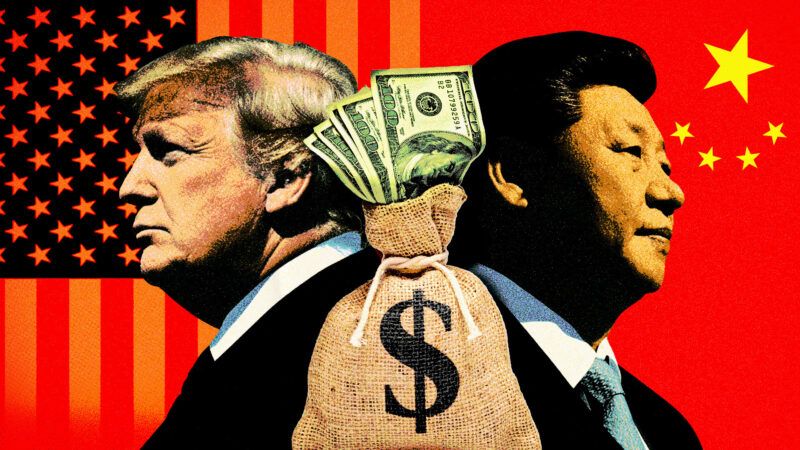
American taxpayers are supporting cellphone networks in sub-Saharan Africa, airlines in Turkey, and a host of other large-scale infrastructure projects worldwide as part of President Donald Trump's plan to increase America's influence internationally, presumably to break China's stranglehold on the global critical mineral supply chain.
In FY 2025, the U.S. Export-Import Bank (EXIM)—a federal credit agency that provides loans and guarantees to international buyers of American goods, and insurance to domestic exporters when the private sector is unwilling or unable to take the risk—approved $5.03 billion in loans and long-term guarantees across 23 transactions. The Trump administration authorized 16 of those deals, for a total of $3.39 billion. Since the start of Trump's second term, EXIM has authorized $4.83 billion in spending through project and structured finance—the bank's most flexible financing options—alone. That's 61 percent more than the $2.99 billion the Biden administration approved under the same vehicle.
Last week, the White House added another deal to its ledger when EXIM provided a $99.6 million loan to Africell—the only U.S.-owned cellphone network operator in Africa—to finance the company's operations in Angola. Africell said the loan is part of a broader $5 billion commitment for developing railways, bridges, and broadcasting in the Lobito Corridor, a transnational network that connects mineral-rich regions of the Democratic Republic of the Congo and Zambia to Angola's port of Lobito.
It's hard to see how building Angola's telecommunications industry benefits American taxpayers. For the Trump administration, the deal is a chance to counter China-based Huawei, which is "estimated to have supplied more than half the 4G and 5G network infrastructure in Africa," according to the Associated Press.
If the president hopes to cut into Beijing's market share of critical minerals by replicating its foreign lending strategy, both he and American taxpayers will be displeased by the return on investment.
In 2013, China announced its Belt and Road Initiative, a plan to finance infrastructure projects across the developing world by providing fixed-interest loans with favorable repayment terms through the Export-Import Bank of China and the China Development Bank. Since it began, China has spent $1.39 trillion on the initiative, according to the Green Finance & Development Center, a think tank within China's Fudan University. In 2025 alone, Beijing spent $61.2 billion on developing countries in Africa like Angola.
Yet, because of their nascent economies, these countries often struggle to repay the principal and interest on Chinese loans, leaving them in significant debt distress and beholden to Beijing.
In 2023, a study by Stanford's Center on China's Economy and Institutions found that distressed borrowers made up 60 percent of China's overseas lending portfolio. In a 2025 report, the Lowy Institute—an Australian think tank—projected that the world's poorest countries "will make record high debt repayments totalling $22 billion to China" that year. The group also said that "China is grappling with a dilemma of its own making," including "growing diplomatic pressure to restructure unsustainable debt, and mounting domestic pressure to recover outstanding debts."
Meanwhile, many details of its loans are unknown because "Chinese loan contracts often include far-reaching confidentiality clauses that bar the borrower from revealing the terms or even the existence of the debt," according to a study in The Journal of Economic Perspectives.
If Trump is trying to replicate China's public spending spree, American taxpayers should be wary that it might come with little transparency. In fact, there are already reasons for concern.
While federal law bars EXIM from granting final approval for any loan, financial guarantee, or insurance of $100 million or more without sending Congress a detailed statement on the transaction, the explanation isn't published, and the bank isn't required to disclose whether private financing was available. For deals under the $100 million threshold—like Africell—EXIM isn't required to publish anything at all.
When private lenders exit a market or decline to back a project, it typically signals that success would be prohibitively costly. However, with public financing, there are no such signals, meaning that American taxpayers will have to eat the losses when these "investments" fail.
It'd be understandable if the government were providing American companies with market access in other countries through trade agreements (something Trump has scorned), but playing the role of financier for the world's development projects is a losing gambit.
The U.S. can't beat China by copying its foreign lending playbook.