
9/11 Turbocharged America's Worst Foreign Policy Impulses—but Didn't Change Its Direction
The United States' shift toward aggressive interventionism was well underway before the 2001 attacks.
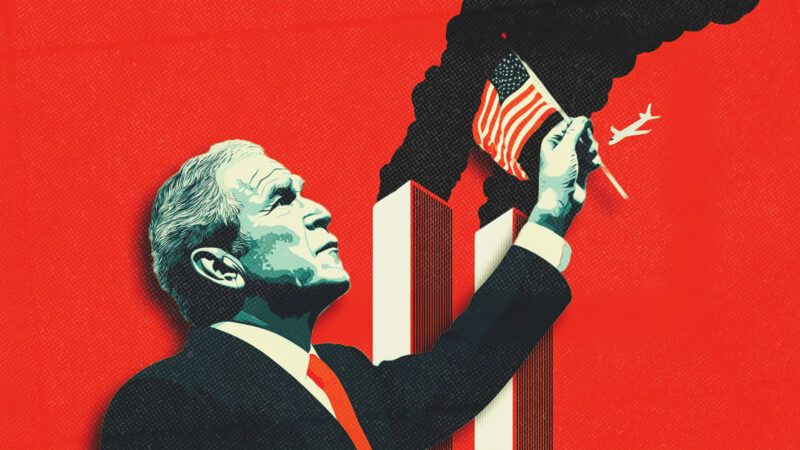
Like many others in the Washington, D.C., or New York metro areas, my experience of 9/11 was horrifying and yet unremarkable at the same time.
I was a 16-year-old British student spending a year in an American high school in Arlington, Virginia, just a few miles from the Pentagon. That Tuesday morning dawned like any other. It was sunny and warm; D.C. was experiencing its traditional third or fourth blast of summer heat well into September. In second period, someone flipped on the TV, which was showing images of a plane disaster in New York. Tragic, but hardly cause to break routine. The band teacher flipped it back off and returned to teaching.
It wasn't long, though, before things went off the rails. While walking to my next class, there was a commotion down the hall: someone screaming, the hysterical sound bouncing off the tiled corridor. I would later learn that a girl was trying to reach her parents at work in the Pentagon—and failing. By the time the principal made the announcement that school was closed, rumors and panic had begun to spread throughout the student body.
Things after that are a disconnected blur. Waiting in classrooms for parents to come and collect students without transportation; some arrived crying. My mother managed to get a phone line and briefly call me. She was trapped on a Metro platform, the trains disgorging all their passengers and going out of service. Even the television news was frenetic and unclear: Another plane was headed for the White House. No, it was headed for CIA headquarters in McLean. There are car bombs downtown. The president has been taken to a secret location. One classmate's father, who worked at the Pentagon, saw the crash in his rearview mirror as he drove to a dentist's appointment.
My mother finally made it to school and took me home. It would take several more hours for my father, who worked mere blocks from the White House, to arrive: Like many others, he had been forced to walk out of Washington, across the bridges, and through miles of suburbs to get home.
These experiences remain etched in my mind, horrible enough to be fresh even all these years later, and yet they were in no way unique. In the days, months, and years to follow, I would hear so many distinct variants of the same story: a group of students on a trip who'd seen the plane as it descended toward the building; a classmate whose father was whisked away by government helicopter to some unknown location, leaving them to wonder where he was; a think-tanker whose child attended an on-site daycare at the Pentagon. I kept thinking back to that last story after I became a mother myself. Could I even imagine the panic and terror of a parent in that situation?
It's tempting to look back at the shock and horror of 9/11, a trauma shared by much of Washington's foreign policy class, as the genesis of many foreign policy mistakes that would follow. Hurt people, as the saying goes, hurt people. And as the events of the following years unfurled—the toppling of the Taliban, the invasion of Iraq, the internments at Guantánamo Bay, the passage of the USA PATRIOT Act, and so on—it became tempting to blame it all on that singular day of pain and horror.
But as we approach the 25th anniversary of the attacks, it's important to understand the limits of that story. The events of 9/11 undoubtedly had a major impact on foreign policy. Yet this impact was less a change of direction and more an intensification of already existing trends. The 9/11 attacks would create a permissive political and psychological environment for a particular foreign policy vision, but it did not set America on the path to liberal interventionism and forever war all by itself. For that, we must look back into the 1990s.
The Unipolar Moment
The collapse of the Soviet Union unchained America. Economic and social malaise had been undermining the USSR for decades, as an aging parade of apparatchiks presided over stagnation and discontent. The rise of Mikhail Gorbachev and a sudden, unexpected series of arms-control agreements brought an era of détente, while a series of popular revolutions in Eastern Europe severed the USSR from its Eastern bloc dependencies. By the time the Soviet flag was lowered on the Kremlin walls on Christmas Day 1991, it was clear to all involved that America had won the Cold War.
This outcome raised hopes in Washington of a better world. As President George H.W. Bush told Congress, the dawning of something better might be visible: "Out of these troubled times, our fifth objective—a new world order—can emerge….An era in which the nations of the world, East and West, North and South, can prosper and live in harmony." The Soviet collapse, leaving America as the only superpower, offered policymakers a chance to use America's overwhelming power to build that better world.
The end of the Cold War was thus marked not only with a sense of righteous victory, but also with a feeling in Washington that a new foreign policy consensus needed to be forged. The early 1990s was nicknamed the "Kennan Sweepstakes." Thinkers vied to become the next George Kennan, whose 1946 telegram created a doctrine for the Cold War, with new missions and new rationales for U.S. foreign policy. The bipartisan consensus that emerged married Republican primacists and neoconservatives to Democratic liberal internationalists around a form of "liberal hegemony."
What united these groups was a conviction that America—the "indispensable nation"—could transform the world into something better, whether that was by toppling prospective enemies of the United States or engaging in humanitarian intervention. Each administration from Bill Clinton to at least Barack Obama held it as an article of faith that if America could make the world more interconnected and more liberal, it could also make the world more peaceful.
U.S. foreign policy thus became increasingly assertive. It is an oft-forgotten irony that George W. Bush was elected in 2000 promising to reject excessive humanitarian intervention and nation building, sentiments that helped him to win the Republican nomination over noted hawk John McCain.
The nation building in question was President Clinton's repeated interventions in the Balkans, designed to prevent atrocities in the former Yugoslavia. Crimes like the mass killing at Srebrenica in the 1990s led U.S. officials to embrace the "responsibility to protect"—the notion that if a state did not or could not protect its own citizens, the international community was obliged to intervene to protect civilians. In practice, "the international community" meant the United States.
Indeed, when conflict broke out between Serbian forces and Kosovar separatists, the Clinton administration ran an air campaign not with the approval of the U.N. Security Council, where Russian and Chinese vetoes prevented action, but under the auspices of NATO. The campaign forced Serbia to accept a peace deal and in effect created a new country in Kosovo.
Other elements of U.S. foreign policy under Clinton were similarly ambitious and transformative. His administration engaged in strenuous negotiations with Congress over the admission of China to the World Trade Organization. Concerns about China's growing economy and undemocratic government were smoothed over by the notion that greater trade and interdependence could bring greater global stability in the long run. By bringing China into the community of nations in this way, it was believed, China's rise could be managed, turning it into a "responsible stakeholder" in the existing American-led order.
Then there was NATO expansion. With the collapse of the USSR, NATO no longer had an enemy to protect against, raising the possibility that the alliance was obsolete. But as early as George H.W. Bush's administration, U.S. policymakers demanded that a unified Germany stay in NATO, inherently implying that the pact still had a role to play in European security.
It was the Clinton administration that suggested that NATO might also have a place for the countries of the former Warsaw Pact. By the end of his term, Clinton had authorized the first round of NATO expansion and set the stage for more. NATO expansion was increasingly seen as a way to lock in stability, democracy, and economic reform in Eastern Europe.
NATO's expansion was coupled with an American push to expand its scope, transforming it from a deterrence force inside Europe to a global peacekeeping army that could act when the United Nations could not. More than 60,000 NATO-associated troops participated in the Bosnian implementation and stabilization efforts that followed the Dayton Peace Accords of 1995.
What tied many of these Clinton-era policies together was the aim of prolonging the post–Cold War period of American predominance over both allies and adversaries. One way this manifested itself was the idea that the United States should not withdraw from European security, keeping European allies purposefully weak. Another way was a policy of "dual containment" against both Iraq and Iran. Across the 1990s, the U.S. would sustain a no-fly zone over Iraq, enforce U.N. sanctions on Iraqi oil, and engage in several bombing campaigns against Iraqi military targets and to protect civilians in Kurdish areas.
As we exited the 1990s, American policymakers were riding high. No challengers were on the horizon, proto–rogue states like Iraq were contained, and globalization and liberalization were flourishing around the world. Perhaps nothing exemplified the mood surrounding U.S. foreign policy better than a declaration by Madeleine Albright, Clinton's secretary of state: "If we have to use force, it is because we are America; we are the indispensable nation. We stand tall and we see further than other countries into the future." At home, the president might have been embroiled in a sex scandal, but abroad, America's destiny as leader and prophet of the post–Cold War world seemed assured.
Turbocharged
It was in this messianic ground that the seeds of 9/11 were sown. An introspective observer might have wondered how the nation who "saw further into the future" had so disastrously missed the threat from Al Qaeda. Future inquiries would conclude that the attacks would not have been possible without serious lapses in both Clinton and Bush's counterterrorism policies, as well as institutional and intelligence failures.
The 9/11 attacks were clearly terror and barbarism; thousands of grieving American families at funerals proved that beyond any doubt. But they were also a challenge to America's post–Cold War image. A terrorist group had been able to hatch a plan in caves in one of the world's poorest and most isolated countries (never mind that most of the actual plotting and preparation had taken place in Germany!), turning the very tools of global connectivity against America. The attacks came to be seen as an affront to America's new world—a challenge to the forces of civilized, liberal order.
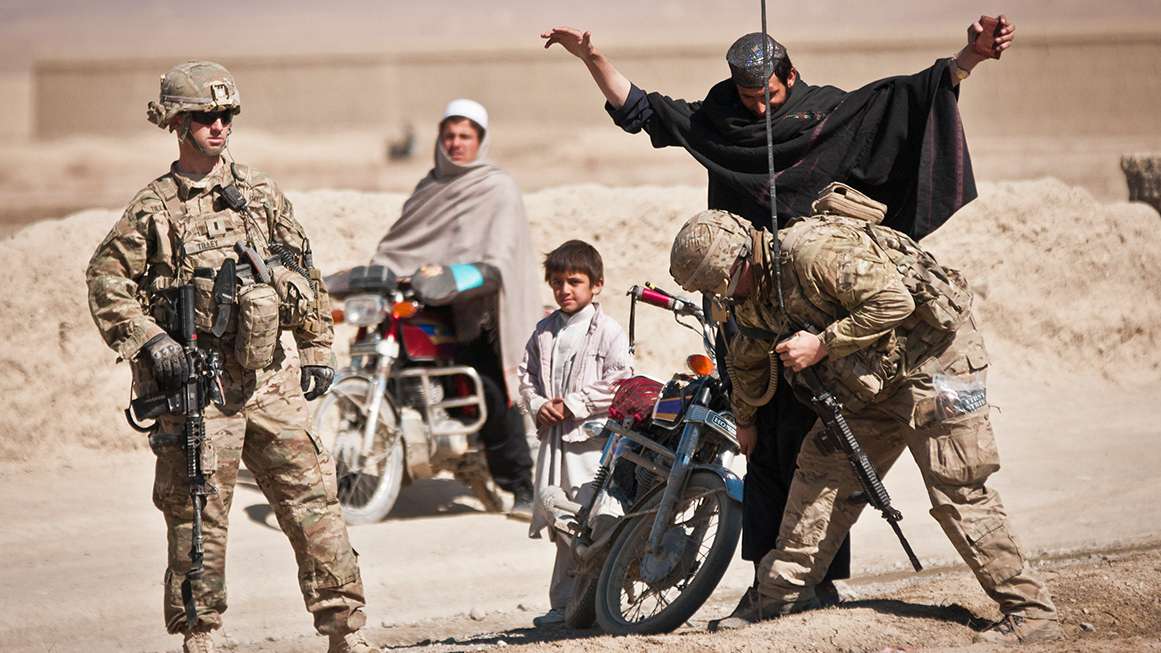
The invasion of Afghanistan was a logical and justified response to the attacks. The Taliban had sheltered Al Qaeda and its leader, Osama bin Laden; they had, in a very real sense, declared war on the United States. The toppling of the Taliban was swift and merciless. Less than three months after the attacks, Kabul was conquered and an interim Afghan government was in place.
But in the atmosphere of the time, mere military victory was not enough. Bin Laden and many of his top lieutenants were still at large. "Rogue states" such as Iran, Iraq, Syria, and North Korea might need to be deterred. Other "ungoverned spaces" might pose a similar threat in future.
In response, the Bush administration formulated the "freedom agenda," a hugely ambitious strategy that sought to address all of these problems at their root. This freedom agenda turned the war in Afghanistan into an exercise in modernization and nation building, which was used to sell a separate war of regime change in Iraq. In each case, U.S. military power was to transform whole societies. Iraq and Afghanistan were prototypes, proving grounds for the idea that a democratization campaign could act as a catalyst for change across the whole of the Middle East. "The great strength of this nation," the 2002 U.S. National Security Strategy document put it, "must be used to promote a balance of power that favors freedom."
Though U.S. public opinion began to turn decisively against the wars in Iraq and Afghanistan as Bush's presidency ended, his successors continued to pursue similarly transformative goals on the world stage. President Barack Obama, for example, had come into office promising to pull back from the global war on terror, but he ended up surging troops into both Afghanistan and Iraq. His administration also engaged in regime change in Libya and covert intervention in Syria.
Obama was building not just on Bush's freedom agenda but on the Clinton administration's invocation of the responsibility to protect. Several of Obama's foreign policy advisers—Hillary Clinton, Samantha Power, Susan Rice—were true believers in using U.S. power to protect human rights and spread democracy. As the Arab Spring crashed across the Middle East in 2011 and mass protests in Libya spilled into open civil war, the administration authorized a NATO-led campaign that quickly advanced from a no-fly zone designed to protect civilians to an open campaign of regime change.
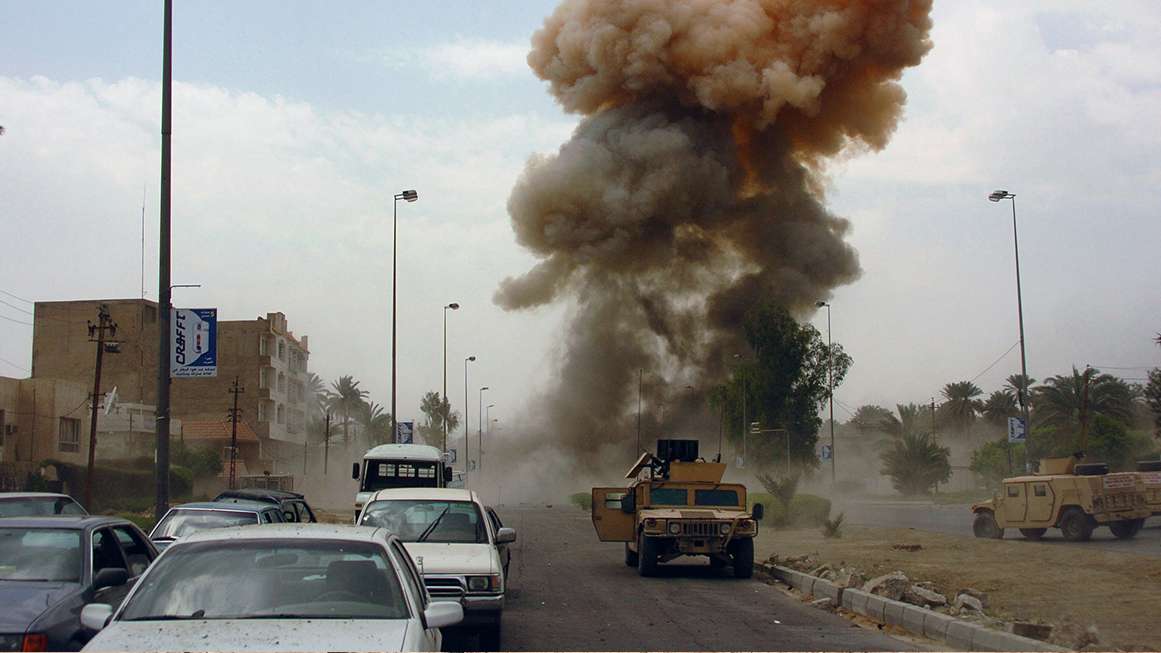
America's Middle East interventions after 9/11 even bolstered its other ambitious post–Cold War policies. For example, NATO now had more impetus to focus on expeditionary and "out of area" capabilities. The alliance played an active role in the International Security Assistance Force process in Afghanistan and then in the Libya campaign. NATO expansion and the war on terror would become practically symbiotic: For newer members, providing political support and token military forces in Iraq and Afghanistan was viewed as a quid pro quo for membership, while the sacrifices made by their soldiers became a justification for that membership.
The Hangover
Public disillusionment with all of these policies grew throughout the 2000s and 2010s. By 2016, Donald Trump was reaching swing voters by declaring the Iraq War a mistake; by 2020, Democratic primary candidates would be pledging en masse to extricate the U.S. from the Middle East. Twenty-five years after 9/11, elements of the war on terror still linger across the Middle East and, increasingly, Africa—and the war is generally viewed as a failure. The Middle East became less a proving ground for democracy and human rights promotion, and more a graveyard for the notion that freedom can be built at the point of a gun.
Yet with 25 years of space, it also becomes easier to see how the war on terror fits into the broader trajectory of post–Cold War U.S. foreign policy. America's response to 9/11 turbocharged many of its worst impulses but did not fundamentally change its direction. The zeal of the indispensable nation mixed with the shock of a large-scale terrorist attack—one experienced firsthand by many of Washington's foreign policy elites—created a permissive environment in which ambitious theories of global peace and change could flourish.
The war on terror is simply the best-known and most visible of the transformative impulses that characterized the post–Cold War pursuit of liberal hegemony. Would regime-change wars in Iraq or Libya have happened without 9/11? Would America have spent two decades bogged down in the Middle East, wasting blood and treasure while China rose quietly? Perhaps not. But a quarter-century later, we should ask ourselves how much of what followed the 9/11 attacks stemmed from shared trauma and panic—and how much was merely an intensification of existing trends.