
This ICE Office Detains People for Days in Overcrowded Holding Cells
ICE's standards say these cells shouldn't be used to confine people for more than 12 hours. But that's not how it works in Miramar, Florida.
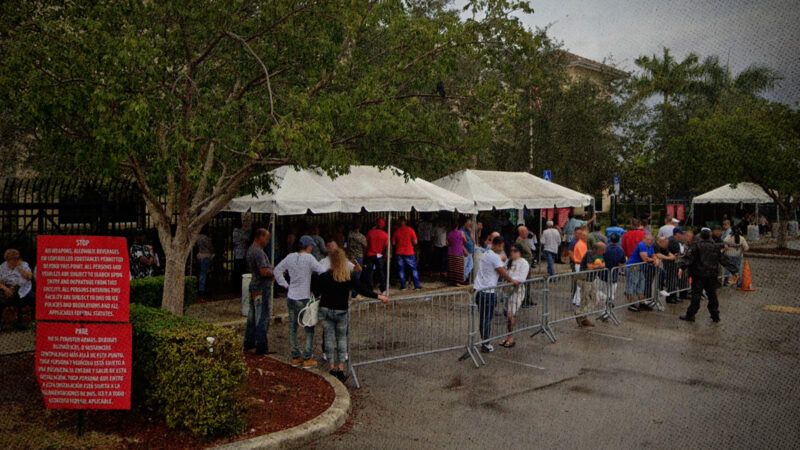
An Immigration and Customs Enforcement (ICE) field office in Miramar, Florida, is supposed to be where immigrants go for regular appointments with federal authorities. However, family members of detainees, immigrant legal aid groups, and Democratic lawmakers say the South Florida facility has become a dangerously overcrowded detention center in the past few months, with people languishing for days in what are meant to be temporary holding cells.
A South Florida resident who asked to only be identified by her first name, Marlene, says her sister Yajaira, a 37-year-old mother of two, spent five days last month detained at the Miramar facility before being transferred to another detention center across the country.
Marlene says Yajaira was jammed into a bare concrete holding cell with roughly 50 other people, where she suffered an anxiety attack. Yajaira was given barely any food, no room to sleep, limited phone time, and no confidential access to legal counsel.
"She lasted five days in there, five days without brushing her teeth, without showering and things like that," Marlene says.
According to an extraordinary waiver that ICE granted itself last year, Yajaira should have been in that holding cell for no longer than 72 hours at Miramar, but advocacy groups say that extended stays like Yajaira's are the norm now at the facility.
María Bilbao, the campaigns coordinator for the American Friends Service Committee of Florida, says she's been fielding texts and phone calls every day from family members of detainees being held at Miramar for up to 12 days at a time. Bilbao is also an organizer for the Miramar Circle of Protection, a volunteer group that provides support and legal guidance for immigrants outside the Miramar ICE office.
"Miramar is supposed to be a space where you go to do a check-in or pay a bond," Bilbao says. "But now I describe it like a clandestine detention center, because there is no clarity."
Paul Chavez, an attorney with Americans for Immigrant Justice, said his organization has been hearing the same thing.
"We've seen people held there for multiple days at a time—eight days, even nine days in some cases," Chavez continues. "Miramar is not designed or equipped to function as a detention facility. It's essentially an administrative field office where people have historically gone for immigration check-ins. Now people are being held there for days, sleeping on concrete floors with those thin aluminum emergency blankets."
Yajaira's experience is a typical example of immigration enforcement in South Florida since the Trump administration ramped up its mass deportation campaign this spring and summer, hitting a record-high number of arrests in July.
Yajaira, a noncitizen from Honduras, became part of that statistic on July 20, when she was pulled over and arrested by federal immigration officers while driving through the Florida Keys. Marlene says Yajaira had a valid work permit, but ICE and Customs and Border Protection (CBP) do not consider a work authorization to be legal status, only proof of legal residency or citizenship.
Yajaira was first taken to a CBP field office in Marathon, Florida. In the one-minute phone call Yajaira was allowed, she told Marlene she would soon be transferred to the ICE-ERO Miramar field office.
"They have too many people in just one cell, like 50 people in one cell," Marlene says.
The cells have one toilet with no privacy.
Rep. Debbie Wasserman Schultz (D–Fla.) inspected the facility in July after immigrant advocacy groups and detainees' families began drawing attention to it.
"I can tell you that the conditions that they're being held in are horrific," Wasserman Schultz told reporters after her tour.
"There are literally people lining the floors," Wasserman Schultz continued. "There is absolutely no room at all. It is wall-to-wall people."
According to ICE's revised 2025 National Detention Standards, the holding rooms at field offices such as the one at Miramar are supposed to be short-term cells for detainees awaiting processing, transfer elsewhere, or court proceedings. Those standards limit confinement in holding rooms to no longer than 12 hours.
However, ICE issued a nationwide waiver last June allowing field offices to hold people for up to 72 hours.
That directive has fared poorly in court. A federal judge vacated the memo in June, in response to a lawsuit challenging conditions at ICE's San Francisco field office. Last year, federal judges also ordered ICE to drastically improve living standards in migrant holding cells in its New York City and Los Angeles offices, ruling that plaintiffs were likely to succeed on their claims that they were being held in unconstitutional conditions and illegally denied access to legal services.
"The overcrowding and the length of time people are spending in what are supposed to be temporary holding rooms are really the crux of the problem," Chavez says.
Marlene says her sister Yajaira suffers from anxiety, which was heavily exacerbated by the overcrowding.
"She ended up passing out in there," Marlene says. "They took her to the hospital in an ambulance. However, they brought her back with her IV still in her arm. I work in a hospital. That should have never happened."
Detainees, family members, and advocacy groups allege those detained in Miramar aren't allowed to keep their prescription medications, and families who try to deliver medications are turned away.
Because the Miramar ICE office is not a dedicated detention center, it doesn't have on-site medical staff or equipment. As a result, the facility appears to have outsourced urgent care to a local hospital.
The Miami Herald obtained public records showing that 911 medical calls to the Miramar ICE facility rose sharply during the 12-month period ending July 1, surging especially high between this May and July.
Chavez says that, while a healthy person may be able to spend several days in such conditions, the dangers become acute for those with preexisting illnesses and chronic conditions, such as diabetes.
"My fear is that once someone reaches day three, day four, or day five without access to their prescription medications or ongoing medical care, a manageable medical condition can quickly become an emergency," Chavez says. "This is simply not a facility designed or equipped to provide ongoing medical care."
Access to confidential legal counsel is impossible at Miramar as well. The facility doesn't allow attorneys in-person access to detainees, and phone calls are monitored.
There have been numerous reports that staff at Miramar and other Florida ICE facilities disconnect phone calls whenever legal matters are brought up.
"Whenever you mentioned those things, they just hang up the phone," Marlene says. "Because every time I'll [say], 'Oh, don't sign anything,' they will take the phone away from her, and they will hang up the phone."
The Herald similarly reported that phone calls were disconnected. A family member of a Miramar detainee told the Herald that during a phone call with her father, "people in the background repeatedly told him to hang up" as he described witnessing another man have a seizure. "Another call disconnected after the family told him they had obtained an attorney," the Herald wrote.
The restrictions also stop attorneys from contacting detainees who don't have lawyers already, a critical problem for South Florida immigrants who've been living in the country without issue for years, sometimes decades.
"We're seeing elderly Cubans who have been reporting to Miramar for immigration check-ins for 15 or 20 years and are now suddenly being detained," Chavez says. "Because many have been living in the community for decades, they may no longer have an active relationship with an immigration attorney. And because Cuba often does not accept deportations in individual cases, some may face the prospect of removal to a third country where they have no ties. That makes meaningful access to counsel especially important."
After five days at Miramar, Yajaira was transferred to a detention center in El Paso, Texas. Marlene says she waited four to six hours outside the Miramar office to try to deliver some of Yajaira's belongings and documents, only to be eventually told that her sister had already been put on a bus and was gone.
Marlene says Yajaira is currently being held at an ICE detention center in Spokane, Washington. Her family has spent thousands of dollars to hire an attorney to file a habeas corpus petition on her behalf—one of the only legal avenues for immigrant detainees to obtain release from ICE detention on bond.
Marlene says her family has told Yajaira's 4-year-old daughter that her mother is away working to save up money so they can go to Disney World, "but she's at the point where [she] just doesn't care about anything."
"She misses her mom to the point that she'll go four days without a shower, and she'll be like, 'I'm not showering until my mom shows up.'"
The Department of Homeland Security did not immediately respond to a request for comment.