
Trump's Dictator Envy Is Once Again on Display in Tiff with South Korea
The president openly admires world leaders who exercise absolute power.
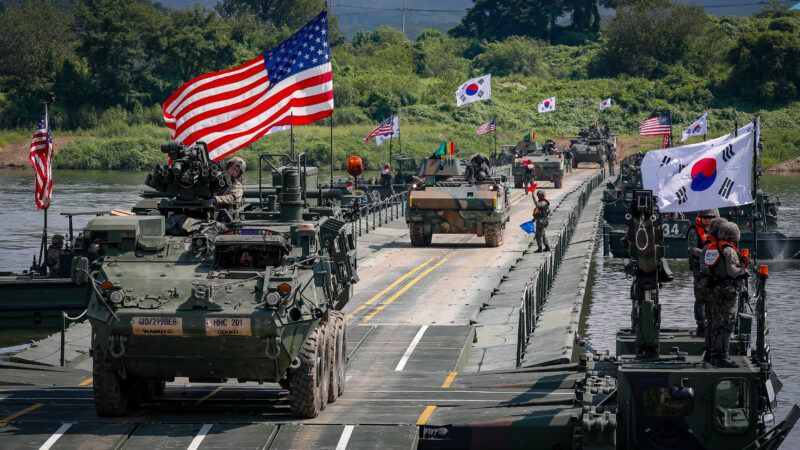
President Donald Trump's decision to "substantially reduce" joint military exercises between the armed forces of the United States and those of South Korea captures the distilled essence of the nation's current chief executive in its combination of petulance and affection for autocrats. On the one hand, he wants to punish our allies in the Republic of Korea for withholding support for the U.S. war with Iran. Especially, though, he wants to avoid offending the communist dictator of North Korea by training alongside our democratic and relatively free allies on the Korean peninsula.
You are reading The Rattler from J.D. Tuccille and Reason. Get more of J.D.'s commentary on government overreach and threats to everyday liberty.
'My Very Good Relationship with Kim Jong Un'
"Based on my very good relationship with Kim Jong Un, of North Korea, I am not happy with the fact that the United States has, long ago, agreed to participate in Joint Military Exercises with South Korea," Trump posted Sunday on Truth Social. "These exercises are not only costly, with much of these costs paid for by the United States of America (as usual!), but send a signal that is totally inappropriate and hostile, to a Country that, as long as Donald J. Trump has been President, has been unthreatening and respectful. Therefore, and based on the fact that it is too late to cancel, I have instructed Secretary of War, Pete Hegseth, to substantially reduce the Joint Military Exercises! While somewhat unrelated (?), I recently asked the President of South Korea if they would like to join us in the Denuclearization of the Islamic Republic of Iran, and they said, 'No thanks!'"
Trump's frustration over the war with Iran is understandable; it's a conflict he refuses to either fully commit to or end as it drags on. There's little evidence that the Iranian officials speaking to U.S. representatives even have control over that country's remaining military. With no plan in play, the Trump administration is now threatening to bomb Oman, a U.S. partner in the region, if it "gets in the way" of a deal with Iran. South Korea isn't the only traditional American ally that doesn't want to get sucked into the quagmire.
South Korea is also highly dependent on fossil fuels from the Middle East, where it gets 70 percent of its oil. It's also geographically close to Iran's allies of convenience—China, North Korea, and Russia—so it's vulnerable to the dangers of a widening war between the U.S. and those authoritarian regimes. Worse, Trump often seems more comfortable with the rulers of those hostile countries than he does with the elected leaders of allied nations. The American president underlined this point when he referred to "my very good relationship with Kim Jong Un, of North Korea" and called that nation "unthreatening and respectful."
The South Koreans listening to Trump praise North Korea and its dictator are the same ones watching their northern neighbors launch ballistic missiles into the ocean as warning shots and send troops across the border to test southern readiness. South Koreans live under constant threat from the communist regime to the north, but its dictator is the one who gets all the praise from the U.S. president. Of course, they're leery of joining in the current administration's overseas adventures. It's not apparent that Trump has thought through his actions, or that he's convinced he's chosen the right allies.
A History of Admiring Dictators
Unfortunately, Trump has a history of turning against our friends and maintaining a soft spot for those hostile to American values.
"It's funny, the relationships I have, the tougher and meaner they are, the better I get along with them," Trump told interviewer Bob Woodward in 2020 about his dealings with world leaders.
It's not just Kim Jong Un whom Trump admires. He has praised both President Recep Tayyip Erdoğan of Turkey and President Xi Jinping of China, in both cases using the term "strong man." He has also been well-disposed towards Russian President Vladimir Putin, though that admiration was sorely tested by the invasion of Ukraine. The president's continuous affection for autocrats has fueled conspiracy theories that he's been compromised by Russian or other foreign intelligence services. But the more credible explanation is that he just envies political leaders who don't have to work within constraints.
"Trump likes and admires dictatorial strongmen," Timothy P. Carney bluntly wrote for the American Enterprise Institute (AEI) in 2018. "This praise for brutal leaders who do whatever necessary to exercise control of their countries reflects other things we know about Trump. I've called his mindset the 'dog park' mindset. Shows of strength earn respect from him. Shows of weakness earn derision."
Carney added that, no matter how much Trump might envy the unconstrained power of explicit dictators, he's bound by the U.S. Constitution, separation of powers, and the courts, which put limits on his authority. But from what he tells interviewers and the world leaders he praises, it's obvious how he would govern if the restraints were removed.
According to a January report in The New York Times: "Asked in a wide-ranging interview with The New York Times if there were any limits on his global powers, Mr. Trump said: 'Yeah, there is one thing. My own morality. My own mind. It's the only thing that can stop me.'"
The Times added: "On topic after topic, he made clear that in his mind, U.S. power is the determining factor—and that previous presidents have been too cautious to make use of it for political supremacy or national profit."
Dictator Envy Is Historically Common and the Reason for Restrained Power
Undoubtedly, Trump thinks he could make better decisions and act more effectively if he didn't have to worry about constitutional restrictions, congressional prerogatives, court decisions, and all the other checks and balances that were deliberately crafted to hobble the exercise of government power in the United States. But so do all would-be autocrats, which includes many U.S. politicians who aren't as honest as Trump in their sentiments. Constraints exist to prevent the unilateral exercise of power no matter how excellently Trump or anybody else think they could govern if only they were unshackled.
South Koreans have many reasons to be leery of Trump and his foreign policy obsessions. Their sensitivity to disruptions in the shipment of Middle Eastern oil, vulnerability to a potentially expanded war, and Trump's obvious soft spot to their main antagonist all play a role in their deliberations.
But Americans should listen closely when Trump—or any other politician—expresses admiration for dictators. Aspirations to rule unchecked and envy for the likes of Kim Jong Un are more common than not among the political class throughout history. The Constitution limits political power precisely because government officials chafe at such restraints.