
Russia Labels Libertarian Party a 'Foreign Agent,' Effectively Ending Its Political Activity
The Libertarian Party of Russia is pessimistic about the chances of overturning these restrictions through the courts or any other legal means.
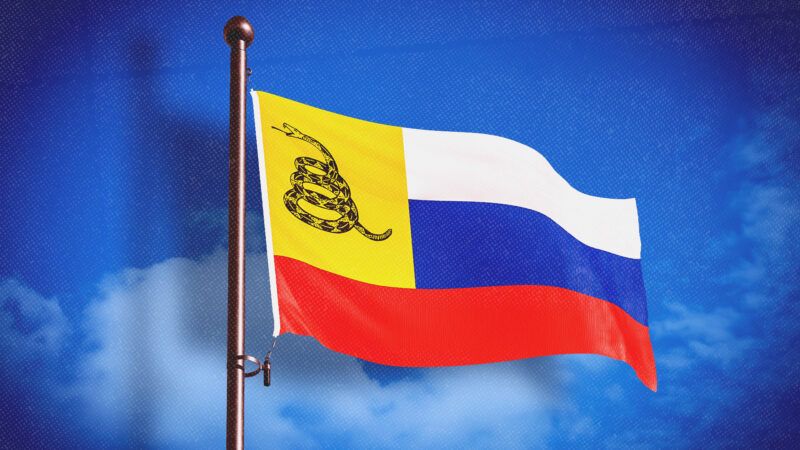
Every Friday, the Russian Ministry of Justice adds new names to its dreaded Register of Foreign Agents, which identifies people and organizations who have allegedly received foreign support while engaging in political activities. This past week, the Libertarian Party of Russia (LPR) and 24 of its members were added to the list.
The registry lists the LPR as an unincorporated public association that disseminated materials of other "foreign agents" and "unreliable information" about the electoral system and policies of the Russian government. Among other allegations, the LPR has been accused of opposing the war in Ukraine and calling for violations of Russia's territorial integrity, according to Russian news agency Interfax.
Being placed on the register means the party can no longer engage in virtually any sort of activity, notably organizing events or participating in elections.
According to a statement provided to Reason, the LPR believes that the "foreign agent" designation was triggered by the Russian government's decision in February to name the International Alliance of Libertarian Parties (IALP) as an "undesirable organization." Although the LPR had no connection with the IALP and issued a public statement distancing itself from the organization, it appears this decision "may have been the first signal from the authorities that libertarians should abandon their fight for the rights and freedoms of Russians," says the party.
Adopted in 2012, Russia's "foreign agents" law empowers the Ministry of Justice to label NGOs as "foreign agents" if they receive foreign funding and engage in political activity. Amendments adopted in 2022 broadened the law to cover media organizations and individuals, including those who do not receive foreign funding but are considered to be "under foreign influence." The legislation, however, does not specify what qualifies as foreign influence, according to Radio Free Europe/Radio Liberty, which cited the Ministry of Justice in saying only 4 percent of the people and organizations added to the "foreign agents" register in 2025 were designated based on foreign funding.
Failing to comply with the vague requirements of Russia's foreign agent laws (which include labeling and reporting rules) will expose LPR members to administrative or criminal liability, including fines, searches, and imprisonment.
In a statement posted to Telegram and X, the LPR condemned the registry placement and denied receiving any foreign support or funding. It also called the move a politically motivated attack by the government to restrict speech and conduct critical of Russian President Vladimir Putin.
"As advocates of individual liberty, freedom of speech, and freedom of association, all of which are enshrined in the Constitution of the Russian Federation, we condemn any attempts to exert pressure on our fellow party members, including the imposition of absurd statuses that have no legal basis, no connection to physical reality or common sense, and that contradict the country's fundamental law," the party said.
Many of those the Ministry of Justice designated as "foreign agents" are prominent figures in one faction of Russia's divided libertarian community, which currently includes two different organizations calling themselves the Libertarian Party of Russia. Among those listed are disputed LPR Chairman Marina Matsapulina and the politician and activist Mikhael Svetov, who was at the center of a party split in 2020. For individuals, the new status will make "their lives significantly more difficult," says the LPR, as they are now required to disclose their "foreign agent" designation in many contexts, which will negatively affect their employment and educational prospects.
Since its formation in 2008, the party has made several unsuccessful attempts to gain official registration. Nevertheless, the party has run candidates in elections, at times in coalition with the leading opposition party PARNAS. In 2012 and 2014, LPR candidates won at the municipal level. The party has also organized a series of large protests and rallies, each of which drew thousands throughout the last decade.
The LPR's open activism, though, has slowed down after authorities began widespread suppression of anti-government activity following the arrest of opposition leader Alexei Navalny. Others in the party left Russia after the country invaded Ukraine in 2022. Many party members have faced prior direct persecution by the state, including Matsapulina, who was forced to leave Russia in 2022 after being accused of "telephone terrorism" due to her participation in anti-war protests.
While the LPR has sought legal counsel to appeal the government's decision, the overall assessment of their situation is pessimistic: "We do not expect that these restrictions and prohibitions can be overturned through the courts or by any other legal means," says the party. As a result, Russian libertarians will likely face even greater persecution in the future as Putin's authoritarian regime continues to tighten its grip.