
The Republican Party Is Nothing More Than a Cult of Trump
The GOP has shifted from endorsing conservative ideas to embodying the whims of one man.
The Republican Party is dead. Long live the party of Trump, which wears the GOP like a skin suit.
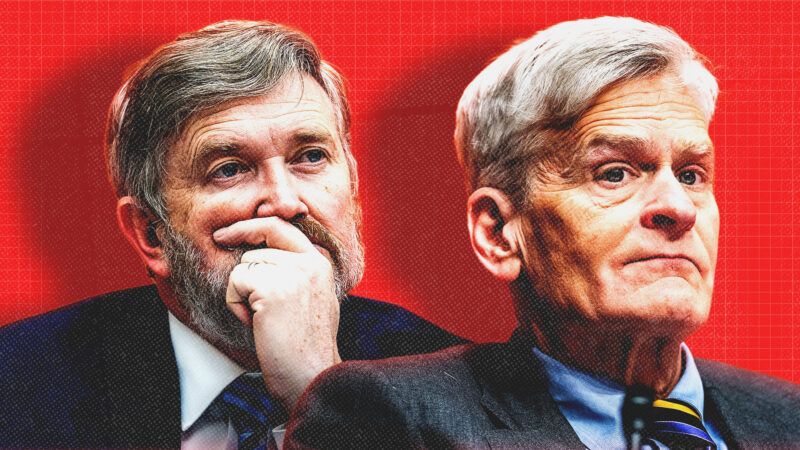
On Tuesday, President Donald Trump took down libertarian-leaning Rep. Thomas Massie (R–Ky.), to whom he'd taken such a profound dislike that he backed a primary challenger in the form of MAGA stalwart Ed Gallrein. Massie was highly ranked for his voting record by conservative organizations, but so were other candidates Trump pushed out of office—and out of the party. In truth, it's been years since the Republican Party was a conservative organization; these days it's a cult of personality around the president.
You are reading The Rattler from J.D. Tuccille and Reason. Get more of J.D.'s commentary on government overreach and threats to everyday liberty.
Trump Turns on 'Unreliable' Members of His Own Party
"Tom Massie of Kentucky, the worst and most unreliable Republican Congressman in the history of our Country, is an even bigger insult to our Nation than Senator Bill Cassidy of Louisiana," President Trump snarked on May 17. That was the day Cassidy lost his state's Republican Senate primary to Trump-backed challenger Rep. Julia Letlow and State Treasurer John Fleming, who now head to a runoff.
By that point, Trump-backed primary challengers had already turned out five Republican Indiana state senators who resisted the president's drive to gerrymander congressional districts to gain advantage in this year's midterm congressional elections.
"Good luck to those Great Indiana Senate Candidates who are running against people who couldn't care less about our Country, or about keeping the Majority in Congress," the president posted on Truth Social prior to release of the Indiana results. "There are eight Great Patriots running against long seated RINOS — Let's see how those RINOS do tonight!"
Massie in turn lost this week to Gallrein, who was backed 54.8 percent to 45.2 percent by Republican primary voters responding to the president's call. Massie had won 99.6 percent of the general election vote in his district in 2024, 65 percent in 2022, and 67 percent in 2020, according to BallotPedia. He was popular until dismissed by Trump, who won 64.5 percent of Kentucky votes in 2024.
When Personal Loyalty Overshadows Principles
Like Cassidy, Massie seemed like a good fit for a nominally conservative political party. Cassidy had a lifetime rating of 79.97 out of 100 from the Conservative Political Action Conference (CPAC). He defeated Democrat Mary Landrieu for the seat in 2014 with 55.9 percent of the vote, then took 59.3 percent in his 2020 reelection effort, reports BallotPedia.
But Cassidy was a Republican before he was a Trump supporter. After voting to acquit Trump during the first impeachment effort against him in 2020, he voted (unsuccessfully) for conviction in 2021 following the January 6 riot by the then-outgoing president's supporters.
"Our Constitution and our country is more important than any one person. I voted to convict President Trump because he is guilty," Sen. Cassidy commented at the time.
That lack of personal loyalty gained the Louisiana senator the eternal hatred of the thin-skinned Trump.
Massie's CPAC score is even more impressive, from the perspective of old-fashioned Republican politics, at a lifetime rating of 92.26. His strongest issue, according to CPAC, is taxes, budget, and spending, on which he holds a score of 100 percent.
But like fellow Kentucky Republican Sen. Rand Paul, who has also drawn Trump's wrath, Massie has a libertarian streak. He generally supports limited government, restraint on the executive branch, and a non-interventionist foreign policy, even when that's inconvenient for a president from his own party.
At one time, that would have earned respect from peers as a matter of adherence to principles over political convenience. It would have annoyed some within his party, but given that those principles are largely ones they allegedly share, his clashes with GOP leadership wouldn't have been career-killers.
In fact, Massie held a seat on the powerful House Rules Committee until early 2025. He was booted off last year after crossing the increasingly Trump aligned GOP leadership.
Trump is hardly done with his efforts to purge Republican lawmakers who show anything other than complete loyalty to his leadership of the Republican Party. Next up is Sen. John Cornyn (R–Texas) who has an 86.63 CPAC lifetime score and has held office since 2002. But, complains Trump, "John was very late in backing me in what turned out to be a Historic Run for the Republican Nomination."
Instead, the president favors Texas Attorney General Ken Paxton, who has been ensnared in several scandals, including allegations of security fraud. He may win the nomination only to lose the seat. But, importantly, the president describes him as "someone who has always been extremely loyal to me and our AMAZING MAGA MOVEMENT."
A Cult of Personality With a Peronist Future
Loyalty to the president keeps popping up because, as conservative commentator George Will pointed out in 2019, the GOP has "become a cult" centered around Donald Trump. Its beliefs are whatever the party leader says, even if that means rejecting free trade in favor of protectionism and dumping free markets for state ownership of industry. "Trump's Republicans agree with the 'opposition' progressive Democrats that the government should be running the economy," I wrote in January.
The embrace of whim-driven state control explains why the president and New York's left-wing Mayor Zohran Mamdani could so easily find common ground when they met last November. Mamdani is a socialist by expressed choice, while Trump is one when it suits him. That doesn't mean they're on the same side of all issues, but they both like top-down decision making so long as they're at the top.
That the GOP is now little more than an expression of Donald Trump's will holds real risks for the party's future. For one thing, the president is unpopular, with an average approval rating of 39.4 percent and 58.5 percent disapproval. Linking Republican candidates' fates to his is like cutting loose an anchor and holding fast to it as it sinks into the depths (countered only by Democrats' own authoritarian lunacy).
Then there's Trump's advanced age; he turns 80 next month. After he leaves the scene, a party that has reshaped itself as an extension of him will be hard-pressed to define itself in his absence. It's in danger of becoming a U.S. version of Argentina's Peronist party, forever asking itself "what would the former strongman do" while waiting to be pushed aside by an American Javier Milei with fresh ideas.
But fading into irrelevance is what a political movement risks when it becomes a cult built around one man. Its prospects rise and fall with those of single fallible and temporary figure.