
Damned if You Do
Plus: Ella Emhoff's SSRIs, measuring childhood independence, the hantavirus cruise ship, and more...
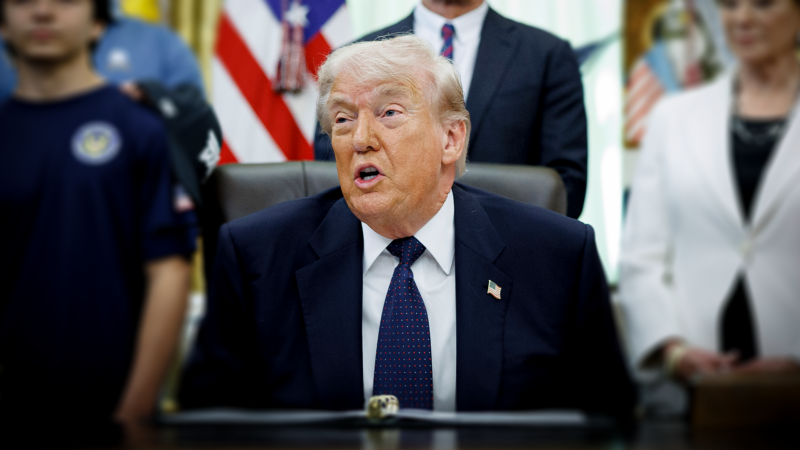
"Below the threshold": At a Pentagon briefing yesterday following Iran's attacks on the United Arab Emirates, the chairman of the Joint Chiefs of Staff told reporters that our adversary's actions were "below the threshold of restarting major combat operations." This shows laudable restraint; it seems the U.S. is interested in shepherding shipping vessels out of the Strait of Hormuz without being pulled back into combat, despite all of Iran's taunts. (Iran's foreign minister said "the U.S. should be wary of being dragged back into quagmire by ill-wishers" and "so should the UAE." I wonder who those mysterious ill-wishers might be!)
The New York Times has warped this restraint into "White House Insists Iran War Is Over, Even While Missiles Fly"—implying that defense officials are delusional vs. choosing not to respond with maximum force to Iran's provocation. ("The White House is turning to rhetorical leaps as President Trump tries to put the biggest political crisis of his presidency behind him," writes the Times' David E. Sanger.)
The Reason Roundup Newsletter by Liz Wolfe Liz and Reason help you make sense of the day's news every morning.
President Donald Trump had said, rather clearly, that the ceasefire would be considered violated if the Strait of Hormuz were blocked. But things aren't always so binary, and sometimes you say things as part of a negotiating tactic. It's probably good that Trump has started to move away from some of his initial objectives (like regime change) and that the administration seems opposed to being dragged into a protracted conflict.
Naturally, as I was writing this, Trump went off and tweeted this. Never a dull moment, never a coherent strategy to analyze. It's possible the restraint I was lightly lauding ends up not being restraint at all, alas:
President Trump says Iran must agree to give up "what has been agreed to," or "the bombing starts." pic.twitter.com/7Ei9sMWWyi
— Trey Yingst (@TreyYingst) May 6, 2026
The new war on drugs: Health Secretary Robert F. Kennedy Jr. has opened up a new front in the war on drugs. No, not psychedelics—he tends to support those. The new Public Enemy No. 1 is selective serotonin reuptake inhibitors. Yesterday, RFK Jr. announced a few federal initiatives aimed at reducing the prescription of SSRIs like Zoloft, Lexapro, and Prozac.
About one in six American adults takes SSRIs. Women in every age group tend to be more likely than men to be SSRI users. Use (among adults) has gone up in recent years, rising from about 13 percent (2015–2018) to a little over 16 percent today. The rate of use among both teens and adults increased by almost 400 percent between 1988–1994 and 2005–2008, according to a 2011 review. That number has only risen since.
"Psychiatric medications have a role in care, but we will no longer treat them as the default, we will treat them as one option, to be used when appropriate, with full transparency and with a clear path off when they are no longer needed," said Kennedy at a summit on mental health and overmedicalization. Side effects discussed by Kennedy, and long reported by users, include a numbing, dulling effect during use as well as difficulty withdrawing.
"We may take issue with this blanket 'overprescribing' hypothesis that underpins the secretary's statements," Marketa Wills, the chief executive and medical director of the American Psychiatric Association, told The New York Times (rather predictably) in the wake of Kennedy's comments. "There is probably overprescribing and underprescribing in all parts of medicine, and mental health care is no different. And there are people who still can't access care at all who need it." (That last sentence is always thrown in, no matter the subject, isn't it? Like a tic.)
Interestingly, Kamala Harris' stepdaughter, Ella Emhoff, went on a whole diatribe on this subject six months ago. She said she's been on antidepressants for at least the last decade, "fifteen years probably"—which would mean she started taking them at age 11, or at age 16 at the latest (if her decade calculation is more accurate). She said she worried about the lack of research done on long-term dependence and noted intense withdrawal symptoms.
You know the cultural consensus is shifting when Ella Emhoff and RFK Jr. start agreeing.
Scenes from New York: Fascinating report out from the Institute for Family Studies on how childhood independence started to disappear and what's to be done about it. Some assembled thoughts here:
It seems like there are quite a few reasons why American parents have gotten risk-averse for this middling bracket (let's call it ages 6-12)––and it's not because life in the world suddenly got more dangerous.
1) CPS more likely to be called than in yesteryear (unsure when… https://t.co/bQQBo9zOSC— Liz Wolfe (@LizWolfeReason) May 5, 2026
QUICK HITS
- A cruise ship that set off from Ushuaia, Argentina, to go explore Antarctica and make its way up to the Canary Islands is now implementing containment measures off the coast of Cape Verde due to the spread of hantavirus aboard the ship. Three people have died so far. This whole situation sucks not only for the people on board, some of whom are infected with hantavirus (which is gotten from rodent droppings and urine), but also for the cruise ship industry overall, which had experienced a bit of a rebound since pandemic cruise ship lockdowns.
- How new tech is changing (ruining?) fishing and hunting. ("We're about ethical hunting," Tony Schoonen, chief executive of the Boone and Crockett Club, tells The Wall Street Journal. "And that argues for self-restraint by the hunter when it comes to technology.")
- "The Education Department has opened a civil rights investigation into whether Smith College, the women's school in Northampton, Mass., violated anti-discrimination laws by allowing transgender students to enroll," reports The New York Times.
- Labor market improving? "Employers hired 5.55 million people in March, a stunning rise of 655,000 from February," reports Axios. "In another positive sign for the job market, the quits rate ticked up, with 125,000 more Americans voluntarily leaving their jobs—a small move but a sign of greater confidence in finding work elsewhere." Still, job openings numbers dropped and layoffs surged a bit, so it's a mixed bag.
- Delta tries penny-pinching.
- It's happening:
Breaking: The EEOC has sued the New York Times, alleging that it violated federal law by discriminated against a white, male employee, passing him over for a promotion. pic.twitter.com/SGmzJvlhlC
— Scott Nover (@ScottNover) May 5, 2026
- New Ehrlich just dropped:
Personal news: I am writing a book!
The conversation around birthrates has grown toxic. The truth is that fertility decline is mostly a consequence of greater freedom and opportunity, and seems unlikely to reverse. We can deal with the downsides -- if we confront them head on. pic.twitter.com/tyPbJBUxsj
— Lydia DePillis (@lydiadepillis) May 5, 2026