
Lindsey Graham Says the President Can Start a War, but Only Congress Can End It
The feeling is perfectly consistent: Graham feels it should be as easy as possible for the U.S. to start a war, and as hard as possible to end one.
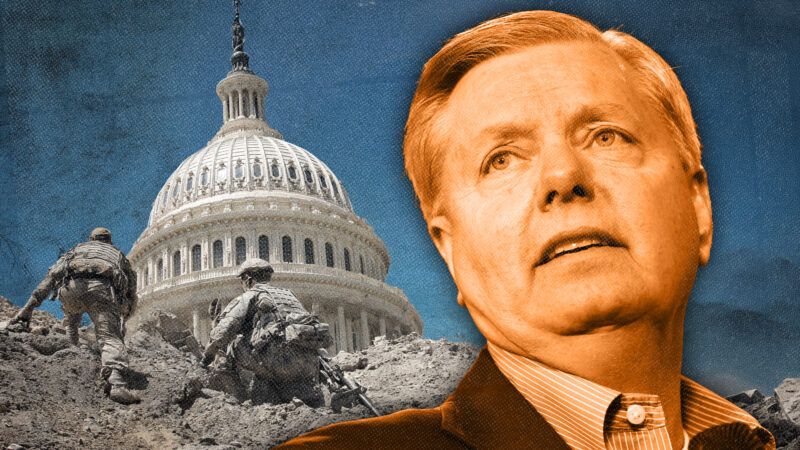
This week, Iran submitted a list of demands to end the U.S.' ongoing war in that country; President Donald Trump said he and other officials "believe it is a workable basis on which to negotiate." Either way, it's clear most Americans are hoping for an off-ramp from a conflict that is wreaking havoc on gas prices and American infrastructure.
Sen. Lindsey Graham (R–S.C.) suggested Congress has a role to play in that process. But given his past statements, as the Senate's biggest supporter of war with Iran, Graham apparently thinks Congress can only end a war, not start one.
"Like everyone, I hope we can end the reign of terror of the Iranian regime through diplomacy," Graham wrote on X. "As to an Iranian ten point proposal to end the war, I look forward to reviewing it at the appropriate time and its submission to Congress for a vote, like we did with the Obama JCPOA"—referencing the Joint Comprehensive Plan of Action, the 2015 multinational agreement that sought to limit Iran's pursuit of a nuclear weapon. Trump withdrew from the deal in 2018, calling it "one of the worst and most one-sided transactions the United States has ever entered into."
"A congressional review process like the one the Senate followed to test the Obama Iranian deal is a sound way forward," Graham added in a later post. "Fair and challenging questions with a full opportunity to explain, and a healthy dose of sunlight is generally the right formula to understand any matter. Simply put, kick the tires."
That's an admirable goal, to leave consequential U.S. policymaking to the country's elected policymakers in Congress. If only Graham felt the same way about the process of starting a war in the first place.
"The Congress shall have Power," under Article I, Section 8 of the U.S. Constitution, "To declare War." And yet the administration's supporters in Congress have happily ceded that power to the president: In March, a vote to rein in Trump's Iran war failed in the Senate.
But when NBC's Kristen Welker asked Graham, "Does Congress now need to vote to approve this war with Iran?" the senator replied, "No. I have no desire."
Welker then asked whether Trump needed to ask for authorization. Graham again said no.
"This is a military operation designed to eliminate threats that have existed against our country," he explained. "[Trump] was justified doing this. Every president before him talked about doing it. He actually did it. He has the legal authority to do it. And these operations will continue until the threat is no longer there."
In fact, Graham has been so giddy about Trump's unconstitutional war in Iran that he immediately started looking forward to the next one, teasing last month that Cuba would be next.
In 1973, Congress passed the War Powers Resolution, which put constraints on the president's ability to commit American troops to open-ended conflict. If the president deploys troops, he must either end the conflict or seek congressional approval within 60 days.
It's certainly plausible that the law is unconstitutional: The Constitution says nothing about the president's ability to command troops in a conflict not authorized by Congress. Yet the War Powers Resolution takes it for granted that he can, and merely sets limitations on that illusory power.
Graham, on the other hand, believes the law is unconstitutional because it gives the president too little power.
"The Founding Fathers…designated a single entity in the Constitution, the president, as commander in chief. They gave power to Congress to declare war," Graham said last month amid Senate debate on whether to terminate the Iran war. "Now, does it mean that you can't have military conflict unless Congress declares war? No."
Graham noted that Congress has only ever declared war five times, whereas "we've had over 130 conflicts since the War Powers Act, where Congress never authorized anything." (Congress has actually declared war 11 times, though only in five individual conflicts.)
"The norm in this country is not to declare war by Congress, but for the military to be used by the commander in chief—sometimes authorization from the Congress is requested, sometimes it's not. More than not, it's not requested," Graham said. "The president, as commander in chief, has the ability to use our armed forces to protect our nation, and Congress, if we disagree with that choice, has the ability to terminate the action by taking the money away."
So, Graham feels that even though the Founders, when drafting the Constitution, felt it necessary to enshrine Congress' "power…to declare war," it's merely a formality, and the president has the freedom to use American soldiers as he wishes. Congress' only recourse, if he does so unwisely, is to stop paying for it—a much more complex process than the president simply deploying troops on a whim.
By the same token, in the debate around operations in Iran, Graham feels the president can start a war without anybody's permission except his own. But ending a war, says Graham, would require the consent of a majority of all 535 members of Congress.
While it sounds like nonsense, this is actually perfectly consistent: Graham apparently believes it should be as easy as possible for the U.S. to start a war, and as difficult as possible to end one.