
New York Wants a Cut of Counter-Strike's Loot Boxes
Attorney General Letitia James says they're a form of illegal gambling. But the state seems more interested in untaxed revenue than consumer protection.
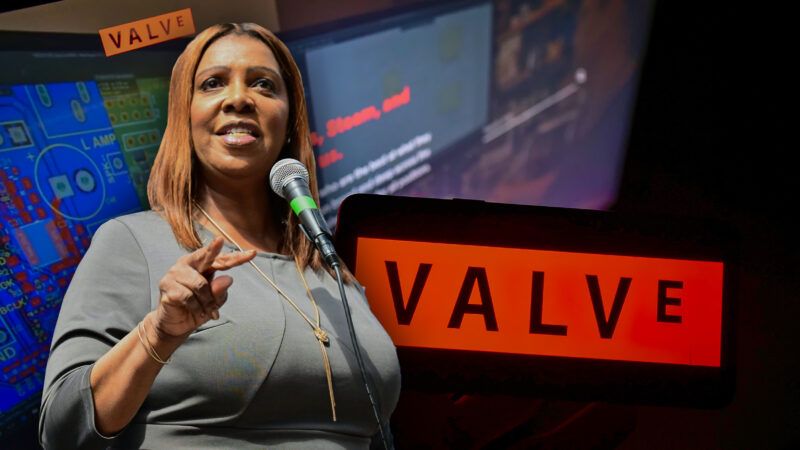
New York Attorney General Letitia James has discovered a new threat to public safety: a $2.50 video game purchase. She recently sued Valve Corporation, the company behind Counter-Strike 2 and the Steam gaming platform, over a supposed illegal gambling feature. The lawsuit demands refunds for affected New Yorkers and a substantial fine paid to the state.
What exactly is this case about, protecting consumers or making sure Albany gets a cut?
Filed in February 2026, James' complaint targets Valve's "loot boxes," where players spend $2.49 on a digital key, open a virtual case, and receive a randomly assigned, purely cosmetic "skin" for weapons like the AK-47. Most players get something common, worth pennies. But some receive rare virtual items worth hundreds or even thousands of dollars. A single Counter-Strike skin reportedly sold for over $1 million in June 2024.
"Valve has made billions of dollars by letting children and adults alike illegally gamble for the chance to win valuable virtual prizes," James said in a statement. "These features are addictive, harmful, and illegal, and my office is suing to stop Valve's illegal conduct and protect New Yorkers."
James argues that paying for a chance at a random outcome of real value is gambling under New York law. When New Yorkers place sports bets, they face access restrictions, age verification, and a hefty tax. Valve and Counter-Strike players face none of those requirements.
Yet the attorney general isn't just seeking to regulate Valve like a gambling operator. She wants something far more punishing: full restitution to every New Yorker who has ever "gambled" on a loot box—regardless of age—plus a fine of three times Valve's related profits.
That raises an immediate problem: It's hard to pay restitution for something without a fixed value. Skin prices fluctuate, driven by rarity, game updates, and community sentiment. The market hit around $6 billion in early 2025 before Valve's own rule changes reduced the market cap significantly. Calculating players' supposed losses is, at minimum, a serious legal headache.
The penalty demand is even more revealing. James is seeking a threefold penalty on all "gains" accumulated in New York since 2014. While precise revenue figures are proprietary, a back-of-the-napkin estimate places the penalty somewhere north of $150 million.
That is not a consumer-protection remedy. It's a revenue target—and an especially punitive one from a state that has no problem with gambling. New York operates the largest online sports betting market in the country, processing roughly $2.4 billion in wagers in January 2026 alone. DraftKings and FanDuel advertise freely in sports broadcasts watched by children and adults alike. Slot machines run at licensed casinos. Lottery tickets are sold in corner stores.
The difference is simple: Valve pays Albany nothing. New York taxes 51 percent of gross gaming revenue—the highest rate in the nation—netting over $1 billion in 2024. On loot boxes, the state collects zero.
And Valve may not be the only target. Just weeks before filing the suit, James issued a consumer alert warning New Yorkers to stay away from prediction markets like Kalshi and Polymarket, calling their products "bets masquerading as event contracts." These platforms are federally regulated by the Commodity Futures Trading Commission but do not pay state gambling taxes. A win against Valve would create a useful precedent for going after other untaxed markets.
New York can decide what counts as gambling within its borders. But other governments have approached loot boxes without resorting to exorbitant fines. Belgium and the Netherlands blocked loot boxes entirely. France and Germany took a lighter touch, requiring an "X-ray scanner" rather than slot machine–style reveal animation to give players visibility into what they are buying. None demanded exorbitant payments or required Valve to refund every individual who ever bought a skin.
Maybe the attorney general really believes making an example of Valve will protect the public. The broader pattern, however, suggests a different strategy: identify online activities that resemble gambling, but have not yet been licensed or taxed, and bring the hammer down. That may fill Albany's coffers, but it comes at the cost of innovation and freedom to participate in emerging digital markets.