
Senate Punts on Iran War Powers as Ground War Grows More Likely
Lawmakers are refusing to acknowledge what is increasingly looking like a big, long war.
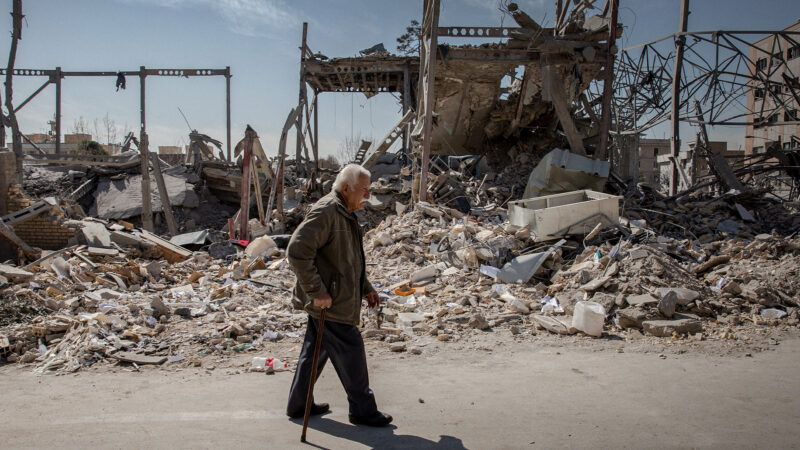
On February 24, 2022, the Russian government announced the beginning of a "special military operation" in Ukraine. Russian propagandists—as well as the CIA—predicted that Ukraine wouldn't last more than a few days. Four years later, the Ukrainian military is carrying out mass air raids inside Russian territory.
A few days after the fourth anniversary of that war, U.S. President Donald Trump announced the beginning of a surprise "major military operation" to bring "freedom" to the people of Iran. He and his advisors insisted that the war would be over quickly, maybe within a few weeks. Now, five days into the war, U.S. Central Command is reportedly preparing for combat that will last at least 100 days and perhaps until September.
But members of Congress are still insisting that the war is not a war. On Wednesday night, the Senate voted down a war powers resolution that would restrain the president. Republicans incoherently insisted that the United States is not at war and has already been at war with Iran. Some Democratic opponents of the war, meanwhile, have indicated that they will still vote to fund it.
"We're not at war right now. We're four days into a very specific, clear mission," Speaker of the House Mike Johnson (R–La.) said at a press conference before the vote.
"We're at war with Iran. We've been at war for a long…they've been at war with us. We're finally at war with them. It's an undeclared state of war," Sen. Lindsey Graham (R–S.C.) told reporters in the hallway of the Senate.
Sen. Todd Young (R–In.) had initially opposed invoking the War Powers resolution over Venezuela earlier this year because there wasn't any war yet and the administration promised to ask for permission "in advance for an authorization of force." On Wednesday, he voted against the war powers resolution for the opposite reason: There's already a war and it's too late for an "abrupt disengagement."
The Department of War is expected to ask Congress for $50 billion in extra funding to continue the war. While some Democrats say that they will not fund the war—Sen. Ruben Gallego (D–Az.) wrote on social media that "countries of the Middle East need to pick up the tab" instead of American taxpayers—other Democratic senators aren't ruling it out. "I mean, we're in it," Sen. Elissa Slotkin (D–Mich.) told Politico.
Meanwhile, the Trump administration has pointedly refused to rule out putting "boots on the ground." American sources and a Middle Eastern official told Middle East Eye, a magazine based in London, that Secretary of War Pete Hegseth is pushing for ground troop deployments in Iran, something Secretary of State Marco Rubio is pushing back against.
U.S. ground troops have already clashed with the Iraqi army while carrying out an unknown operation in the desert. And U.S. covert operators are training exiles in Iraqi Kurdistan to attack Iran and create a "buffer zone" within the country, CNN and Al Monitor report. The administration told Fox News, Axios, and The Jerusalem Post on Wednesday night that the Kurdish offensive had already begun, only for Kurdish leaders and journalists on the ground to deny it was happening.
Although U.S. and Israeli officials insist that their air patrols have been able to suppress Iranian missile fire by hunting down launchers, they haven't been able to stop Iran's attack drones, which have killed at least six U.S. troop members in Kuwait and shut down oil shipping throughout the region. Arab states that host U.S. troops are complaining that they're running dangerously low on air defense ammunition, CBS reports.
Trump's goals for the war may go beyond what airpower alone can do. The President told Axios on Thursday that he needs to be personally involved in picking Iran's next leader.
Axios also reports that Israeli Prime Minister Benjamin Netanyahu, who pushed Trump to start the war, was asking the White House for assurances that the U.S. wasn't negotiating for peace with Iran after Israeli spies caught wind of secret talks.
"Once war begins and American soldiers are under fire, a rational discussion of the pros and cons of war becomes nearly impossible. That is exactly why our Founders wrote a Constitution that demands a debate before the initiation of war," Sen. Rand Paul (R–Ky.), sponsor of the war powers resolution, wrote in an essay published by Fox News.
"And because there was no national discussion about going to war, we do not know whether ground troops will be used. We have no idea how long the war will last. We have no idea who will lead Iran after the death of the supreme leader. And we have no idea how many casualties the American people are supposed to tolerate," he continued.