
The Goalposts of the Iran War Keep Shifting
Trump and his team can’t get their story straight on why they started this war, how long they plan to fight it, and whether they'll put boots on the ground.
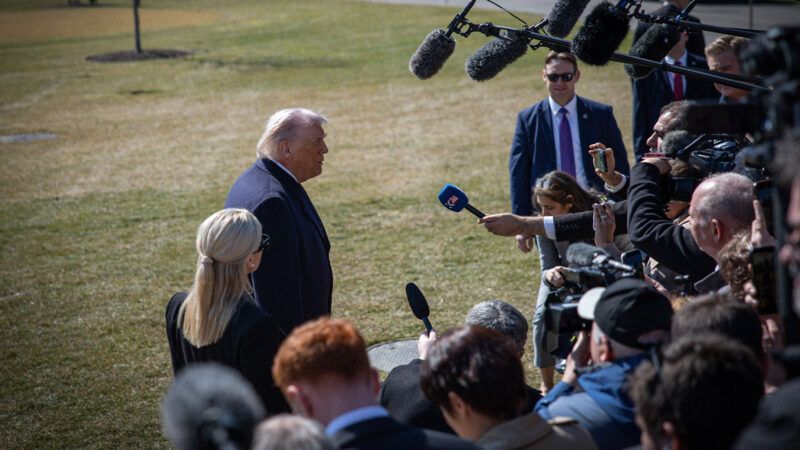
The U.S.-Israeli attack on Iran that began over the weekend is shaping up to be a serious regional war. Iran has not only fired back at U.S. troops but has fired at countries that host them. The Pentagon has acknowledged four American deaths and 18 serious injuries, with President Donald Trump expecting more. On Monday morning, three U.S. fighter jets were shot down in an "apparent friendly fire incident" over Kuwait, and natural gas prices shot up by 50 percent in Europe after Iranian air raids shut down Qatari and Saudi energy facilities.
While the war has been carried out by air so far, Trump has pointedly refused to rule out a ground invasion of Iran. "I don't have the yips with respect to boots on the ground—like every president says, 'There will be no boots on the ground.' I don't say it," Trump told the New York Post. "I say 'probably don't need them,' [or] 'if they were necessary.'"
The administration didn't try to sell the war beforehand, and it can't get its story straight now. Over the weekend, U.S. officials gave a series of explanations for why they attacked Iran when they did: to preempt a possible Iranian attack (which other officials say wasn't real), to join in an Israeli attack that was going to happen "with or without the United States," to take advantage of a fleeting opportunity to kill Iranian leadership, or to punish Iran for failing to give in to U.S. demands in time.
Trump himself has given several different answers about what his goals are. He has told different journalists that he is fighting for "freedom for the people" of Iran, for a leadership shuffle similar to "what we did in Venezuela," or for a diplomatic deal. Trump also said that he has "very good choices" for who should lead Iran, only to claim later that "none of the people we had in mind are going to come to power, because they are all dead."
And the original justification that Trump and Vice President J.D. Vance offered—stopping an Iranian nuclear bomb—seems to have completely fallen by the wayside. There's "no indication" from satellite imagery that either the U.S. or Israel has attacked any Iranian nuclear sites so far, U.N. International Atomic Energy Agency Director General Rafael Grossi told an emergency meeting of nuclear officials on Monday morning.
At a press conference on Monday morning, Chairman of the Joint Chiefs of Staff Gen. Dan Caine said that the U.S. goal was to remove Iran's "ability to project power outside its borders" by destroying its military. Defense Secretary Pete Hegseth added that "this is not a so-called regime change war, but the regime sure did change."
Trump told The New York Times that the war could last "four to five weeks," and Hegseth said at the press conference that the President "has all the latitude in the world to talk about how long it may or may not take. Four weeks, two weeks, six weeks. It could move up. It could move back." Of course, as the saying goes, the enemy gets a vote. In response to a report that U.S.-Iranian negotiations were about to resume, Iran's de facto military leader Ali Larijani declared on social media, "We will not negotiate."
Although most Americans have not felt it directly yet, the war has had an immense cost in blood and treasure in the region in just its first three days. The fighting in the Persian Gulf has disrupted global shipping and air travel, especially through the Straits of Hormuz, which carry 15 percent of the world's oil and 20 percent of its liquified natural gas. Banks and analytics firms estimate that oil prices could rise to $100 per barrel (from a prewar price of less than $70) if the war drags on.
Qatar, the world's largest exporter of natural gas, shut down all exports due to Iranian air raids on two of its facilities on Monday morning. The same day, Saudi Arabia temporarily halted operations at its largest oil refinery after shrapnel from an intercepted drone started a fire.
Perhaps the worst single incident of the war was the attack on the girls' elementary school in Minab, Iran. The school is about a quarter mile from a naval base that was also targeted in U.S.-Israeli raids. The U.S. military told the Washington Post that it was "looking into" the incident. Authorities report that 165 people, many of them schoolgirls, were killed. "Her head was crushed by falling stones from the building. That is what killed her," the father of one schoolgirl, Zeinab Mirkhayali, told Drop Site. "My dream died with her."
Despite all the chaos, the Trump administration is insisting that it is too smart and too bold to be bogged down in the same kinds of Middle Eastern debacles as its predecessors. "This is not Iraq. This is not endless," Hegseth said at the press conference. "We fight to win, and we don't waste time or lives."