
Peru's Marxist President Changes His Mind, Doesn't Make Hernando de Soto Prime Minister
The libertarian-leaning economist warns of the coming “Venezuelization” of Peru.
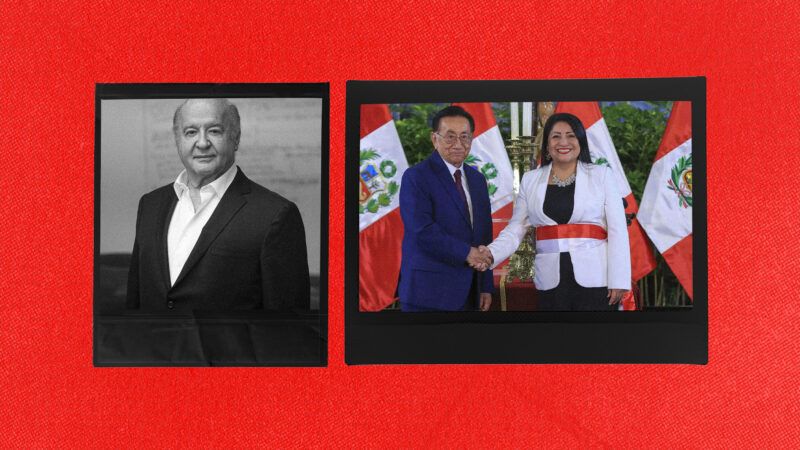
Marxist Peruvian President José María Balcázar announced Monday that free market economist Hernando de Soto would serve as Peru's next prime minister. What was expected to be a rare display of camaraderie between Marxists and free marketers in Peru has since turned sour. On Tuesday, de Soto was blindsided by the surprise appointment of Finance Minister Denisse Miralles as prime minister. De Soto blamed Cerronistas, an extreme faction within the Marxist-Leninist Perú Libre party, for conspiring against him.
Miralles' appointment is the first major mistake of Balcázar, who Congress elected last week to replace the scandal-ridden former President José Jerí, who was ousted over "undisclosed meetings with a Chinese businessman," reports Reuters. Even though Balcázar will only serve as the interim president until a new one assumes the office in July, foregoing de Soto's economic expertise is a missed opportunity for the South American nation, a conclusion Balcázar himself acknowledged earlier this week.
On Monday, Balcázar told Peruvian news outlet Exitosa that the country must turn to de Soto "to guarantee [Peru's] economic model and ensure that the new president of the republic…has clear guiding principles and no economic shocks."
A native of Arequipa, Peru, de Soto founded the Institute for Liberty and Democracy (ILD) in 1980 to study the relationship between property rights and poverty. At the time of the ILD's founding, Peru was one of the least economically free countries in the world, scoring 3.66 out of 10 (placing it at 102 out of 110 countries) on the Fraser Institute's economic freedom index. It had a measly GDP per capita of about $3,800 (in constant 2010 U.S. dollars).
De Soto explored the connection between Peru's lack of economic freedom and its poverty in The Other Path (1986). In the October 1989 issue of Reason, de Soto condemned Latin American Marxists for treating "the poor as an oppressed proletariat with no interest in entrepreneurship and free markets" and explained the relationship between the country's regulatory bloat and economic underdevelopment.
De Soto blamed the 27,000 rules created per year—only 1 percent of which were actual laws passed by the Peruvian Congress—for driving Peruvians into the black market, thwarting capital accumulation, investment, and growth by imposing unjustifiable burdens to entering the formal economy. (As an example, de Soto's team compared the difficulty of registering a small garment shop with the government in Peru to doing the same in New York City. What took the ILD team four hours in the U.S. took them 289 days in the outskirts of Lima.)
Responding to the regulatory strangulation identified by de Soto's research, the Peruvian Congress passed the Administrative Simplification Law in June 1989, which "oblige[d] the State to remove…unnecessary obstacles and costs for society," according to Andina, Peru's state-owned news agency.
But not everyone appreciated de Soto's work. The Shining Path, a Maoist terrorist group, bombed the ILD's offices in April 1991 and stormed them in July, resulting in a skirmish with security guards that killed three and wounded at least 20.
Still, de Soto continued advocating for private property rights for Peru's most vulnerable, which earned him the Cato Institute's 2004 Milton Friedman Prize for Advancing Liberty and created lasting impacts for the country.
The World Bank credits the ILD for "conceiving, promoting, and implementing all aspects" of the Registro Predial, an inexpensive property registration system that "registered some 300,000 titles from 1991 to the end of 1995 in urban Lima." Inspired by this success, the Law to Promote Access to Formal Property was passed in March 1996, establishing the Comisión de Formalización de la Propiedad Informal, "with the principal mandate to formalize existing property in poor urban settlements." It was a stunning success: "By December 2001 nearly 1.2 million of the country's previously unregistered residents became nationally registered property owners," according to Erica Field, a professor of economics at Duke, increasing labor force hours and reducing distortions in labor allocation.
By 2023, Peru's economic freedom score had doubled, and its real GDP per capita had increased by 73 percent.
Despite Peru's political turmoil—cycling through five presidents in as many years—Bloomberg reports that the country's economy, "one of Latin America's most resilient…with growth that outpaces its peers, low inflation and a stable currency," remains unfazed. On Monday, Balcázar cited de Soto's technical expertise, ability to build consensus, and international contacts as reasons for his appointment. At the end of the day, these words proved to be meaningless, and it was Miralles, an economic engineer specializing in public-private partnerships, who has led the finance ministry since October, who was sworn in as prime minister.
After his surprise replacement, de Soto told reporters on Wednesday night that he conditioned his acceptance of his appointment on bringing about real institutional changes rather than being used as a mere figurehead. To do so, de Soto told Balcázar he must be allowed to replace the Cabinet of Ministers with people uninvolved in Balcázar's government, including independent advisers from the U.S., Europe, and Asia. De Soto said Balcázar stipulated to this plan and agreed to his list of cabinet members after a three-hour-long breakfast.
In a statement released by Blacázar around midnight, the president said "it was not possible to reach the necessary consensus…due to the brief and transitional nature of the constitutionally granted mandate." De Soto, however, has a different explanation; he told reporters that Cerronistas, the farthest-left faction of Perú Libre, did not want to see him and Central Reserve Bank Chairman Julio Velarde continue the trend of turning Peru into a market economy.
Perhaps Miralles' replacement of de Soto can be explained by her less stringent fiscal policy.
Miralles told Bloomberg in a late January interview that Peru should soften its 2026 fiscal target, 1.8 percent of gross domestic product (GDP), after achieving its 2025 target of 2.2 percent—the first time in three years it did so. While the Peruvian economy is expected to grow by 3 percent in 2026, Miralles defended her support of increased deficit spending by optimistically projecting 5 percent growth. On Tuesday, Miralles did an about-face, saying "the government's policy direction will remain firm and unchanged" and that her council "will act with clear signals of stability, fiscal responsibility, and respect for the rules that build confidence," according to Andina.
Hopefully, Miralles will be actually committed to fiscal responsibility and policies that foster real economic growth. De Soto, however, believes that the replacement of him and his cabinet is further evidence of the "Venezuelization" of Peru.