
Trump Administration May Grant Asylum to Turkish National Who Burned a Quran in the U.K.
Like free speech in the U.K., the White House’s interest in this case shows that free speech is for some, but not for all.
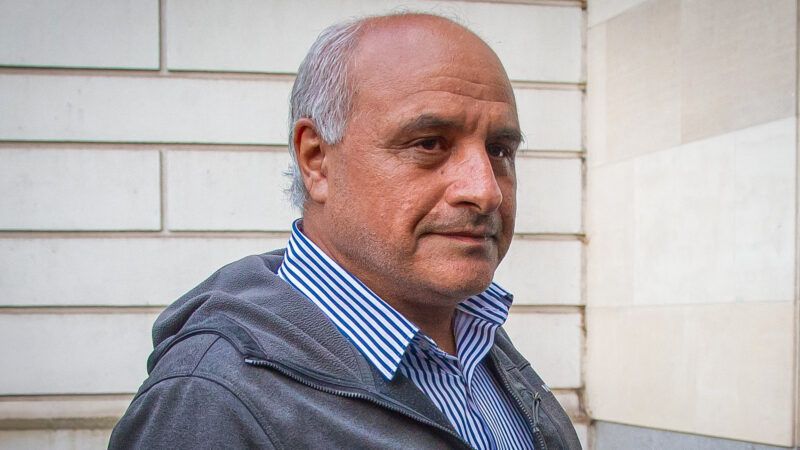
Last February, Hamit Coskun stood outside the Turkish embassy in London and lit a Quran on fire while shouting "Islam is a religion of terrorism" and "fuck Islam." On Tuesday, his case returned to a U.K. court. According to the BBC, a decision is due to be made "at a later date," but if things don't go his way, he might be granted asylum in the United States.
Last June, Coskun, a U.K. asylum seeker from Turkey, was convicted of breaching the U.K.'s Public Order Act, which makes it an offense to use "threatening or abusive words or behaviour, or disorderly behaviour," and for harassing the "religious institution of Islam." During the trial at the Westminster magistrates' court, U.K authorities argued that burning the Quran in front of an embassy amounted to disorderly public behavior. Coskun was then convicted of a religiously aggravated public order offense. This carried a fine of 240 pounds (about $323) and "a statutory surcharge" of 96 pounds ($129), according to the BBC.
His conviction was overturned in October by Justice Joel Bennathan. He ruled that "while burning a Koran might be something 'many Muslims find desperately upsetting and offensive', the right to freedom of expression 'must include the right to express views that offend, shock or disturb,'" reported The Telegraph at the time.
On Tuesday, U.K authorities launched an appeal against that decision. Barristers told a hearing at the High Court that it is "in itself disorderly" to burn a religious text," and have asked the High Court to send the case back to a lower court for reconsideration.
Stephen Evans, chief executive officer of the National Secular Society, which helped fund Coskun's appeal, said that the government "appears determined to establish a blasphemy law by the back door," according to The Times.
Now living in a safe house, Coskun said that if he won the case, he would remain in the U.K. and continue to burn Qurans as part of a political protest against "the dangers that Islam poses to the Western world." If he loses, he told The Telegraph that he "may be forced to flee the UK and move to the USA, where President [Donald] Trump has stood for free speech and against Islamic extremism."
A senior U.S. administration official told the paper that Coskun's case was "one of several cases the administration has made note of." The Trump administration has discussed granting him refugee status, which would allow Coskun to apply for political asylum.
This is not the first time that someone has been arrested in the U.K. for speech that would have been constitutionally protected in the United States. Lucy Connolly, a 42-year-old mother from Northampton, was sentenced to 31 months in prison over a single tweet. Graham Linehan, comedian and cocreator of British sitcom Father Ted, was arrested at a London airport by five armed police officers after flying from Arizona for a tweet he had posted while in the United States. On average, 33 people in the U.K. are arrested for offensive posts on social media per day, according to The Times.
The case also reveals an interesting juxtaposition in U.S. immigration policy. Since his return to office, Trump has made it increasingly difficult for immigrants from certain countries to receive state protection or come to America. In June 2025, the Department of Homeland Security "terminated the parole status of hundreds of thousands of migrants from Cuba, Haiti, Nicaragua, and Venezuela," writes Reason's Autumn Billings. In December, the State Department placed a complete hold on all asylum applications, regardless of nationality.
And yet, in Coskun's case, the Trump administration is essentially encouraging him to claim asylum, which is difficult to ignore, given how neatly his anti-Islam protest aligns with the president's rhetoric on the issue.
Taken together, Trump's interest in Coskun's case suggests that asylum, like free speech in the U.K., is being treated more as a political tool than a principle: It's vigorously defended when it aligns with government interests, and abandoned when it does not.