
When Police Can Keep Seized Cash, Abuse Follows
An Oklahoma City scandal highlights how civil forfeiture incentives undermine accountability and public trust.
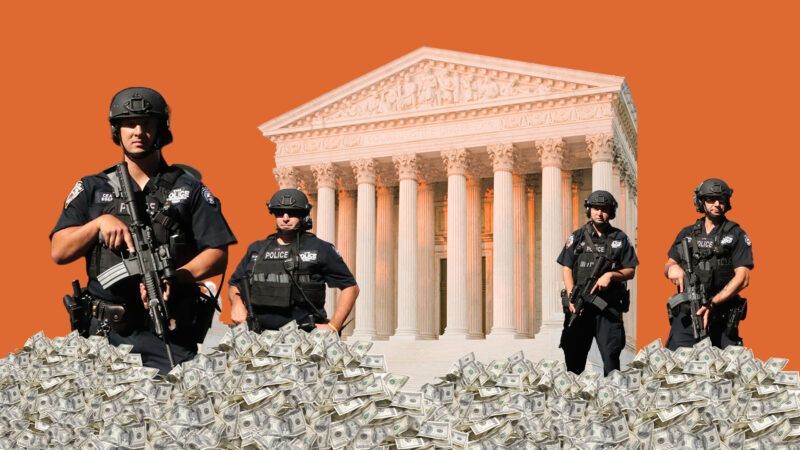
Oklahoma City's police department is the latest law enforcement agency exposed for mishandling forfeited money. Former city attorney Orval Jones blew the whistle, accusing the city of participating in a "nefarious scheme" to divert forfeiture proceeds into police coffers instead of returning property to owners or using it to reimburse victims and the courts.
As reported by The Oklahoman, Jones compiled a list of seizures spanning over 20 years that totaled over $400,000 in misappropriated funds. He says many "unclaimed property" cases labeled owners as unknown even though their information appeared in police reports. In one 2017 case, $7,000 was kept in a police forfeiture fund because an address was missing from paperwork. When the owner sued, he was reimbursed with taxpayer funds while police kept the cash. After bringing these findings forward, Jones was reassigned at the police chief's request and later resigned "under duress."
"It is critical for the reputation of Oklahoma City that we are not considered the center of highway robbery in the heart of the country," Jones wrote in an email to a city official.
Highway robbery may be the most accurate description of civil forfeiture, which typically begins with a traffic stop or an airport encounter where officers manufacture a reason to search and seize cash or goods. Cash is not contraband, but officers frequently assume that carrying large amounts must be tied to illegal activity.
Unless actual contraband is discovered, owners are rarely charged with a crime. They are simply sent on their way without their property, with little chance of getting it back. They must hire an attorney—often at a cost greater than the property's value—or try to navigate a byzantine legal process that frequently ends in default judgment.
People lose their property without ever being charged because civil forfeiture relies on the legal fiction that property itself can be "guilty," forcing owners to effectively prove their own innocence to recover it. Against such odds, they rarely succeed.
Meanwhile, law enforcement often keeps the proceeds, depositing them into extra-budgetary funds that can be spent with minimal oversight. These accounts have financed everything from margarita machines and a Zamboni ice-clearing machine to armored MRAPs, a muscle car for a sheriff's personal use, and trips to Aspen and Paris.
Other times, officials simply keep the money. Last June, Hialeah, Florida's former police chief was charged with grand theft and organized fraud after over $3.6 million in forfeiture funds went missing. In 2024, a sheriff's office budget analyst in Albany, New York, was sentenced for stealing over $122,000. In 2023, a Pennsylvania drug task force detective pleaded guilty to stealing $171,000 in forfeiture funds, while a Detroit-area prosecutor admitted to embezzling over $600,000.
These cases are not coincidences. Corruption is endemic to forfeiture: The system's lopsided procedures shield law enforcement agencies from accountability while granting access to millions in loosely supervised funds. That's a practically foolproof formula for fraud and misconduct.
To fix this, reforms are needed at the federal, state, and local levels.
To start with, Congress should pass the FAIR Act to end the profit incentive that drives many federal forfeiture abuses by directing proceeds to a general fund instead of law enforcement accounts. It would also end the so-called "equitable sharing" program, which allows agencies to bypass state protections.
States must follow suit. Oklahoma Gov. Kevin Stitt's recent executive order mandating public reporting of civil forfeiture use is a start, but it won't improve the state's D- grade for its civil forfeiture laws in the Institute for Justice's Policing for Profit report. Real reform would mirror New Mexico and Maine, which have replaced civil forfeiture laws with criminal forfeiture requiring a conviction.
Local police departments and prosecutors should go further by abandoning civil forfeiture altogether or at least setting minimum thresholds to avoid targeting people who rely on cash for everyday expenses. Doing so would help insulate local officials from the scandalous events of Oklahoma City and the expensive litigation likely to follow.
These recurring scandals are symptoms of a deeper problem: Civil forfeiture allows law enforcement to self-fund with little accountability. Until those incentives are removed, it will remain a fertile breeding ground for waste, fraud, and abuse.