
The Hawks Are Lying Us Into Yet Another Middle Eastern War
Like the Iraq War, the planned war with Iran is built on false premises. Unlike the Iraq War, there hasn’t even been a real public debate.
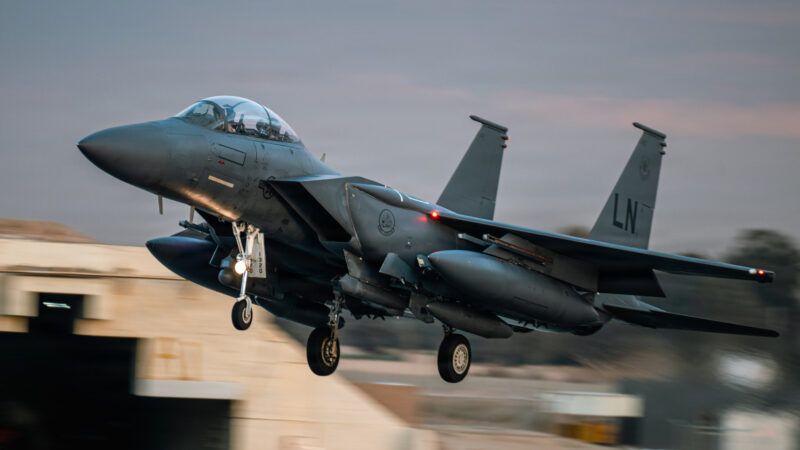
The United States is entering a self-inflicted crisis in the Middle East. President Donald Trump has ordered a "beautiful armada" into the region while demanding Iran make a "deal" to avoid war. The crisis began when Trump promised to help Iranian protesters during a two-day uprising that was violently crushed, but since then, his administration has issued demands on completely different issues.
Vice President J.D. Vance has focused on the remnants of the Iranian nuclear program, while Secretary of State Marco Rubio is demanding concessions on Iran's conventional military power, regional policies, and domestic political system. On Tuesday, Special Envoy Steve Witkoff and Trump's son-in-law Jared Kushner met with Iranians in Switzerland to discuss some kind of deal.
"It was very clear that the president has set some red lines that the Iranians are not yet willing to actually acknowledge and work through," Vance told Fox News afterwards, without explaining what those red lines actually are. U.S. negotiations have reportedly given Iran two weeks to come up with a satisfactory offer.
Rubio, meanwhile, is publicly expecting his own negotiators to fail. "We're dealing with radical Shiite clerics and people who make geopolitical decisions on the basis of pure theology," he said at the Munich Security Conference on Monday. "No one's ever been able to do a successful deal with Iran."
It's almost like the administration wants to use force in the Middle East—and is just searching for a reason. An adviser to the president told Axios that there is a "90% chance we see kinetic action in the next few weeks." Of course, a war could come much sooner. Trump said in June 2025 that he would decide in "two weeks" whether to attack Iran, a couple of days before attacking Iran.
Twenty-three years ago, the U.S. launched a war against Iraq based on lies about the Iraqi nuclear program and other "weapons of mass destruction." The imminent war with Iran rhymes with that project, with two important differences. Rather than a grand narrative about mushroom clouds, hawks have told a long series of small lies, constantly shifting the goalposts while hiding their own aims. And rather than actually trying to gin up a public mandate, the administration is barreling forward towards war without asking Congress.
A decade ago, Sen. Lindsey Graham (R–S.C.) was mortally offended at the suggestion that he was pushing war with Iran, because he only wanted to negotiate a "better agreement." Now he is one of the loudest voices against negotiations, period, and for war. After the June 2025 bombings, the White House declared that "Iran's Nuclear Facilities Have Been Obliterated—and Suggestions Otherwise are Fake News." Now the administration is waving around the threat of an Iranian nuke.
"We're not at war with Iran. We're at war with Iran's nuclear program," Vance told NBC News during the June 2025 war, adding that the goal was not "regime change" or "to prolong or expand this conflict any further."
Less than a year later, the administration is planning for "a joint U.S.-Israeli campaign that's much broader in scope—and more existential for the regime—than the Israeli-led 12-day war last June," reports Axios. The Israeli government, Iran's archnemesis, is "pushing for a maximalist scenario targeting regime change as well as Iran's nuclear and missile programs," the report states.
Arab states, which host U.S. forces and therefore could become an Iranian target, have been publicly pushing back on plans for war. But they may be talking out of both sides of their mouths. Saudi Defense Minister Khalid bin Salman privately told the Trump administration that failing to attack "will only embolden the regime," according to Axios.
While Middle Eastern and U.S. leaders debate their plans for war, the little people of America have not been consulted. A poll from January 2026 shows that 70 percent of Americans do not want a war with Iran and want the president to ask Congress before starting one.
But Congress itself does not seem keen to debate the issue. A war powers resolution introduced by Sens. Tim Kaine (D–Va.) and Rand Paul (R–Ky.) has been sitting in committee, and Kaine says it is unlikely to be voted on while negotiations are ongoing. The text of the Kaine-Paul resolution itself has an explicit carveout allowing the president to defend "Israel and other nations" against "retaliatory attacks by Iran," which would enable Israel to start a war and demand U.S. intervention, just like it did in June 2025.
In 2013, after the Obama administration asked Congress for permission to bomb Syria, sex predator Jeffrey Epstein wrote to former Israeli Prime Minister Ehud Barak, "hopefully somone [sic] suggests getting authorization now for Iran. the congress woudl [sic] do it." How quaint that he thought Congress was a relevant actor.
Many people in Washington seem to be betting that war will unfold so quickly—and appear so costless—that any domestic opposition fades away. That bet paid off in June 2025, and in the January 2026 operation in Venezuela. Iranian leaders, however, have been signaling that they will not play along with a limited war this time.
And what American hawks want now is much bigger than the June 2025 and January 2026 campaigns. Two officials told Reuters that they are planning for weeks of large-scale warfare. Trump told reporters last week that regime change in Iran "would be the best thing that could happen." Kushner believes that the Middle East "is a liquid and the ability to reshape is unlimited," as he wrote in September 2024.
That rhetoric is exactly how the Bush administration and its supporters sounded on the eve of the Iraq War. Not to worry, though. The Trump administration knows that it's better than the last people who got struck down for their hubris.
"I empathize with Americans who are exhausted after 25 years of foreign entanglements in the Middle East," Vance told NBC News in his June 2025 interview. "I understand the concern, but the difference is that back then we had dumb presidents and now we have a president who actually knows how to accomplish America's national security objectives."