
Housing Policy Can Be Win-Win
Allowing more homes to be built on existing residential land would be good for homeowners, homebuyers, and homebuilders.
Happy Tuesday, and welcome to another edition of Rent Free.
This week's newsletter takes on some rather unfortunate comments from President Donald Trump about his desire to keep housing prices high for current owners, even if it means less affordability for everyone else.
Additionally, we have an item on the Trump administration's strange, probably illegal, but still interesting effort to preempt local permitting requirements for wildfire rebuilds in Los Angeles.
Also, if you'll forgive some non-housing-related self-promotion, I've started a new podcast called Freed Up with my colleague Robby Soave. Each week, we shoot the breeze about the week's news, plus movies, books, and more.
If you're in the market for a podcast where the hosts discuss how to improve the rules of Risk or whether Mad Men is a Randian drama, this is the show for you.
Anyway, on with the housing news.
Rent Free Newsletter by Christian Britschgi. Get more of Christian's urban regulation, development, and zoning coverage.
Housing Policy Can Be Win-Win
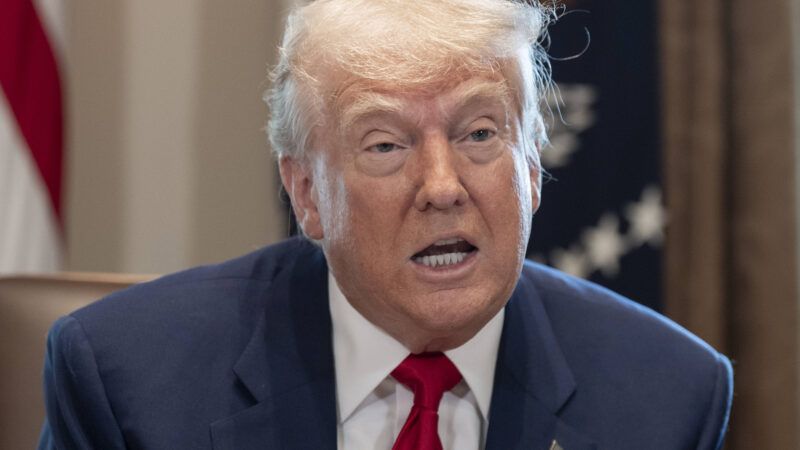
President Donald Trump caused a major stir for saying that he wants to keep the price of housing high for existing homeowners while also making it easier for first-time homebuyers to purchase a house.
"People that own their homes: We're going to keep them wealthy. We're going to keep those prices up. We're not going to destroy the value of their homes so that somebody who didn't work very hard can buy a home," said Trump during the Cabinet meeting last Thursday.
"When you get the housing—when you make it too easy and too cheap to buy houses, those values come down. I don't want those values to come down," he added.
Trump: "People that own their homes: we're gonna keep them wealthy. We're gonna keep those prices up. We're not gonna destroy the value of their homes so that somebody who didn't work very hard can buy a home." pic.twitter.com/V3cviRAO3F
— unusual_whales (@unusual_whales) January 29, 2026
The president's comments clearly struck a nerve for a couple of reasons.
Trump said pretty bluntly what people often argue is the implicit goal of American housing policy: keeping prices high for incumbent owners at the expense of first-time buyers.
He also fully embraced the supposed contradiction of a housing policy that's supposed to boost both homeownership and home values. The higher the values go, the fewer people are actually able to afford to buy homes.
There's reason to be skeptical of Trump's plan to use lower interest rates to square this circle.
As Daniel McCue notes in a brief for Harvard University's Joint Center for Housing Studies, interest rates are "not abnormally high in historical terms. That is not the case for home prices which, after increasing by 50 percent nationwide since 2020, are at unprecedented heights in nominal terms, real terms, and relative to household incomes."
Lower mortgage rates would reduce buyers' monthly payments, but that only helps so much when prices are as inflated as they are.
Creating true housing affordability for homebuyers would require an expansion of housing supply to lower overall housing prices—the thing Trump said he did not want to do.
The good news is that the federal government does not have too much direct influence over the number of homes that are built in the country. It's local and state governments that decide what's allowed to be built where.
Local and state policies are overwhelmingly moving in the direction of enabling more supply, not less, through liberalizing zoning and building codes, relaxing growth controls, and streamlining permitting processes.
The president's critics on social media were right to chide him for embracing a zero-sum, protectionist housing policy that limits new construction to increase home prices for current owners.
Yet it'd also be a mistake to completely dismiss the idea that we can lower buyers' housing costs and raise property values at the same time. Contra the president, that can easily be accomplished by allowing more homes to be built on existing residential land.
Free markets are generally win-win institutions. One should expect that free market reforms in the housing sector would produce win-wins for homeowners, buyers, and builders.
When local officials "upzone" land to allow more housing to be built on it, one expects the value of that land to increase to reflect the additional development potential. If a single-family property is upzoned to allow apartment construction, the current owner will see a windfall increase in the value of their property.
For recent, real-world evidence of this, I'd suggest people watch this news segment from Sydney, Australia, where upzoning has created a hot seller's market.
While upzoning drives up the cost of individual parcels, one would also expect it to drive down the overall cost of land, which is good for developers and builders. Expanding the supply of buildable land means there's less competition among developers for each individual property. They can all expect to pay less for the land they consume as a result.
As homeowners sell off their more valuable properties to builders who turn them into denser developments, one would expect the overall price of shelter to fall to the ultimate benefit of new homebuyers.
Trump is given to zero-sum thinking in so many policy areas, and housing is no exception.
Supply-side reformers shouldn't make the same error when advocating for policies that lower the cost of housing. Free markets in housing will be good for everyone.
Wildfire Rebuild Preemption
There is one area of the country where Trump is eager to see housing get built: Los Angeles.
Last Tuesday, the president issued an executive order that preempts local and state permitting requirements for federally assisted wildfire rebuild projects in the Los Angeles area.
The order says that property owners receiving federal disaster benefits can skip these local processes and instead self-certify to a federal designee that they're in compliance with applicable building codes.
Such sweeping federal preemption is a pretty remarkable and unique means of speeding up the painfully slow wildfire rebuilding process.
Last January, wildfires burned down some 13,000 residential properties in the larger L.A. metro area.
It wasn't until November 2025 that the city granted the first certificate of occupancy for a wildfire rebuild. According to the Associated Press, only about 900 homes are under construction.
Los Angeles Mayor Karen Bass and Democratic Gov. Gavin Newsom have on the one hand attempted to streamline the permitting process by waiving some regulations and fees.
Instead of finally sending to Congress the federal relief Los Angeles needs to rebuild from last year's firestorms, Donald Trump continues to live in fantasy land.
Mr. President, you can actually speed up recovery by providing the assistance that survivors have been waiting for. https://t.co/0cSvoUkkMC
— Governor Gavin Newsom (@CAgovernor) January 27, 2026
On the other hand, they've also suspended laws and issued new regulations that prevent property owners from selling off their land or rebuilding their properties as larger, denser developments.
Both expressed deep objections to Trump's efforts to suspend local and state permitting requirements generally.
Whether the president can unilaterally preempt local land-use regulations for projects making use of federal funds is questionable legally.
"This is completely unprecedented in terms of the history of federal disaster aid," Daniel Farber, faculty director of the Center for Law, Energy, & the Environment at U.C. Berkeley Law, told Politico. "They're gonna have a hard time making this stand up in court."
Legal or not, it will be interesting to see local and state officials argue in court that the wildfire rebuilding process should take longer.
Quick Links
- A new bipartisan bill in Congress would make it easier for federal infrastructure loans to support transit-oriented development.
- The Senate has approved an appropriations bill that would increase federal housing funding to $77 billion, or roughly a 10 percent increase from the previous year.
- Bloomberg has a comprehensive look at Trump's faltering affordable housing agenda.
- Preliminary data suggest that homelessness fell in 2025. The past several years have seen an unprecedented rise in homelessness rates, driven largely by an influx of migrants into big city shelter systems.