
Rand Paul's Annual Festivus Report Highlights $1.6 Trillion in Wasteful Spending
These wasteful boondoggles add up. So do the programs that many Americans insist are important but refuse to reform.
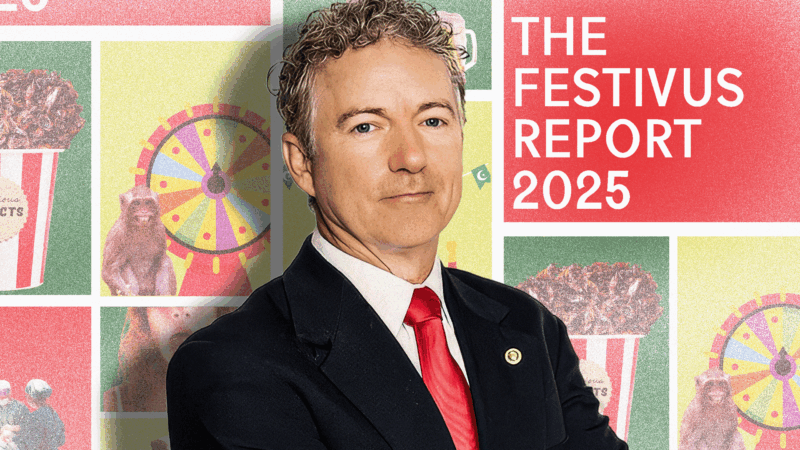
There are many traditions for ushering out the old year and ringing in the new, and among those to be enjoyed with a stiff drink and a sense of grim humor is Sen. Rand Paul's (R–Ky.) annual Festivus report on government waste. This year's edition may require a taller glass than usual as it documents $1.6 trillion squandered on everything from questionable science to social engineering schemes and even projects that show all the hallmarks of having been brainstormed as alternatives to piling money in heaps and setting them on fire.
You are reading The Rattler from J.D. Tuccille and Reason. Get more of J.D.'s commentary on government overreach and threats to everyday liberty.
Jaw-Dropping Waste
"This year, I'm spotlighting a jaw-dropping amount of government waste—the kind that makes you wonder if anyone in Washington has ever heard the word 'priorities,'" Sen. Paul writes in the introduction as he opens The Festivus Report 2025 on a promising—for some value of the word—note. "A grand total of $1,639,135,969,608, which includes $1.22 trillion in interest payments on the debt."
Among the highlights of the report:
The U.S. Department of State gave $244,252 to Stand for Peace in Islamabad to produce a television cartoon series that teaches kids in Pakistan how to fight climate change.
[The U.S. Department of Health and Human Services] gave $3.3 million to Northwestern University so they can hire 15 people, erect 'scientific neighborhoods,' install 'safe space ambassadors,' and form endless committees to 'dismantle systemic racism.'
The Biden Department of Transportation (DOT) received $7.5 billion from Congress to fund electric vehicle charger stations nationwide, but only 68 charging stations are up and running.
More Money for Wuhan-Bred Viruses
The report includes some blasts from the past that I thought had to be accidental inclusions from an earlier edition until I read a little further. In the years since the COVID-19 pandemic, strong evidence has pointed to a lab leak in Wuhan, China as the likely culprit for the outbreak. That led to a lot of denials by public health officials, suppression of well-founded claims, and ultimately red faces in D.C. because the U.S. government helped fund experiments at the Wuhan Institute of Virology (WIV) from which the virus likely escaped. So, I was surprised to see not one, but two mentions of continuing U.S. funding for WIV.
"Fauci and the NIH weren't the only ones who funded the Wuhan lab," notes the report. "The disgraced USAID gave EcoHealth Alliance $54 million to collect underground bat coronaviruses, transport them to labs like the Wuhan Institute of Virology, and soup them up in gain-of-function experiments with 'humanized' mice to make them more contagious and deadly to people…USAID continued forking over millions of tax dollars to the tainted group until mid-2024."
And then, "in 2021, the Biden U.S. Department of Agriculture (USDA) funded a five-year, $1 million collaboration to soup up bird flu viruses between the Wuhan Institute of Virology's (WIV) Chinese Communist Party (CCP)-controlled parent organization and a researcher affiliated with WIV." The funding was discontinued by the Trump administration early in 2025.
Aren't scientists supposed to learn from their mistakes?
Drunk Ferrets and High Puppies
A few items struck near to my heart. The report discusses an ongoing project—called out in an earlier report—under which the National Institute on Drug Abuse doses beagle puppies with cocaine. In my experience, puppies do just fine without stimulants, but maybe beagles are different than my mutts. On a similar note, the Department of Veterans Affairs forces teenage ferrets to engage in binge drinking.
Those stories reminded me that back in my broke youth, as I scrambled to keep a roof over my head and food on the table in Boston, I worked for a while as a paid guinea pig in medical experiments (written up here). Strapped into a chair, I snorted cocaine and took bong hits while reporting how I felt. High as a kite, folks! Yes, that important research was federally funded and thank you, very much, taxpayers.
Another science-y boondoggle that caught my eye, if only for its pointless cruelty, was this $14 million gem: "Researchers at Brown University are enlisting monkeys to play a video game they invented called 'Planko'—a variation on the famous Price is Right game Plinko. The monkeys have 'headposts' screwed into their skulls to keep their heads still while they played the game and researchers track their brain activity and eye movements." As the report summarizes, "The groundbreaking conclusion? Monkeys are very good at Plinko."
Waste Adds Up to Big Trouble
The Festivus Report 2025 makes for alternately entertaining and frustrating reading. But, if you tally the costs of the schemes and scams, they seem to make up barely a wad of spit in the vast sewage sea of trillion-dollar-plus annual federal spending. What's a few billion dollars among grifting friends, right? But those expenses add up, year after year, especially since the federal government continues to spend vastly more money than it collects. That means each pointless (or dangerous) medical experiment or nonsensical flush of taxpayer money down the fiscal toilet increases debt and the price of borrowing.
"Our country is over $38.4 trillion in debt, and the Treasury Department reports that our interest payments hit $1.22 trillion for 2025, an all-time record," the report observes of the largest expense documented. "Interest is now the third largest 'expense' in the federal budget—outranked only by Social Security and Medicare."
As I've reported in the past, economists with the Penn Wharton Budget Model (PWBM) say the day of reckoning for the U.S. federal government—and the taxpayers dragged along with that sad institution—is rapidly approaching. A 2023 PWBM report forecast that "under current policy, the United States has about 20 years for corrective action after which no amount of future tax increases or spending cuts could avoid the government defaulting on its debt." That's the authors' best-case scenario, assuming capital markets don't lose faith in the government sooner. After that period, the federal government will either be unable to pay its bills or will, more likely, monetize debt by devaluing the U.S. dollar through inflation, essentially turning the country into Argentina pre–Javier Milei.
So, those wasteful boondoggles add up. So do the programs that many Americans insist are important but refuse to understand require prioritization and hard choices. Taxpayers can't afford to fund everything that people want.
Here's to a happy new year. May it bring a brighter, and cheaper, Festivus report as it approaches its end.