
If the Syrian War Is Over, Why Are Americans Still Getting Killed in Syria?
The weekend’s ISIS attack came as the Trump administration is trying to expand the U.S. presence in Syria.
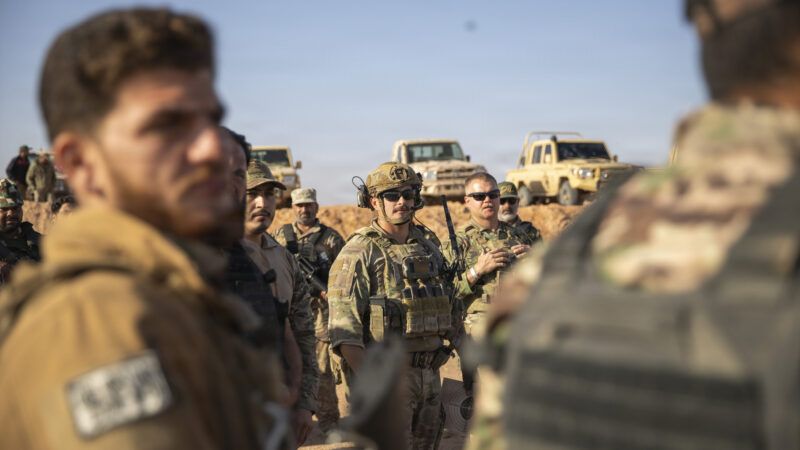
President Donald Trump declared in his first term that the Islamic State group was defeated and that U.S. troops would leave Syria. This weekend, a gunman linked to the Islamic State group killed two Iowa National Guardsmen and an American translator in Syria.
Syrian and U.S. troops were returning from a joint patrol on Saturday when a shooter attacked them at the gate of a military base in Palmyra, a former stronghold of the Islamic State group. U.S. Central Command described the attacker, who Syrian forces killed, as a "lone ISIS gunman." Trump wrote on social media that the shooting was an attack on America and Syria alike, vowing revenge.
Those statements airbrushed a disturbing fact: The gunman himself was a member of the Syrian armed forces. A Syrian government spokesman, Nour al-Din al-Baba, said in a TV interview that the shooter was already facing an investigation for "extremist" views before the attack. The authorities were scheduled to make a decision on his case at the beginning of this week.
According to al-Baba, the Syrian authorities are now trying to determine whether he was an actual Islamic State member or merely a sympathizer. Agence France Presse reports that 11 other members of the Syrian security forces were taken in for questioning after the attack.
In other words, the attack in Palmyra was the first overseas "green-on-blue" incident—a betrayal by an allied soldier—since the U.S. withdrawal from Afghanistan in 2021. And like the war in Afghanistan, the U.S. military campaign in Syria has been dragging on without a clear purpose.
U.S. troops entered Syria to fight the Islamic State group, which lost its last territory in 2018. They stayed to counter Iranian forces, who were in Syria at the invitation of former leader Bashar al-Assad and were kicked out during the December 2024 revolution by the new Syrian President Ahmad al-Sharaa. The possibility of a Turkish invasion of Syria scuttled Trump's first withdrawal attempt in October 2019, but that is unlikely now that Kurdish factions are negotiating peace with the Syrian and Turkish governments.
In theory, there are no more battles for the U.S. to fight. Yet the Trump administration has been expanding rather than shrinking America's military involvement in Syria. It recently began talks to build a new U.S. base right outside Damascus, the Syrian capital, ostensibly for peacekeeping between Syria and Israel.
Sharaa, eager to stay in Washington's good graces, visited the White House in November 2025 and announced that he would be joining the U.S.-led coalition against the Islamic State group. Americans were suddenly patrolling alongside Syrian forces in areas they had never patrolled before, such as Palmyra, which Trump described on social media as "a very dangerous part of Syria, that is not fully controlled by them."
Cooperation with the new Syrian government may have looked like a relatively cost-free way to keep a U.S. foothold in Syria, but the incident in Palmyra shows that there is, in fact, a greater risk to American troops than the White House realized. Yet the administration is doubling down, arguing that the attack is actually a reason to stay in Syria.
"A limited number of U.S. forces remain deployed in Syria solely to finish the job of defeating ISIS once and for all, preventing its resurgence, and protecting the American homeland from terrorist attacks," Tom Barrack, who serves as both U.S. ambassador to Turkey and special envoy to Syria, wrote on social media. "Our presence empowers capable local Syrian partners to take the fight to these terrorists on the ground, ensuring that American forces do not have to engage in another costly, large-scale war in the Middle East."
Trump, in his social media comments, promised "very serious retaliation" against the Islamic State group. In the hours after the attack, locals filmed American jets flying low and dropping flares near Palmyra. Jared Szuba, the Pentagon correspondent for Al-Monitor, wrote that a U.S. military campaign against underground cells would serve two purposes: to "deny ISIS a propaganda win," and to take the focus away from the Syrian government.
That sounds like a recipe for endless wars. We're told that American troops are in Syria to prevent "another costly, large-scale war," but every time someone attacks those troops, we're told the U.S. has to double down on its commitment to avoid humiliation—which will create more opportunities to attack Americans. And the Palmyra shooter is not the only Syrian who has a problem with the new government or its American backers.
On Sunday, Islamic State insurgents killed 10 Syrian soldiers, reports a Syrian media outlet, the Step News Agency.
"I'm heartbroken that we lost soldiers in Syria, but now is the time to ask: Why are we in Syria?" libertarian-leaning Rep. Thomas Massie (R–Ky.) posted on social media Saturday. "I offered an amendment last week to defund foreign military groups in Syria. We should withdraw U.S. forces as well."