
What Is Syria Like 1 Year After Its Revolution?
A former leader of Al Qaeda has convinced Washington that he’s a liberal reformer. Now comes the hard part of following through.
Syrian President Ahmad al-Sharaa says he wants feminist solutions to his country's problems. "Polarization can lead to unsatisfying results for the entire [Syrian] people," he said at a meeting in Aleppo, describing a recent study his government carried out. "One of the problems that came up was female representation. A patriarchal society likes to keep women at home." Then Sharaa joked that if he tried to impose gender quotas, people would call him a womanizer.
A month earlier, Sharaa's foreign minister posted a video of the president playing basketball with Adm. Brad Cooper, commander of U.S. forces in the Middle East and Central Asia. It was a far cry from just a few months before, when the U.S. government considered Sharaa an outlaw with a $10 million bounty on his head. A few years before that, Sharaa was commander of Al Qaeda in Syria, a rebel army that enforced religious law, including female seclusion, on the territories it controlled.
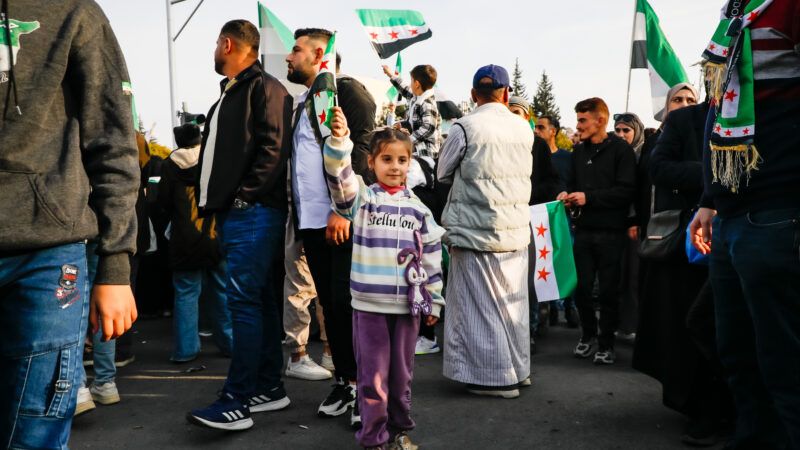
One year ago today, Sharaa's forces marched into Damascus, overthrowing the previous Syrian government of Bashar al-Assad, backed by Russia and Iran. In a surprise turn, Sharaa has tried to cast himself as a business-friendly, classical liberal, pro-American reformer. While inefficient government bureaucracies are shut down, DOGE-style, Syria's bars remain open. In a show of impartiality, the Syrian authorities even shut out Sharaa's businessman brother from government contracts to avoid the appearance of nepotism.
For all the personal and economic freedoms, political freedom remains in short supply. One-third of the "transitional" Syrian parliament was directly appointed by Sharaa, and the rest were "elected" by 6,000 handpicked delegates. More disturbingly, when the Alawite and Druze religious minorities rebelled, pro-government forces carried out mass reprisals, killing hundreds of people. And ghosts of the past are coming back. After a long dormant period, the Islamic State group has been escalating its attacks in Syria.
The Syrian revolution matters to Americans for two different reasons. In immediate policy terms, the U.S. military still has hundreds of troops in the country, and is looking to expand its footprint, with Sharaa as a valued partner. More abstractly, the Syrian revolution has been a natural experiment in building a new government after total social collapse. At least rhetorically, it is committed to free markets and a free-ish society.
If Sharaa seems like a contradictory figure, that is because his country is torn between so many contradictory forces. Syria was at war for more than a decade, and under a paranoid police state for decades longer. The Assad family, Alawites, relied on a coalition of minorities who feared Sunni Muslim majority rule. That majority itself has its own divisions between secular and religious, and rural and urban.
Just this weekend, ahead of the revolution's anniversary, years-old private footage of Assad driving around and talking to his adviser was leaked to Saudi media. He mocked one bombed-out Sunni neighborhood as "the dirtiest area of Syrian society," joking that he destroyed everything but the sign on a mosque so that he could see where he was.
Add the international dimension. Russia has kept bases in Syria, and Iran reportedly has underground stay-behind networks. Neighboring Turkey and Israel, which had intervened in the civil war, still occupy chunks of Syrian territory. A U.S. trade embargo had wrecked the livelihood of Syrians under Assad, a fate any successor is keen to avoid. Although Sharaa enjoys goodwill from some factions in Washington for defeating Russia and Iran, others mistrust him for his past militancy.
At the Doha Forum in Qatar over the weekend, CNN anchor Christiane Amanpour asked Sharaa about his role in Al Qaeda. (He broke off violently from Al Qaeda and formed his own rebel faction in 2017.) "I have never harmed a civilian," Sharaa responded. "I fought with honor."
So far, the Trump administration has suspended almost all economic sanctions on Syria, allowing money to flow into the country's reconstruction, and Congress is moving to permanently repeal the sanctions. Damascus now enjoys 24-hour electricity for the first time since the beginning of the war. (By late 2024, the capital was suffering 20-hour blackouts.) Foreign investors are lining up to sign multibillion-dollar deals in the newly opened market.
"We want to rebuild Syria through investment, not through aid and assistance," Sharaa said at an October 2025 business conference in Saudi Arabia.
Perhaps the most improbable aspect of the Syrian revolution—beyond Sharaa's newfound liberal vocabulary and friendliness to America—is the reconciliation between Damascus and the rebels of northeast Syria. For a decade, the country's resource-rich northeast has been controlled by the Syrian Democratic Forces (SDF), a Kurdish-led coalition that has partnered with U.S. forces.
The SDF's rule could not have been more different from Sharaa's rebel enclave in Idlib. It was multiethnic, multireligious, and feminist. The gender quotas that Sharaa joked about in Aleppo were mandatory for local governments in northeast Syria. But not all was well in the anarchist kingdom. The further the SDF strayed from the Kurdish heartland, the worse Kurdish-Arab relations got. And cut off from the central Syrian state, institutions in the northeast could not conduct normal trade with the outside world or even issue recognized diplomas.
The new government in Damascus and the SDF have a lot to gain from unifying—and a lot to lose from reopening the civil war. So in March 2025, with quiet U.S. encouragement, Sharaa and SDF Gen. Mazloum Abdi agreed in principle to merge their institutions, while leaving all of the important details up for negotiation. Along with resource sharing and the degree of federalism in the new Syria, one of the thorniest issues is what to do with the SDF's all-female brigade. Kurdish official Salih Muslim claimed last month that Damascus had given its "verbal" agreement to let the women keep operating.
The elephant in the room is Turkey, which backs the new Syrian government. The Turkish authorities, who have been dealing with a rebellion by the Kurdistan Workers' Party (PKK) since the 1980s, consider the SDF to be an extension of the PKK. Turkish forces invaded Syria several times to prop up anti-SDF militias, some of whom committed grave human rights abuses against Kurds. But in March 2025, the PKK and the Turkish government began a peace process. So long as that continues, Turkey is supporting a peaceful resolution to the Kurdish question inside Syria, too.
Integration has been going a lot worse elsewhere in the country. In March 2025, when Alawite insurgents began attacking forces of the new government along the coast, Damascus declared war on these "remnants of the Assad regime." (According to recent reporting by Reuters, the insurgency started independently, though exiled Assad loyalists have started trying to funnel money to it.) Forces loyal to Sharaa stormed Alawite neighborhoods, killing somewhere between 600 and 1,700 civilians and disarmed prisoners of war.
The Syrian government, which denies ordering the massacres, has started to put perpetrators on trial behind closed doors. The government also claims that one of the most notorious atrocities, the kidnapping of at least 33 Alawite women, was greatly exaggerated. Last month, anti-Alawite riots broke out in the city of Homs, sparking Alawite protests in Homs and along the coast; the Syrian government put down the protests with live gunfire.
The situation is even more unstable with the Druze community in southern Syria. Although Druze fighters joined in the December 2024 revolution, Druze spiritual leader Hikmat al-Hijri rejected Sharaa's rule afterwards, leading to an awkward standoff. In July 2025, when fighting broke out between Druze and Sunnis in Sweida, the Druze heartland, Sharaa unleashed Sunni militias on his opponents, believing he had a U.S. green light.
Around 1,000 civilians were killed in the fighting. Pro-government forces forced three men to jump off a balcony and executed medical staff inside a hospital. Neighboring Israel, which has both ongoing territorial disputes with Syria and an influential Druze minority of its own, intervened. The Israeli military bombed the Syrian army, forcing it to withdraw from Sweida, and began funding Druze fighters. Hijri, now the de facto leader of Sweida, is calling for full independence.
The Druze rebellion, like a microcosm of the Syrian revolution it is resisting, has begun to eat itself. Hijri loyalists claimed late last month that they had uncovered a plot to commit "treason" against the Druze community. They arrested two sheikhs, torturing one of them on camera by shaving his moustache, the same tactic that Sharaa loyalists had used during the July massacres. (The moustache is a symbol of manhood and faith in the Druze religion.) Then the Hijri loyalists dumped the two sheikhs' bodies outside the same hospital where medical staff had been executed.
Meanwhile, the broader Israeli-Syrian conflict may be heating up. Israel had captured the Golan Heights from Syria in 1967 and seized an additional buffer zone during the December 2024 revolution. Now, Israeli Prime Minister Benjamin Netanyahu is demanding a demilitarized buffer zone from the border up to Damascus in order to secure the Golan and Sweida.
At the beginning of the revolution, the new Syrian government signaled that it did not want to fight Israel. But Sharaa may not be able to stop locals in the buffer zone, who are grumbling under martial law and routine raids, from doing so. Late last month, Israeli forces raided the Syrian town of Beit Jinn to arrest three people accused of plotting against Israel. This time, the locals shot back. Thirteen people were killed in the ensuing clashes. One of them was a fighter for a formerly Israeli-backed rebel brigade, his gun now turned against his former patrons.
U.S. President Donald Trump was so alarmed by the escalation that he called Israeli Prime Minister Benjamin Netanyahu on the phone a few days later. "It is very important that Israel maintain a strong and true dialogue with Syria, and that nothing takes place that will interfere with Syria's evolution into a prosperous State," Trump wrote on social media after the call.
For all the horror stories over the past year, the bloodshed is not as intense as it was during the Assad era. And rather than a theocracy, Sharaa has imposed a state based on "bottom-up Sunni populism," according to Alexander McKeever, an American researcher in the region. That may be just enough to keep Sharaa's political base—and his American backers—on board. But can it lead to a stable, productive society in the long term?
In September 2025, the Syrian Prisons Museum opened in Damascus, showcasing the horrors of Sednaya Military Prison, where tens of thousands of people were tortured to death by Assad's secret police. It was a monument to the need for and triumph of the revolution. Nine days later, the revolutionary authorities arrested museum founder Amer Matar because of a dispute over documents they said were state property. They let him go after ten days. Welcome to the confusing new Syria.