
Can America Return to Neoconservatism Without the Same Results?
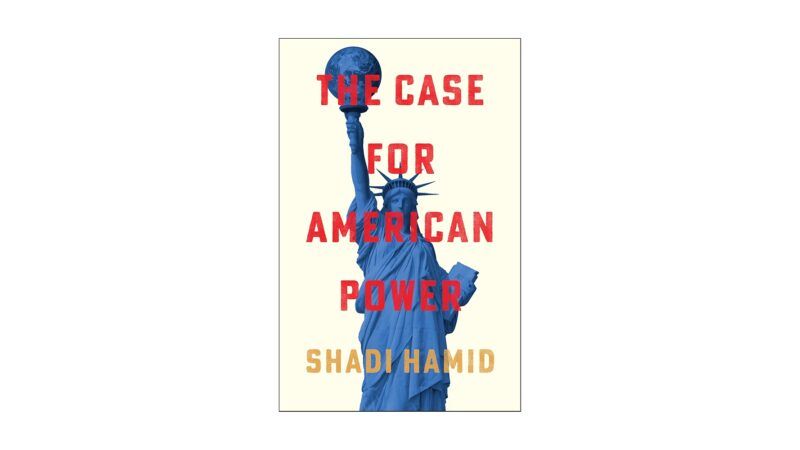
Shadi Hamid’s The Case for American Power implies that true interventionism hasn’t been tried.
Shadi Hamid was my foil on a 2021 panel at the Quincy Institute for Responsible Statecraft. I presented a paper arguing that the U.S. was supporting a rogue's gallery of expansionist states in the Middle East, that their actions were no less malign than the Iranian influence they purported to fight, and that it would be better for Washington to adopt a neutral stance toward the region, with the motto, "First, do no harm." Hamid, calling himself an "interventionist," argued that the U.S. has a moral obligation to stop atrocities because its enemies are so much worse.
Hamid pointed to the Russian-Iranian intervention in Syria while I pointed to the Turkish-Kurdish conflict and the Saudi-Emirati intervention in Yemen. The world has provided many more sad examples since then. I can point to the destruction of Gaza, which Hamid himself calls a genocide; Hamid can point to the Russian invasion of Ukraine, one of the most brazen power grabs of the century. But as a Palestinian friend texted me after watching an Oxford Union debate on the Middle East, "This isn't just a conversation for the sake of enjoyment. It's also our lives."
In other words, the real question isn't about which "team" is more moral in the abstract. It is what we should do with the power we have moving forward. Hamid's new book, The Case for American Power, makes exactly the argument the title suggests. "Power is a fact. Someone must wield it," Hamid writes. "The alternative to America isn't some morally perfect superpower of our own imagination. Such an alternative does not exist and never will."
Hamid runs through the virtues of America's domestic freedoms, then tries to equate them with the U.S. empire abroad, which often stands in the way of other people's freedoms. That contradiction is the fundamental problem with his worldview, and most of the book is Hamid's attempt to philosophize it away. Like a communist arguing that true communism has never been tried, Hamid constantly gestures at the theoretical possibility of a kinder, gentler U.S. empire. He even suggests that the hypocrisy might make Washington a better imperial steward of the world in the future, writing that "insofar as hypocrisy points to an aspiration not met, the aspiration remains." Since the U.S. is a democracy where citizens can vote and criticize their government, he argues, it has room to improve on its mistakes in a way China or Russia cannot.
The journalist Nathan Thrall has called this sort of logic "feeling good about feeling bad." After someone acknowledges a crime, Thrall explains in his 2017 book The Only Language They Understand, "the magnanimity of the acknowledgment can be wielded" as proof of one's own moral superiority—and that superiority then becomes an excuse to prevent any redress of those crimes. We all agree that invading Iraq was a bad idea; with this alchemy, the fact that we are allowed to say so becomes a reason the same institutions should have the power to keep invading other countries.
Hamid focuses much of his argument on the Middle East, the worst possible example for the argument that U.S. power spreads democracy. He recounts how he came to value freedom witnessing his family's fear of the military regime in Egypt. That is a perfectly good argument for preferring America's constitutional system. It is not a good argument for America's power abroad. The Egyptian military is the second-largest recipient of U.S. aid in the world; the political scientist Amy Austin Holmes has called Washington's backing a "pillar of the regime." At best, Hamid can point to a few examples where the U.S. used its leverage to pressure the Egyptian government to act more softly. As the old line goes, the empire will break your leg and hand you a crutch.
And that is one of the less violent U.S. interventions in the region. The influx of American guns and money into the Middle East, especially since the Iraq war, has thrown some countries into utter ruin and left others with dictatorships completely insulated from any popular legitimacy.
Although Hamid doesn't defend the Iraq war outright, he says it shows that U.S. power is better than the alternatives. "The Bush administration didn't intend to make Iraq into a protectorate or take its oil," Hamid writes. "When given the opportunity, Iraqis voted into power Shiite Islamist parties that enjoyed close relations with the Iranian regime. It is difficult to imagine an analogous scenario in Ukraine, where Russia might hand over sovereignty to an elected Ukrainian government composed of even vaguely pro-American parties committed to American-style constitutional liberalism."
That is not exactly what happened, to put it lightly. The U.S. administration preferred to work with certain Shiite Islamist factions, despite their ties with Iran, because they were less hostile to U.S. rule than hardcore Iraqi nationalists. Under U.S. occupation, these factions consolidated their power through secret torture prisons and paramilitary gangs, which still exercise a reign of terror. While Iraqis can in theory vote for their leaders today, the most important decisions about the country's national security and economic policy are made under duress from Tehran and Washington. That sounds a lot like the kind of "self-rule" that Russia accepts in its sphere of influence.
The U.S. is not the only world power that launches invasions, wages proxy wars, props up dictators, or bullies smaller states. The point is that people in American gunsights experience it the same as people in Russian gunsights. It is a cold comfort for the victims if the people holding the guns can then go home and debate the war among themselves. Every empire "tells itself and the world that it is unlike all other empires, that its mission is not to plunder and control but to educate and liberate," Edward Saïd wrote in 2003, shortly after the Iraq war began. The Persian emperor Cyrus the Great, marching into Babylon in 539 B.C., also claimed that Iraqis greeted him as a liberator.
What is unique about the U.S. empire is its global scale. Hamid is right that a "morally perfect superpower" doesn't exist. That is because no other world power without rivals has ever existed. Washington's ability to rule the whole world is a fluke of history; World War II destroyed almost every other competitor, and the Cold War finished off the last one. Maintaining this uncontested dominance everywhere forever is a huge and brutal task. Though he is bearish on China's long-term prospects, Hamid suggests that opening trade with China was a naive mistake. What was the alternative? To try to isolate, impoverish, and destabilize the world's most populous nation?
Faced with resource constraints, restless regional powers, and dwindling public support for intervention, Washington has resorted increasingly to proxy wars fought by dictators and gangsters, campaigns of regime collapse rather than regime change. In 2020, Phil Gordon and Jeremy Shapiro accused President Donald Trump of adopting "a scorched-earth policy apparently designed to destroy what it cannot save." Gordon went on to serve in the Biden administration, whose proxy war strategy was not that different from Trump's.
The alternative is not, as Hamid suggests, to self-flagellate and welcome a Chinese world order. China would face an even steeper uphill battle to establish itself as a world hegemon. The alternative is to take a more modest view of what U.S. power can and should do. It means hashing out rules with friendly nations about sharing the burden of collective security—something Hamid correctly endorses for Europe—and with unfriendly nations about how to keep competition from spiralling out of control. And it means no longer propping up faraway client states by letting them replace the consent of the governed with U.S. security aid.
Hamid thinks there is no point in "managing [relative American] decline with grace," because the U.S. actually "has the economic, political, and military resources to resist decline." He presents the problem as one of willpower and ideas, of overcoming those pesky defeatists sapping Americans' gumption. Hamid quite consciously taps into the neoconservative tradition, quoting Elliott Abrams on the urgency he felt about losing the Cold War in 1979. It is an ironic citation: Abrams was spooked not by Soviet missiles but by recent popular revolutions in the Third World—by other people making the "wrong" decisions about their future.
That is the final irony of The Case for American Power. Hamid laments Washington's toxic relationships with Middle Eastern dictators as an "exception" to the march of democracy in a U.S.-dominated world. Yet he finds himself agreeing, in principle, with the people who forged that relationship. Perhaps Hamid should inquire more seriously how those principles led to the results that they did.