
Ted Kennedy, Political Abstraction
I have two strong memories of Teddy Kennedy, neither of them (appropriately enough) involving Teddy Kennedy. The first came in the summer of 2007, when I was in Capitol Hill covering the immigration reform bill that Kennedy had long championed with John McCain. The Senate press gallery, a place I hope to never set foot in again (did you know you can't bring a computer or any recording equipment onto the press balcony above the Senate floor, and that the people who enforce this ridiculous rule are journalists?), was a noisy hive of over-caffeinated daily reporters, chasing down threads, cornering various Senate staffers, cussing out their editors. It was that rare journalistic scene that actually somewhat resembled the hurly-burly of reporting portrayed in movies (the reality of newspapers is a good deal more like Office Space).
But then all went totally silent. I looked up, to see whether Jesus had finally returned. Instead, it was a senior staffer for Sen. Kennedy, breaking down in impressive and exhaustive detail each and every political and policy in-and-out of the immigration debate as it then stood. The reporters weren't listening or deferring to the woman because she worked for the liberal icon Teddy Kennedy, they were soaking up her words because she clearly knew more about the issue than any other living human being. This is a common theme in the beyond-superficial portrayals of Kennedy, stretching back at least to Hunter Thompson's Fear and Loathing: On the Campaign Trail '72–his Senate office, regardless of what you thought of its policy aims, was staffed by some of the most talented and effective people on Capitol Hill. We don't usually think of politicians as managers, but they most definitely are, and whether Kennedy just attracted top talent because of the aura of his name, or whether he organized and directed their work with particular success, he seemed to be damned good at managing his staff. Unfortunately, as Nick Gillespie pointed out in his great obit this morning (and as underlined by the immigration-reform sausage that thankfully never passed), such success often came at the expense of good policy.
Memory number two couldn't be more different. It was at that overdog hate-bath known as the 2004 Republican National Convention in Madison Square Garden, an event that I hope some day to collect in its entirety on DVD, to show future generations just how debased post-9/11 politics became in this country. It was prime time after a daylong festival of snarling, and I forget who was barking from the stage, maybe Zell Miller, but at some point my eyes wandered, as they always do at the political conventions of any party, to the insane people on the delegate floor. I was in the middle of regarding an overweight, middle aged woman in a red-white-and-blue tracksuit and a thousand Ronald Reagan buttons, when I heard from the podium, "… and Teddy KENNEDY!!!" The speaker didn't need to finish the sentence. The woman, like the other 15,000 people assembled, lit up from sneaker to cowboy hat in a full-bodied war-whoop of disapproval. In a convention full of call-and-responses, it was the loudest.
It's always interesting to observe when politicians morph from humans into abstractions, particularly (though not only) in the hands of their political opponents. You see this with Ronald Reagan, who remains to this day the focus of both uncritical worship and fact-averse loathing. Well into this decade you saw this (among liberal activist groups) with Pat Buchanan and Jerry Falwell; it remains to be seen who among the Bush/Cheney/Rumsfeld triumvurate will endure as the totemic hate-figures, though my money's on the Dick. Ted Kennedy was like no other Democrat in this regard. Who's gonna replace him, Barney Frank? Bill Clinton has long since wriggled off the hook.
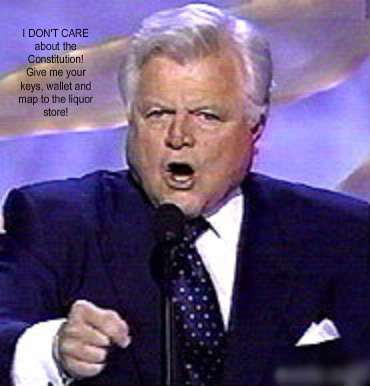
Having spent most of my adult life around liberals, not conservatives, and on the West Coast, not the East, I always had a difficult time recognizing the Ted Kennedy of Republican Convention speechcraft. (And, in fact, it's difficult to reconcile the way Republicans talked about Kennedy at their gatherings with the way they talked about him on the Senate floor, or when joining with him to pass bipartisan legislation.) Not that he wasn't a bloated caricature, and one with blood on his hands, but rather that he just didn't mean all that much to my liberal friends. (My liberal friends' dads, though are another story.) He was arguably more an icon of the opposing team than the political tendency he represented, more interesting to nostalgia-addicted Baby Boomers than to the majority of people who now participate in politics.
I know that the opposite will seem true for the next several days of 24/7 NPR love-ins, but that's the world I've lived in, anyway.
