Radley Balko from the January 2009 issue

On October 13, Neel Kashkari, an interim assistant secretary of the U.S. Treasury, sought to ease concerns about how the just-enacted $700 billion financial bailout plan would be implemented. “We are committed to transparency and oversight in all aspects of the program,” Kashkari said, “and have already taken several important steps in this area.”
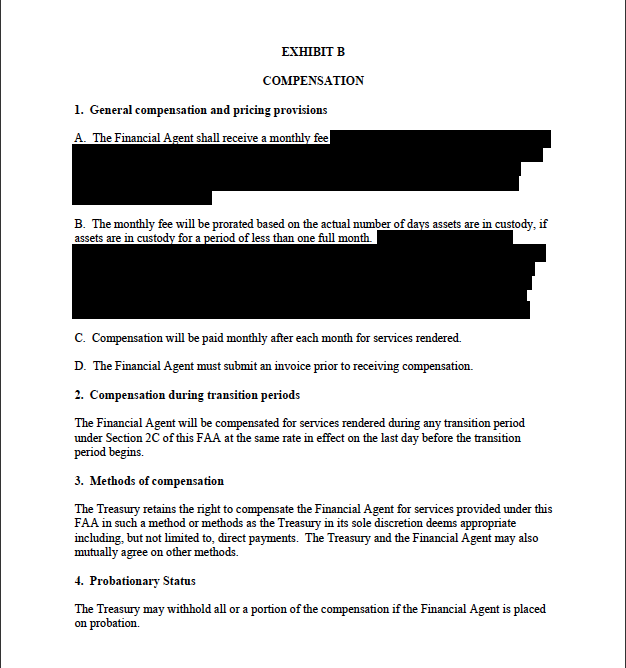
Four days later, the Treasury Department announced one of the first major contracts of the bailout plan: The Bank of New York Mellon would oversee the auction and tracking of distressed assets, one of the biggest contracts in the package. But when the department posted notice of the contract, it blacked out how much the company would be paid.
BailoutSleuth.com, a new watchdog website, soon found more examples of the Treasury Department’s redacting the details of bailout-related contracts. The government blacked out the hourly rate it will pay the law firm of Simpson, Thatcher & Bartlett for advice on when to inject cash into the economy. It also redacted the fee that the consulting firm Ernst & Young quoted for its services. And the posted contract with PricewaterhouseCoopers hides not just the amount of the company’s original bid for its contract but the names of the firm partners who signed the agreement.

Help Reason celebrate its next 40 years. Donate Now!
Try Reason's award-winning print edition today! Your first issue is FREE if you are not completely satisfied.
Transparency means you can see through it. The closer you get to
invisibility, therefore, the more transparent it is.
If the bailout budget becomes totally invisible, then it will have
become 100% transparent.
Ergo, Paulson is a champion of transparency. QED.
As an employee in the securities industry who has had to deal with the transfer agents at Bank of New York on many horrific occasions, I'm pretty confident that the feds have chosen one of the more inept and poorly run institutions to oversee this aspect of the bailout. I guess they're just going for consistency.
Well what else did you expect in a country run by a bunch of crooks? The sad thing is they don't see anything criminal in what they do.
Transparency means you can see through it. The closer you
get to invisibility, therefore, the more transparent it is.
If the bailout budget becomes totally invisible, then it will have
become 100% transparent.
Ergo, Paulson is a champion of transparency. QED.
Are you nuts? Or just being facetious?
The Bush/Cheney team of criminals is the LEAST transparent group
ever.
I am convinced that they are repaying Wall Street for not
gift-wrapping Social Security for them to securitize in 2005.
The average Joe should be holding MBS in his 401k by now - that is
the "Bush failure".
"Are you nuts? Or just being facetious?"
Why are these mutually exclusive?
I was being facetious in a nutty way.
Ugh, I would love to say I'm surprised but nothing these people do can shock me anymore. I just hope we have the pleasure of seeing them jailed for it later - oh, and paying tax money to keep them there. Scratch that, execution would be fine in this case...
Sorry to walk out of the Outrage Party here. Few thoughts - BNY
Mellon is the top dog in the security services industry - if they
chose anyone else it would be a reason to be outraged. Pricing is
pretty standard but disclosing it would have put BNY Mellon at a
competitive disadvantage - their competition would know what their
pricing is for their largest clients. Same goes for Simpson,
E&Y and PWC.
And why ask for the names of the Partners signing the agreement? So
60 minutes could have an easier time to go track them down? Wanna
run a background check, maybe let the State of Ohio look for
liens?
If you're concerned about transparency focus on the output side of
the bailout - are they getting the results, where can they be
improved, where are they different?
If you focus on transparency around the inputs (costs of contracts,
hourly bill rates, etc.) all you'll get is inaction.
And quit whining! It's like we're in a sinking boat that most of us
saw sinking for years, it's crisis time and most of you nuts are
wanting written documentation on what we're doing to stop the boat
from sinking. Get a life!!
And Merry Christmas.
GaDog94: Well I guess your money must be in some protected bank
account somewhere within these bailout banks, or off-shore, since
you're so unconcerned. Merry Christmas to you, too, Grinch.
It is the secretive nature and greed of the banking industry and
Wall Street that has us where we are today. Nitpicking about
proprietory claims do nothing to solve the problem.
GaDog94 - And quit whining! It's like we're in a sinking
boat that most of us saw sinking for years, it's crisis time and
most of you nuts are wanting written documentation on what we're
doing to stop the boat from sinking.
Most of us would rather they stopped trying to prevent the boat
from sinking by pumping more water into the boat.
GaDawg is right about the blacked-out pricing information. Nothing abuot it will improve our understanding of whether the bailout is being implemented properly, but it would put the respective contractors in a potentially difficult position when bargaining with other clients. Publicizing the fee would only drive it up. Promising secrecy holds it down. No doubt some less competent firm would be willing to do the work for a public fee just to get its name out there.
I'm sorry, but that line of thought doesn't make sense. Prices
go down when there is a competitive market with prices that are
known. How can anyone argue secrecy leads to lower prices? Are you
suggesting that somehow the government got a great price from BNY
Mellon and they want to keep it a secret so their other clients
don't find out? Plausible perhaps, but highly unlikely. And even if
that were true, the size and scope of the contract, plus the fact
it is a governemtn contract would argue for a lower fee than they
normally charge, no?
I'm sorry, but this would have to be the first time in history a
secret price turned out to be lower.
From GaDawg94:
"If you're concerned about transparency focus on the output side of
the bailout - are they getting the results, where can they be
improved, where are they different?"
To that point,
this.
Doesn't clear up a thing. Doesn't that give you a nice warm fuzzy
feeling?
$#%^%^&* bailout!
CrackerBarrel.
How can anyone argue secrecy leads to lower
prices?
Isn't that the premise behind a sealed-bid auction? If these were
early contracts,it may make sense to not reveal the price if, over
time, it were expected increased entry and competition might drive
the price down.
Otherwise, to reveal the price might establish "price leadership"
and reduce competitive pressures.
Agreed, over time this secrecy should fall away, I'm simply saying
that at the outset of the program there is a theoretical basis to
keep it secret, asuming good faith with the taxpayer at
Treasury.
Flipping back to the article, it does seem it was early in
the process:
On October 13, Neel Kashkari, an interim assistant secretary of
the U.S. Treasury, sought to ease concerns about how the
just-enacted $700 billion financial bailout plan
would be implemented. "We are committed to transparency and
oversight in all aspects of the program," Kashkari said, "and have
already taken several important steps in this area."
Four days later, the Treasury Department announced
one of the first major contracts of the bailout plan: The Bank of
New York Mellon would oversee the auction and tracking of
distressed assets, one of the biggest contracts in the package. But
when the department posted notice of the contract, it blacked out
how much the company would be paid.
So what would you expect from a guy named Kash&Kari, hell, he's just another well connected snake oil purveyor.
Pricing is pretty standard but disclosing it would have put
BNY Mellon at a competitive disadvantage - their competition would
know what their pricing is for their largest clients.
BNY just won one of the biggest, if not the biggest,
contracts ever awarded in history. How could they ever be at a
competitive disadvantage after that, even if, as a condition of
taking the job, they had to disclose their compensation? Lotto
winners, as a condition of accepting their winnings, usually have
to make their situation public. Terms of government contracts in
other areas are commonly public knowledge. See any issue of the
Federal Register. If BNY didn't want to disclose, they could
decline to compete for the job.
This entire ongoing bailout is a horrific raid on the public purse,
and is the beginning of the end of the American economic system. We
have become just the largest version of any other corrupt crony
capitalist third world country. It's not how productive you are,
but whom you know, that decides your level of compensation
now.
Dollars are just created out of thin air, in unlimited quantities,
and handed out to the well connected.
Monopoly money compensation will make Atlas shrug: "They pretend to
pay us and we pretend to work."
Executed contracts between private companies and government
entities are public information, as defined by the Freedom of
Information Act, (with exceptions in rare circumstances.) That
includes dollar amounts being paid for consulting and any other
fees.
It's taxpayer dollars they're talking about, and the damned law
says they have to tell you, me or Joe the Plumber how much they're
paying who, period, unless they get a court order authorizing
redaction for privacy (or these days I suppose national security)
reasons.
OK, consulting fees may be "competitive business information"
during the bidding process and PRIOR to execution of the contract,
but to make the argument that those fees should remain secret AFTER
a contract has been executed between a private company and a
taxpayer-funded government agency is simply absurd. Oh, and,
generally speaking, illegal.
As a recovering professional journalist, I wish that more of the
few remaining seasoned, cynical pros out there in journoland would
just grow a pair and sue the government under FOIA to get this
information un-redacted. For Pete's sake, it's right there in black
and white, and it's the law. Of course that costs money and
resources that just can't be spared for something as silly as
upholding the pillars of Democracy...
Along those lines, when will we discover the identities of those
who have undoubtedly lined their pockets with trillions of dollars
by short-selling on the market before and as it tanked? That's a
list of names I'd surely be interested in reading.
This is awful. The whole way the TARP was handled was awful. They took money that my kids might need in the future to bailout companies that had been misbehaving. Are my kids really any better off now than they would have been without the TARP. I just don't think so.
I'm not so much worried about the contractors as I am the banks that are recieving OUR money.They just put their hand out, get billions of dollars and don't have to tell us what they are doing with it??? This is crazy!!!
Site comments/questions:
Media Inquiries and Reprint Permissions:
(310) 367-6109
Editorial & Production Offices:
3415 S. Sepulveda Blvd.
Suite 400
Los Angeles, CA 90034
(310) 391-2245